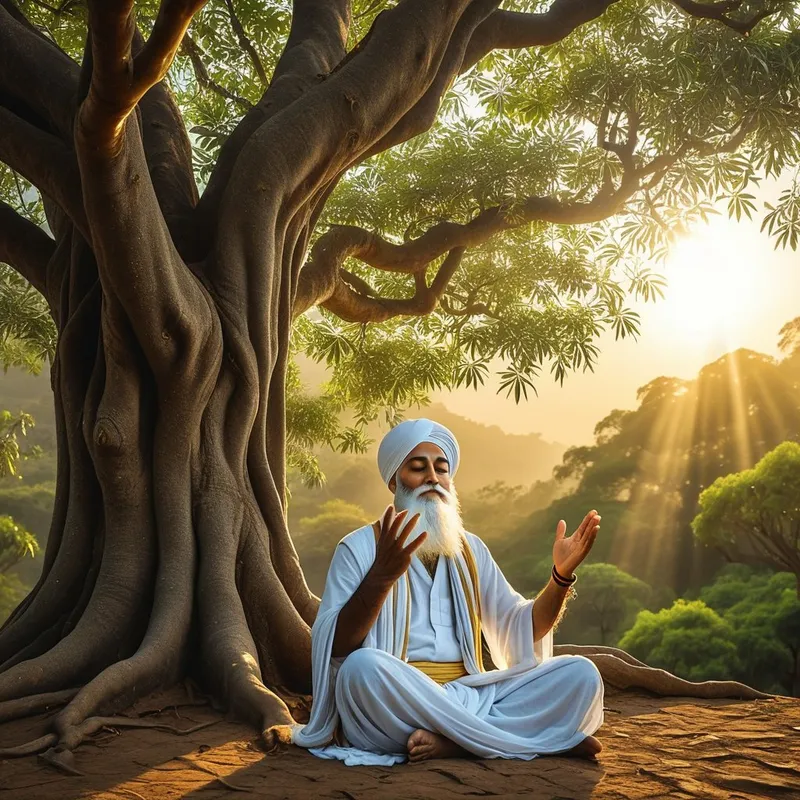
Guru Nanak Myth Meaning & Symbolism
A mystic child awakens to a singular divine reality, embarks on epic journeys to dissolve illusion, and founds a path of devotion, truth, and service.
The Tale of Guru Nanak
In the land of the five rivers, under a sky heavy with stars and the scent of ripe wheat, a light was kindled. It began not with a thunderclap, but with a silence so deep it swallowed sound. In the village of Talwandi, a child was born who did not cry, but seemed to listen to a melody only he could hear. They named him Nanak.
As a boy, he saw the world not as solid, but as a veil. While other children played, he sat beneath the shade of a jand tree, his gaze turned inward, watching the play of a greater sun. His father, a practical man of accounts, despaired. He sent Nanak to tend buffalo, but the boy meditated and the herd wandered into a neighbor’s field, which remained untouched, as if protected by an invisible fence. He sent him with money to trade, but Nanak fed a band of hungry ascetics, returning with a profit of divine grace instead of coin. The world’s logic could not contain him.
Then came the day of the great vanishing. Nanak, now a young man, went to bathe in the river Vein. He walked into the water and did not return. For three days and nights, his family mourned. The current had taken him, they believed. But on the third day, he emerged. His clothes were dry. His eyes held the depth of the cosmos. And when he spoke, his first words were a thunderous whisper that shook the foundations of heaven and earth: “Na koi Hindu, na koi Musalman.”
He had been taken to the court of the Akal Purakh. There, he was offered a cup of Amrit. “Drink this,” the Divine Voice commanded, “and preach the Name. Let your life be one of devotion, truthful living, and service.” The mission was etched upon his soul.
Thus began the Udasis. For decades, with his faithful companion Mardana playing the rabab, Nanak walked the earth. He walked to the east, where priests chanted to idols by a river; he threw water west towards his arid fields, a living parable that true service irrigates the soul, not stone. He walked to the south, to the temple of Kali, where blood offerings flowed; he asked why the goddess, creator of all, would crave the blood of her own creation, silencing the priests with the logic of compassion. He walked to the harsh north, to the snow-laden Sumer Parbat, where Siddhas, powerful ascetics who had mastered magic and longevity, challenged him. They scoffed at his householder’s life. Nanak simply smiled. “You have fled the world to find truth. I carry the truth within me, so the world cannot touch me.” His presence was a mirror in which their powers seemed like child’s play.
He walked into the heart of the Mughal empire and the sacred cities of Islam. In Baghdad, he slept at the threshold of a mosque, his feet pointed towards the holy Kaaba. An outraged priest shook him awake. “Fool! Why do you dishonor the House of God?” Nanak replied softly, “Then turn my feet to a direction where God is not.” Everywhere, he sang his shabads, dissolving dogma with melody, building not a new religion, but a new vision: of One Light, seen through every window; of a path walked in the marketplace, not the mountaintop.
At the end of his journeys, he settled in the town of Kartarpur on the banks of the Ravi. Here, the Sangat gathered. He established the langar, where all sat in a single row, emperor beside beggar, to eat the same simple food. He taught not of withdrawal, but of engagement—Sach, Santokh, Daya, Nimrata. When his time to depart this world came, a argument arose. His Hindu disciples wished to cremate him; his Muslim disciples to bury him. He asked for flowers from each group. “Let those whose flowers remain fresh by morning have their way.” He drew a sheet over himself. When it was lifted, the body was gone. Only the flowers remained, fresh and fragrant, intermingled. Both groups took half—a final lesson in the illusion of separation.

Cultural Origins & Context
This is not a myth lost in antiquity, but a living narrative born in the 15th and 16th centuries in the Punjab region of South Asia. It exists at the precise intersection of history and hagiography, recorded in texts called the Janamsakhis. These are not dry chronicles but devotional stories, passed down orally by disciples and later compiled, meant less to document facts than to convey the transformative presence of the Guru.
The societal function was revolutionary. Punjab was a crossroads, and often a fault line, between Hindu and Islamic civilizations. The myth of Nanak emerged as a direct response to the conflict, corruption, and empty ritualism of his age. It was told to forge a new kind of person: the Sikh. The story was a blueprint for identity, emphasizing direct, personal experience of the divine (Naam Simran) over priestly mediation, and radical equality (exemplified by the langar) over caste or creed. It provided a spiritual anchor that was householder-centric, ethically rigorous, and socially defiant, offering a path of dignity and direct access to the sacred in a tumultuous world.
Symbolic Architecture
At its core, the myth of Guru Nanak is a masterful map of the awakening consciousness. Nanak himself is the archetype of the awakened one who realizes the fundamental unity (Ik Onkar) behind the manifold drama of reality. His journey is the psyche’s journey from identification with form to realization of the formless.
The river of ordinary consciousness must be entered and transcended; one must vanish into the depths to be reborn with dry clothes—untouched by the very waters of transformation.
The three-day disappearance symbolizes the necessary nekyia, the descent into the unconscious (the waters of the Vein) where the ego is dissolved in the encounter with the Self (the court of Akal Purakh). Returning with the proclamation “No Hindu, No Muslim” represents the shattering of the primary complexes and internalized dogmas that structure our identity. The Udasis that follow are not mere travelogues, but the systematic application of this unified consciousness to every compartmentalized aspect of the world—ritual, power, asceticism, dogma. Each stop is a confrontation with a collective shadow: empty ritualism, violent sacrifice, spiritual pride, and religious exclusivity. Nanak does not fight these shadows; he illuminates them with a consciousness they cannot comprehend, thereby integrating their energy back into a holistic understanding.
The Dreamer's Resonance
When this mythic pattern stirs in the modern dreamer, it often manifests as dreams of profound disorientation followed by a clarifying mission. You may dream of disappearing—walking into an ocean or a forest and being gone for a “mythic” period. This somatic experience correlates with a psychological state where the old ego-structure is becoming obsolete, dissolving in the face of a deeper truth trying to emerge.
Alternatively, you might dream of being in a crowded, argumentative place (a bazaar, a parliament) and feeling a compulsion to sing, or speak a simple phrase that brings sudden, uneasy silence. This is the psyche rehearsing the courage to voice its own integrated truth in the face of internalized, conflicting voices (the inner “Hindu” and “Muslim”). The companion Mardana with his rabab is a crucial dream symbol, representing the creative, harmonious function of the psyche that must accompany the transformative message—the truth that must be sung, not just stated. To dream of this myth is to be in the process of moving from a life structured by external shoulds and inherited conflicts to one orchestrated by an inner, unifying melody.

Alchemical Translation
The alchemy here is of the base metal of divided, conditioned consciousness into the gold of unified awareness. The process mirrors the stages of individuation.
First, the nigredo: the darkening, the despair of the family, the three days in the river—the necessary dissolution of the persona and its comfortable falsehoods. Then, the albedo: the emergence, the radiant, dry figure who declares the new law—the washing clean, the whitening, where the core Self is revealed. The subsequent journeys are the citrinitas, the yellowing or spreading of this light, where the integrated consciousness engages and transmutes the contents of the personal and collective unconscious (the varied lands and their dogmas).
The final stage, the rubedo, is not Nanak’s ascension, but the founding of Kartarpur and the institution of the langar. The reddening is the embodied result: the creation of a sustainable, communal structure for the integrated psyche—a life where work, worship, and service are one.
For the modern individual, the myth does not prescribe monastic retreat. It prescribes a revolution in the midst of life. Your “Kartarpur” is your daily existence. Your “langar” is the practice of radical equality in your own heart, serving the inner beggar and emperor alike. Your “Udasis” are the courageous journeys into your own entrenched beliefs, biases, and spiritual pretensions, confronting them not with battle, but with the unsettling, simple question born of a unified vision. The goal is not to become a guru, but to become a sikh—a perpetual learner—living truthfully (Sach) in the world, while remembering (Simran) you are not of it. The alchemical gold is a life of grounded wonder, where the divine is not sought, but recognized as the very substance of the path itself.
Associated Symbols
Explore related symbols from the CaleaDream lexicon: