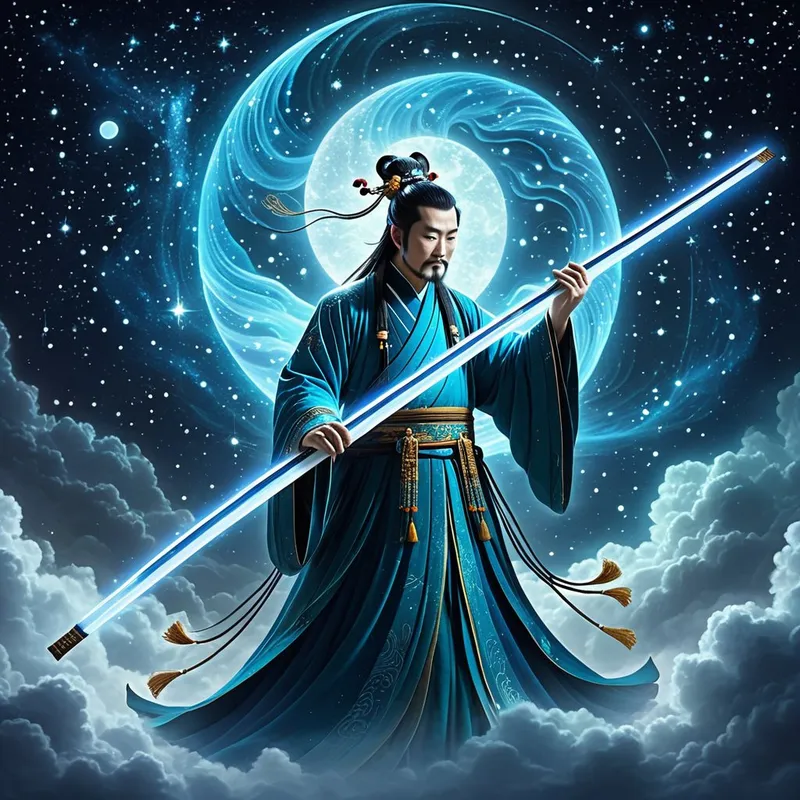
Guqin Myth Meaning & Symbolism
A myth of a celestial zither, born from cosmic conflict, whose music bridges heaven and earth, embodying the soul's quest for resonance and order.
The Tale of Guqin
Listen, and let the silence deepen. Before the world found its rhythm, there was only the great, formless breath of the Tao—a chaos of potential, a silent cacophony. From this primal mist, the celestial sovereign Fuxi emerged, his heart attuned to the disorder. He heard not with ears, but with spirit: the discordant wail of untamed winds, the jagged crack of stone birthing stone, the lonely cry of stars drifting without pattern. It was a symphony of isolation.
His soul ached for a principle, a measure to guide this burgeoning cosmos. He wandered the newly formed earth, tracing the veins of mountains, listening to the whisper of rivers. One day, beneath the sacred Fusang tree, a vision struck him with the force of a falling star. He saw the form: a curved body, like the vault of heaven embracing the curve of earth. He saw the five strings, not as cords, but as the five essential phases of existence—Wood, Fire, Earth, Metal, Water—each a path of transformation.
But what substance could bear such a metaphysical burden? Not mere wood or gut. From the eastern sky, he summoned the essence of the Azure Dragon, weaving its resilient sinew into strings that could hold celestial tension. From the western wilderness, he called upon the spirit of the ancient Qilin, taking a fragment of its horn to craft the bridges that would translate vibration into tone. The body itself was fashioned from a millennia-old Tong tree that had grown listening only to the rain and wind, its wood already a library of natural sound.
With the instrument shaped, Fuxi breathed upon it. He did not play a melody, but a law. The first pluck of a string was the command that set the stars in their orderly procession. The second brought the rhythm to the seasons. The third taught the rivers their flowing course. The fourth gave the winds their names and directions. The fifth, deepest and most profound, resonated with the silent core of the human heart, planting the seed of longing for beauty and order.
Yet, the tale does not end in heaven. The Guqin descended to earth, a divine artifact. It came into the hands of the sage Bo Ya. He mastered its technicalities, but his music, though flawless, remained earthbound. Then, he journeyed to a mountain pass, and under a boundless autumn sky, he played. His notes, carrying his newfound solitude and awe, flowed out like a river. And there, from the shadows of the pines, emerged Zhong Ziqi. Upon hearing the soaring notes, Ziqi did not applaud, but whispered, “How majestic! Like Mount Tai reaching for the clouds.” Hearing the flowing passages, he murmured, “How vast! Like the endless Yellow River.”
In that moment, the myth reached its true climax. The Guqin’s purpose was fulfilled not in cosmic ordinance, but in human resonance. When Bo Ya played his final note and learned of Ziqi’s death, he did not weep. He took his Guqin to his friend’s grave, played one last, devastatingly pure melody, and then shattered the instrument against the rocks. Its physical form was gone, but the harmony it sought—the connection between inner truth and an understanding ear—had been perfectly, tragically, and eternally realized. The true music was now in the silence between souls.

Cultural Origins & Context
The myth of the Guqin is not a single, codified story from one text, but a tapestry woven from strands of Daoist cosmology, Confucian ethics, and literati tradition over millennia. Its origins are attributed to the legendary sage-kings of the highest antiquity, like Fuxi and the later Emperor Shun, grounding its authority in the very foundations of Chinese civilization. It was passed down not by professional bards, but by the scholar-gentlemen, the literati, for whom the Guqin (Qin) was one of the four essential arts of self-cultivation.
Its societal function was profound and multifaceted. On one level, it was an etiological myth, explaining the origin of music itself as a fundamental, ordering force of the universe, not mere entertainment. On another, it served as a moral and spiritual template. The instrument was a microcosm: its rounded top board symbolized heaven, its flat bottom board symbolized earth, and its 13 studs (hui) marked the lunar months. To play it was to ritually align oneself with cosmic principles. The story of Bo Ya and Zhong Ziqi, perhaps the most cherished part of the lore, canonized the ideal of spiritual friendship (zhiyin—"one who knows the tone") and the tragic beauty of an expression so pure it cannot survive the loss of its perfect witness. The myth thus functioned as a guide for living—teaching harmony with nature, depth of feeling, and the supreme value of authentic connection.
Symbolic Architecture
Psychologically, the Guqin is the archetypal symbol of the structured psyche. It represents the human endeavor to take the raw, chaotic material of inner experience—the “formless breath of the Tao” within—and give it resonant, meaningful form.
The Guqin is not an instrument for playing songs; it is a vessel for sounding the soul's topography.
Its physical construction is a map of integration. The heaven-round, earth-square form is the classic Chinese symbol for the reconciled union of spirit and matter, the ideal and the real. The five initial strings correspond to the Wuxing, the five phases of transformation that govern both the macrocosm and the microcosm of human emotion and health. To tune the Guqin is to engage in an internal alchemy, balancing these elemental forces within oneself.
The two later strings, traditionally added by the sage-kings Wen and Wu, introduce the dimension of human culture and moral conflict—the civil and the martial. This completes the instrument’s symbolic architecture: it contains the cosmic, the natural, and the human-social realms. The act of playing, which involves pressing the string to silence it as much as plucking it to sound it, embodies the essential psychological principle that meaning arises from the dynamic tension between expression and restraint, sound and silence, action and reflection.

The Dreamer's Resonance
When the Guqin appears in a modern dream, it rarely manifests as a literal musical instrument. It is more likely to be felt as a structure of profound, latent potential. One might dream of a beautifully carved wooden object of enigmatic purpose, a complex geometric pattern that feels “tunable,” or a set of taut, luminous lines spanning a chasm within the dreamscape. The somatic experience is key: a vibration in the chest that seeks a specific frequency, or a frustrating inability to make a crucial connection “resonate.”
Such a dream signals a process of seeking inner alignment. The psyche is attempting to order disparate elements—perhaps a conflict between professional ambition (the martial string) and personal creativity (the civil string), or a struggle to harmonize emotional chaos (the untuned phases) into a coherent feeling. The dream-Guin represents the innate, psychic structure capable of this harmonization, but it is dormant or unplayed. The dreamer is Zhong Ziqi and Bo Ya simultaneously, both possessing a deep, unexpressed “music” and yearning for the internal “listener” who can truly comprehend it. The frustration in the dream is the gap between possessing the instrument and achieving the zhiyin connection, which, in inner work, is the integration of consciousness with the unconscious.

Alchemical Translation
The myth models the individuation process as a journey from cosmic inheritance to personal mastery, and finally, to transcendent sacrifice. It begins with the inheritance of structure (Fuxi creating the Guqin from cosmic principles). In our lives, this is the given: our innate temperament, the cultural and familial “patterns” we are born into—the basic, often unconscious, structure of our psyche.
The alchemy begins not when we receive the instrument, but when we dare to ask if our own life is in tune.
The second stage is personal cultivation and expression (Bo Ya mastering the instrument). This is the long, disciplined work of analysis, self-reflection, and creative expression—learning to “play” one’s own nature. We tune our strings (develop our functions), practice our pieces (navigate life patterns), and seek to express our unique melody.
The culmination, however, is the sacrifice to the connection. Bo Ya’s shattering of the Guqin upon finding and losing his zhiyin is the critical alchemical moment. It signifies that the ultimate goal is not the perfection of the ego’s “performance” (the preserved instrument), but the realization of a truth so complete it renders its former vessel obsolete. Psychically, this is the point where a complex is fully integrated, a transcendent function emerges, and the old identity that was built around striving for that integration can be released. The music—the newly harmonized Self—no longer needs the specific, struggling ego-structure to contain it. It becomes part of the enduring silence, the Tao, from which it came. The individual achieves harmony not by holding onto their perfected form, but by surrendering it to the greater resonance they have become part of. The broken Guqin is the symbol of the ego that has successfully served its purpose as a crucible for the soul.
Associated Symbols
Explore related symbols from the CaleaDream lexicon: