
Guitarra Myth Meaning & Symbolism
A myth of a stolen celestial instrument, whose earthly echoes birth Flamenco's raw cry, forging beauty from the crucible of human sorrow.
The Tale of Guitarra
Listen. Before the wail of the cante, before the crack of the zapateado, there was only a hollow wind sighing through the olive groves of the south. The earth was silent clay, and the human heart was a sealed vessel of mute longing.
But in the vault of the heavens, where the moon is a silver coin and the stars are scattered salt, there lived a divine being. She was not a goddess of harvest or war, but of pure resonance. Her name was whispered only as Guitarra. Her body was the curve of a perfect tear, her strings were the tendons of the sky itself, stretched between the poles of joy and despair. When the wind of destiny passed through her, she did not merely play music—she wept the raw substance of feeling: the quejío (lament) of creation, the staccato rhythm of a heartbeat, the melodic line of a soul’s journey.
This sound was too potent for mortal ears. It was the unspeakable truth of existence, and the gods guarded it jealously within their celestial juerga (festival). Yet, it drifted down sometimes, a haunting fragment on the night air, to torment a particular people who lived close to the dust and the sun. They were the outcasts, the travelers, the ones whose history was written in displacement and whose present was forged in the heat of the forge and the bitterness of the earth. They heard the ghost of that sound and felt an ache in their bones, a vacancy in their chests where a response should have been.
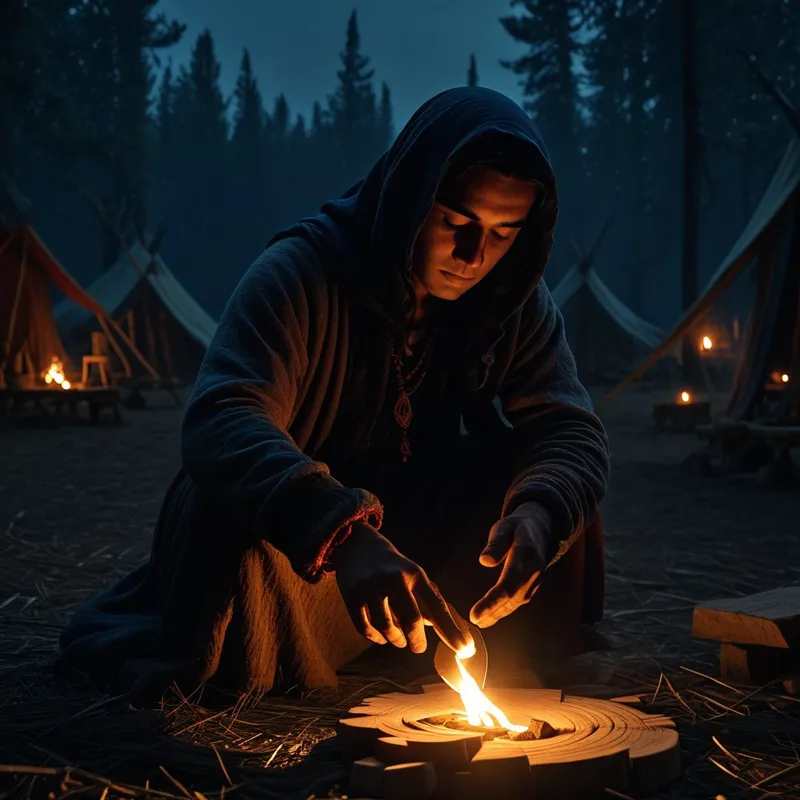
Among them was a man with fire in his veins and silence in his throat. He was a smith, his hands accustomed to shaping iron, but his dreams were filled with impossible curves and vibrating lines. One night, driven by a duende—a spirit of uncontrollable emotion—he did the unthinkable. He climbed the ladder of a desperate prayer, past the realm of sleep, into the very edge of the divine. He did not seek a weapon or treasure. He sought the source of the sigh.
There, in a courtyard of resonant moonlight, he saw her. Guitarra rested, humming with a dormant song. The man, with a thief’s courage and a lover’s tenderness, reached out. But he could not steal the goddess herself; her form was too vast, too divine. Instead, as his calloused fingers brushed a string, a shard of that divine resonance—a tangible echo of her form and voice—splintered off. It was a fragment, a shadow of the true instrument, but it was imbued with her essential cry.
The heavens roared. The theft was discovered. The man fell, not to his death, but back into his world, clutching the burning, resonant shard to his chest. It seared his hands and branded his soul. The gods, in their wrath, did not strike him down. They issued a far crueler curse: the shard would never produce the perfect, divine sound. It would only ever echo the state of the heart that played it. Its music would be forever tied to human suffering, to earthly passion, to the grit of reality.
The smith, his hands now wise with a sacred burn, took the shard and did the only thing he could. He married it to the materials of his world. He shaped a body from the cypress that mourns in graveyards and the rosewood that smells of distant deserts. He strung it with the guts of a brave animal. And when he first drew his thumb across the strings, the sound that emerged was not celestial harmony. It was a guttural cry, a complex tapestry of rhythm and dissonance, a beauty born directly from the fracture. It was the birth of the Flamenco guitar. And from its strings sprang the first cante, the first palmas, the first dance that stamped the truth of the earth into the dust. The stolen echo had found its home in human longing, and in doing so, created something the gods never possessed: Duende.
Cultural Origins & Context
This is not a myth found in a single ancient text, but one woven into the very fabric of Flamenco’s oral tradition. It is a meta-myth, a story told by gitanos (Romani people) and Andalusian singers in the intimate darkness of the tablao or around communal fires, explaining the origins of their art’s profound emotional power. The tale serves as a foundational etiology for why Flamenco is not merely entertainment, but a ritual of catharsis.
The myth’s setting is crucial: the harsh, beautiful landscape of Andalusia, a historical crossroads and crucible of cultures (Iberian, Roman, Jewish, Muslim, Romani). This is a culture deeply familiar with struggle, persecution, and the existential themes of pena (sorrow) and alegría (joy). The myth of Guitarra legitimizes this sorrow as a sacred, creative force. It says the art form was not invented, but stolen from the divine and earned through suffering. The smith-thief is an archetypal figure of the marginalized creator—the Gypsy, the miner, the peasant—who takes what is denied and transforms it into a tool for survival and expression. The myth was passed down not to record history, but to transmit the attitude necessary to approach the art: one of reverence, risk, and deep personal investment.
Symbolic Architecture
At its core, the myth is about the incarnation of spirit into matter, and the necessary imperfection—the "curse"—that makes creation poignant and human.
The celestial Guitarra represents the unmediated archetype of expression—pure, ideal emotion and truth. It is the Self in its unmanifest, perfect state. The earthly guitar, its stolen echo, symbolizes the ego or the personal complex—the flawed, human vehicle through which the Self must express itself in the world. The theft is the heroic, necessary act of consciousness seeking to embody the unconscious.
The most profound beauty is not the pristine ideal, but the perfect echo of an imperfect heart. The flaw is the feature.
The smith’s burned hands signify the wound of consciousness. To handle divine truth, to give form to the formless, one must be marked by it. This is the artist’s burden and credential. The gods’ "curse"—that the instrument reflects only the player’s heart—is, in truth, the great gift. It transforms the guitar from a passive object into an alchemical mirror. It forces authenticity. You cannot hide behind the instrument; it reveals your pena, your alegría, your duende.
The resulting Flamenco is the transmuted product: suffering and passion cooked in the fire of artistic discipline until it becomes communal catharsis. The compás (rhythm) is the ordering principle, the caja (the guitar's body) is the vessel, and the quejío is the raw material being transformed.

The Dreamer's Resonance
When this myth stirs in the modern psyche, it often manifests in dreams of searching for a lost or broken instrument, of hearing an irresistible but unplayable melody, or of trying to repair a beautiful object with crude, earthly tools. The somatic sensation is often one of a tightness in the chest—a longing to give voice to something trapped within.
Psychologically, this dream pattern signals a powerful upwelling from the Self. The dreamer is in a process where a deep, archetypal truth or emotional complex (the celestial sound) is seeking incarnation in their personal life (the earthly instrument). The conflict in the dream mirrors the internal resistance: the fear that one’s abilities are too crude, that one will be "cursed" to only express one’s own pain, or that the act of creation is a theft or an arrogance.
The dream is an invitation to the "smith’s fire." It asks the dreamer to have the courage to reach for that resonant truth, to accept the burn of making it conscious, and to have the humility to build its vessel from the materials of their own life—their history, their wounds, their skills. The anxiety is not a warning to stop, but the friction of incarnation.
Alchemical Translation
The myth of Guitarra is a precise map of the individuation process. It begins with a divine discontent—the haunting echo of the Self that makes the ego’s current life feel silent and hollow. The conscious mind (the smith) must then undertake the theft of fire, actively engaging with the unconscious, risking inflation and divine wrath (psychic overwhelm).
The critical phase is the acceptance of the curse/gift. This is the integration of the shadow. The realized Self is not the pure, celestial archetype; it is that archetype filtered through the specific, flawed, glorious reality of the individual. The "curse" of reflection is the demand for total self-honesty. In Jungian terms, you must play your own complex, not a perfect, foreign melody.
Individuation is not about achieving celestial perfection, but about crafting an instrument unique enough to echo your soul's particular fracture with authenticity.
Finally, the act of building the earthly guitar is the construction of the transcendent function—the psychic structure that can hold the tension of opposites (joy/sorrow, divine/human) and produce a third, living thing: the individual’s authentic life and creative output. The duende that emerges is the numinous proof of successful alchemy: the moment when personal suffering is transmuted into impersonal, communicative power that resonates with the souls of others. The myth teaches that our deepest wound, when shaped with courage and craft, becomes our most resonant chamber.
Associated Symbols
Explore related symbols from the CaleaDream lexicon: