Goddess Kali Myth Meaning & Symbolism
The story of the dark mother who emerges from fury to annihilate evil, then dances wildly upon her own consort, embodying the terrifying grace of absolute liberation.
The Tale of Goddess Kali
Listen. The air was thick with the stench of iron and fear. The battlefield, a trampled plain between worlds, trembled under the feet of the demon army. Their general, Raktabīja, laughed a sound like cracking stone. For every drop of his blood that touched [the earth](/myths/the-earth “Myth from Hindu culture.”/), a thousand clones of himself would spring forth, fully armed. The gods were being overwhelmed, not by strength, but by a terrible, replicating arithmetic. Their divine weapons were useless; to wound him was to multiply him. Despair, cold and heavy, settled in their hearts.
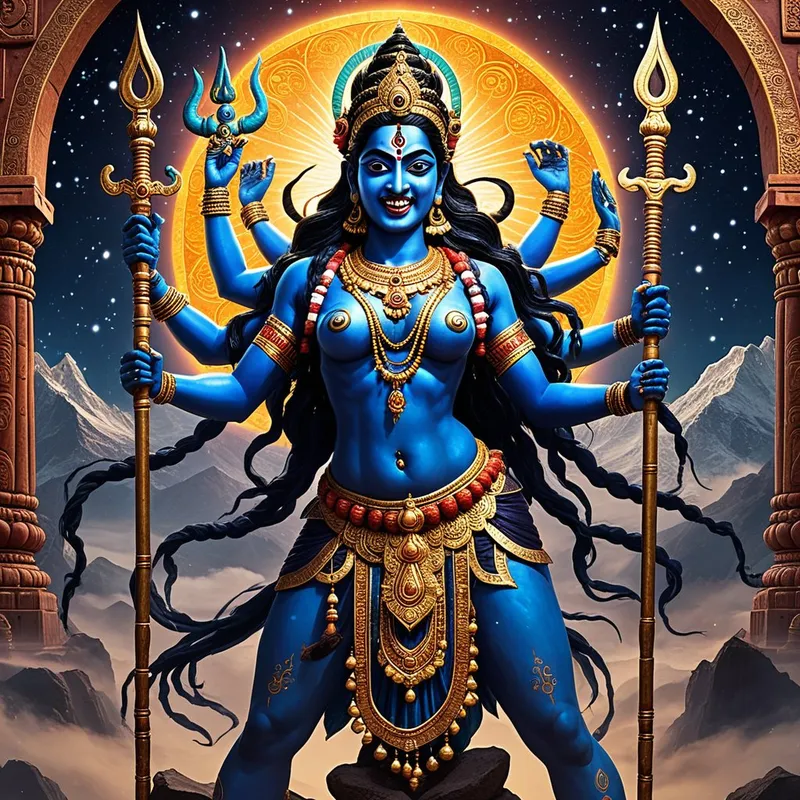
In their celestial council, a fury was summoned. From the knitted brows of the goddess Durga, a profound darkness coalesced. It was not an absence of light, but a presence so intense it absorbed all color, all form. From her [third eye](/myths/third-eye “Myth from Hindu culture.”/), she emerged: Kali. She was the color of a monsoon night, naked but for a girdle of severed arms and a garland of fifty-one gleaming skulls. Her hair was a wild tempest, her eyes held the red glow of a dying sun. In her four hands, she held a sword, a noose, and a severed head. The fourth hand was raised in the Abhaya Mudra, a gesture of protection amidst the carnage.
With a roar that silenced the clangor of war, she descended. She did not fight the demon army; she consumed it. Her sword flashed, and demons fell not in drops, but in torrents. She found Raktabīja. Instead of spilling his blood, she lifted him with impossible strength, pierced him with her trident, and drank every drop from his body before it could touch the ground. She devoured the clones, her tongue lolling out to taste the annihilation. The battle frenzy took her. The taste of victory became an intoxicant, a divine madness. The demon was gone, but her dance of destruction would not cease. The earth shook under her stamping feet. The universe itself began to unravel at the edges, threatened by her unchecked, ecstatic rage.
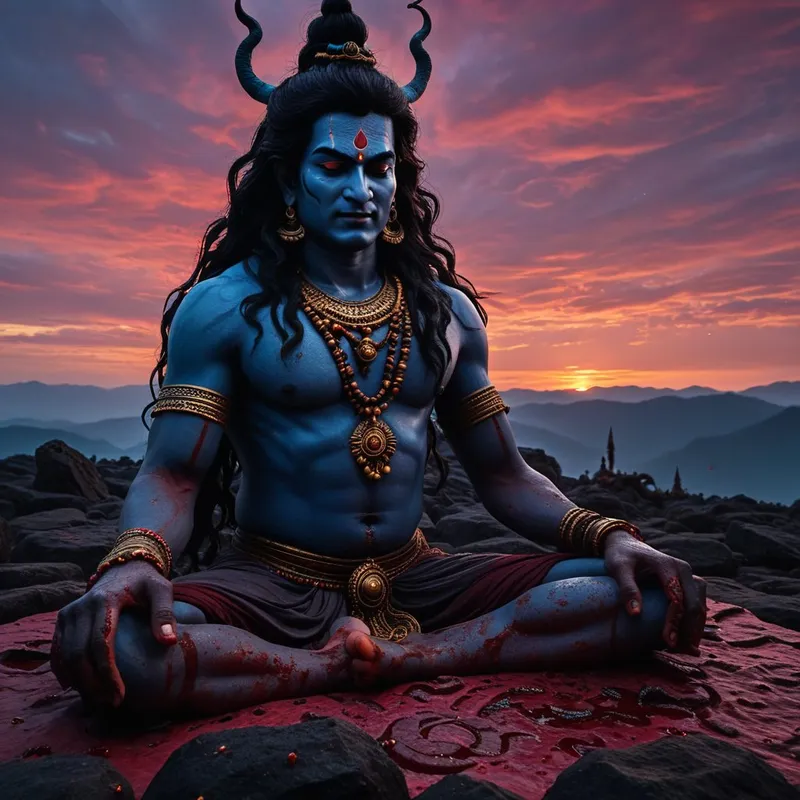
The gods trembled anew, this time not from a demon, but from their own savior. They turned to [Shiva](/myths/shiva “Myth from Hindu culture.”/), the great ascetic, Kali’s consort. Seeing the impending dissolution of all creation, [Shiva](/myths/shiva “Myth from Hindu culture.”/) lay down on the battlefield, directly in the path of her catastrophic dance. In her blind, world-ending ecstasy, Kali stepped upon his chest—and stopped. The moment her foot touched the still, calm body of her beloved, the frenzy broke. She looked down. She saw what she was doing. A shock of recognition, then shame. Her lolling tongue protruded further in a timeless gesture of stunned realization. The wild goddess was pacified. The dance of time and destruction had met the still point of pure consciousness. Creation was saved, not from evil, but from the unchecked momentum of its own cleansing force.
Cultural Origins & Context
The myth of Kali finds its roots in the Devi Mahatmya, a seminal text within the Markandeya Purana, dated to around the 6th century CE. This period saw the flourishing of the Shakta tradition, which venerates the Goddess as the supreme, dynamic energy ([Shakti](/myths/shakti “Myth from Hindu culture.”/)) behind all existence. The myth was not merely a story but a theological and cosmological argument, passed down by sages and recited with devotion, especially during the festival of Navaratri.
Societally, Kali functioned as a complex, necessary counterpoint. In a culture with deeply structured norms and hierarchies, Kali embodied everything outside the fence: the wild, the untamable, the destructive aspect of time (Kāla), and the terrifying, all-consuming love of a mother. She was the protector of the marginalized and the annihilator of pretense. Her worship, particularly in Bengal and at cremation grounds, served as a powerful reminder of life’s [impermanence](/myths/impermanence “Myth from Buddhist culture.”/) and the ultimate equality of all beings before the forces of time and death.
Symbolic Architecture
Kali is not a [goddess](/symbols/goddess “Symbol: The goddess symbolizes feminine power, divinity, and the nurturing aspects of life, embodying creation and wisdom.”/) of evil, but of necessary, radical [truth](/symbols/truth “Symbol: Truth represents authenticity, honesty, and the quest for knowledge beyond mere appearances.”/). She represents the unconscious [shadow](/symbols/shadow “Symbol: The ‘shadow’ embodies the unconscious, repressed aspects of the self and often represents fears or hidden emotions.”/) in its most potent, archetypal form—not personal failings, but the raw, chaotic, creative-destructive potential that underpins [reality](/symbols/reality “Symbol: Reality signifies the state of existence and perception, often reflecting one’s understanding of truth and life experiences.”/) itself.
She is the psychological truth that before the new can be born, the old must be utterly dismantled, often in a manner that feels violent and terrifying to the conscious ego.
Her black [skin](/symbols/skin “Symbol: Skin symbolizes the boundary between the self and the world, representing identity, protection, and vulnerability.”/) symbolizes the all-encompassing, fertile void from which all forms emerge and to which they return. The garland of skulls represents the conquered egos, the “I” thoughts she has severed, showing liberation from identification with the finite self. The severed head in her hand is the severed mind, the end of endless calculation. Her nudity is the starkness of absolute truth, stripped of all cultural and personal garments. The lolling [tongue](/symbols/tongue “Symbol: Represents communication, self-expression, and the power of words.”/) captures the [moment](/symbols/moment “Symbol: The symbol of a ‘moment’ embodies the significance of transient experiences that encapsulate emotional depth or pivotal transformations in life.”/) of self-recognition, the shock of [the ego](/myths/the-ego “Myth from Jungian culture.”/) confronting its own boundless, destructive potential. Finally, standing on Shiva, she illustrates the ultimate [symbiosis](/symbols/symbiosis “Symbol: A dream of mutual dependence and interconnected growth, often representing harmonious relationships or integrated aspects of the self.”/): dynamic, transformative power (Shakti) grounded in silent, witnessing [consciousness](/symbols/consciousness “Symbol: Consciousness represents the state of awareness and perception, encompassing thoughts, feelings, and experiences.”/) (Shiva).
The Dreamer’s Resonance
To dream of Kali is to dream of a profound somatic and psychological crisis point. It is not a nightmare of external monsters, but an encounter with an internal, archetypal force of deconstruction. The dreamer may experience imagery of wild, unstoppable women, black voids, frenzied dancing, or the terrifying yet compelling presence of a dark mother figure.
Psychologically, this signals that the [psyche](/myths/psyche “Myth from Greek culture.”/)‘s self-regulating system has activated a “scorched earth” protocol. A pattern—be it a toxic relationship, a crippling self-concept, or a life structure—has become so entrenched, so self-replicating (like Raktabīja), that gentle negotiation is impossible. The Kali archetype emerges in the dream to perform a radical excision. The somatic feeling upon waking is often one of deep anxiety, awe, or a strange, liberated exhaustion. The process underway is the death of a psychic complex, and the body registers the shock of that dissolution.

Alchemical Translation
The myth of Kali models the most intense phase of individuation: the [Nigredo](/myths/nigredo “Myth from Alchemical culture.”/), or the blackening. This is the “dark night of the soul,” where everything one thought one was begins to crumble.
The modern individual’s “demon army” is the legion of compulsive thoughts, inherited beliefs, and unresolved traumas that replicate endlessly, draining life force. The conscious ego (the gods) is powerless against this inner swarm. The alchemical invocation is the courageous turn inward to face the core shadow—the Kali within. This is not an intellectual exercise but a surrender to a transformative rage and grief that feels like it will destroy you.
The crucial, liberating step is the Shiva-act: the cultivation of a witnessing consciousness that does not fight the inner Kali, but lies down before her.
This is the practice of mindful, non-judgmental awareness amidst inner turmoil. When the furious, deconstructive energy (Kali) finally makes contact with this still, accepting presence (Shiva), its blind momentum stops. The frenzy transmutes into creative power. The individual does not become “nice” or “calm” in a superficial sense; they become integrated. They gain access to the fierce, protective love that can set boundaries, the clarity that can cut through illusion, and the liberation that comes from having danced on the corpse of their own limitations. The myth teaches that true peace is not the absence of destruction, but the conscious embrace of destruction as the partner of creation.
Associated Symbols
Explore related symbols from the CaleaDream lexicon: