
Goanna Spirit Myth Meaning & Symbolism
An ancestral Goanna Spirit journeys across the primordial landscape, creating sacred law and embodying the deep, grounding wisdom of the earth itself.
The Tale of Goanna Spirit
In the time before time, in the shimmering, singing world of the Dreaming, the land was soft and unformed. The great Ancestors walked, and their every footfall was a law, their every breath a story. Among them was Goanna, a being of immense patience and ancient knowing.
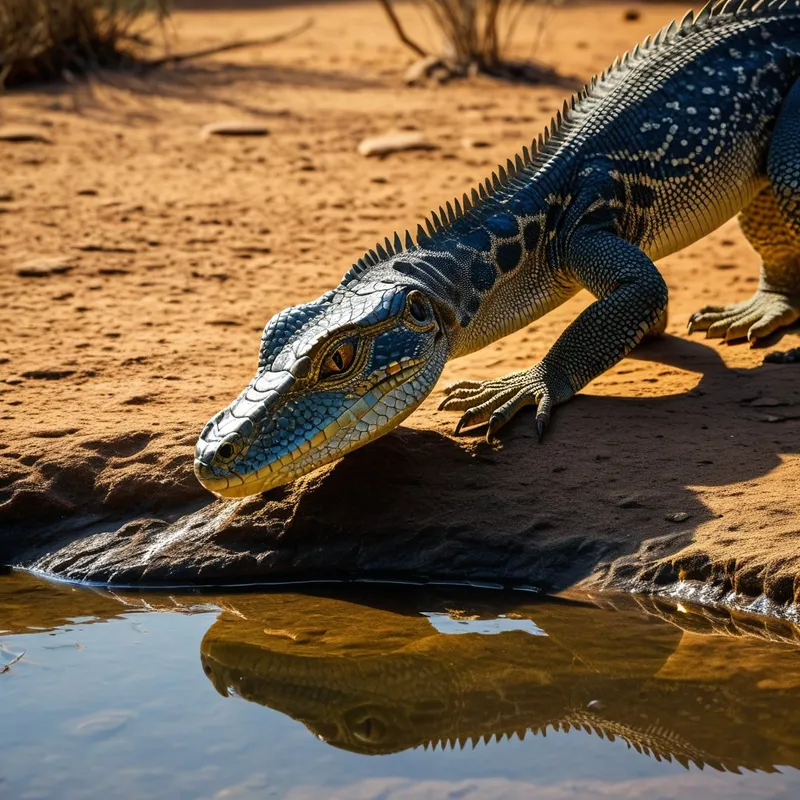
He awoke in the east, where the sun first touches the earth. His scales were the color of dry clay and burnt ochre, etched with the maps of countries yet to be. He felt a deep pull, a song from the west—a memory of a place he had never been, but which knew his name. Without a word, he began to walk.
His journey was not swift. It was the slow, deliberate press of consciousness into the yielding earth. His claws, thick and curved, dug into the soft crust. Where they lifted, a depression remained. Where they pressed again, another. A line of purposeful marks began to stretch behind him—a trail of intention across the blank canvas of the world. The sun beat down, a fierce, white eye. The land was parched, silent but for the whisper of hot wind over stone. Goanna’s tongue flicked out, tasting the air: dry, empty, waiting.
A great thirst grew within him, a thirst not just of the body, but of the spirit. The land was thirsty with him. He scanned the endless plains, his slow heart beating a patient drum. He saw a place where the energy of the earth dipped, where the song of the underground waters hummed closest to the surface. With a powerful, deliberate motion, he began to dig. His forelimbs worked like sacred tools, carving through soil and rock. Deeper and deeper he went, until a cool darkness greeted him, and then—a seep, a pooling, a gift.
Water, clear and life-giving, welled up from the depths. He drank, and as he did, the waterhole became permanent. It was no accident; it was an act of creation. Replenished, he moved on. He climbed a rocky escarpment, and his heavy body, dragging against the stone, carved a crevice that would become a path for generations. He rested in the shade of a particular stand of trees, and his spirit mingled with theirs, marking them as a place of shelter and council.
Finally, as the sun bled into the western horizon, he reached the end of his song. His energy, his kurunpa, was spent. With a final, deep sigh that stirred the red dust, he laid his body down upon the earth. His great form sank into the land, his bones becoming ridges, his scales flaking into the soil, his spirit dissolving into the very substance of that place. He did not die; he became the country. His journey was now the law of that land—the water sources, the travel routes, the resting places, all encoded in the story of his walk.
Cultural Origins & Context
The stories of Goanna Spirit are not mere folklore; they are the living title deeds, ecological manuals, and moral frameworks for many Aboriginal language groups across Australia, particularly in arid central and western regions. These narratives belong to specific Country and are held by the traditional custodians of that land.
Passed down orally over countless generations through song, dance, ceremony, and art, the Goanna Dreaming tracks are sung into being. Elders, as knowledge-keepers, recount the journeys during initiations and at sacred sites, ensuring the continuity of law (Lore) and identity. The myth functions as a geospatial scripture, encoding vital information about water locations, seasonal changes, and resource management. More profoundly, it establishes the inseparable relationship between people, ancestor, and place, teaching that human identity is forged in the literal footsteps of the ancestral beings.
Symbolic Architecture
At its core, the Goanna Spirit myth is a profound map of consciousness inscribing itself upon reality. Goanna is the embodiment of grounded, persistent intelligence.
The journey is not toward a destination, but into the nature of the journeyer. Each step is a commitment, each pause a creation.
The slow, deliberate walk symbolizes the pace of deep, instinctual wisdom—a stark contrast to the frantic speed of modern thought. It is the psyche moving at the speed of geology, of genuine transformation. The thirst and the digging for water represent the soul’s quest for the nourishing, often hidden, depths of the unconscious. The waterhole is not found; it is called forth through effort and attunement, symbolizing the discovery of inner resources and emotional wells in times of spiritual aridity.
The tracks left behind are the ultimate symbol of legacy, memory, and law. They are the visible manifestation of invisible intent, the “footprints” of consciousness that become the paths for others to follow—our habits, our traumas, our wisdom, all etched into the landscape of the self. Finally, the transformation into country signifies the ultimate goal: not to possess the land or the self, but to become indistinguishable from it. It is the ego’s dissolution into a larger, ecological identity.
The Dreamer’s Resonance
When the pattern of the Goanna Spirit emerges in modern dreams, it often signals a profound somatic and psychological process of grounding and instinctual reconnection. The dreamer may find themselves moving slowly through a vast, arid landscape, feeling a powerful, patient drive with no conscious goal. They may dream of digging in the earth, searching for something vital and hidden.
This is the psyche’s response to a life lived too much “in the head”—disconnected from the body, from nature, from ancestral rhythms. The Goanna dream is a call back to the reptilian brainstem, to the deep, slow intelligence of survival and territorial knowing. It asks: Where is your water? What path are you carving with your daily life? Into what landscape is your spirit dissolving? The feeling is often one of immense, quiet potency, a re-membering of a more ancient, embodied self that knows how to navigate scarcity and find sustenance.
Alchemical Translation
For the modern individual, the Goanna Spirit’s journey models the alchemical process of coagulatio—the making solid. In a world of digital ephemera and abstract identities, this myth teaches the work of incarnation.
The spirit must become earth. The idea must become track. The thirst must become the act of digging.
The alchemical journey begins with the recognition of a deep, ancestral pull—a feeling that there is a “country” of the authentic self that we are meant to inhabit. The slow walk is the disciplined, patient work of therapy, meditation, or creative practice, where lasting change is measured in inches, not miles. It requires the tolerance for the “dry” periods, the parched stretches of inner work where nothing seems to happen.
The digging for water is the courageous descent into the personal and collective unconscious—into memory, shadow, and trauma—to tap the aquifer of life-force that fuels transformation. The tracks left behind represent the new neural pathways, the healed patterns, and the lived integrity that become our legacy, guiding our future steps and potentially others. Finally, the transformation into country symbolizes the pinnacle of individuation: no longer identifying solely with the ego’s small story, but with the vast, interconnected ecosystem of the Self. One becomes a grounded, lawful, and life-sustaining presence—a human who is, finally, a true part of the living land.
Associated Symbols
Explore related symbols from the CaleaDream lexicon: