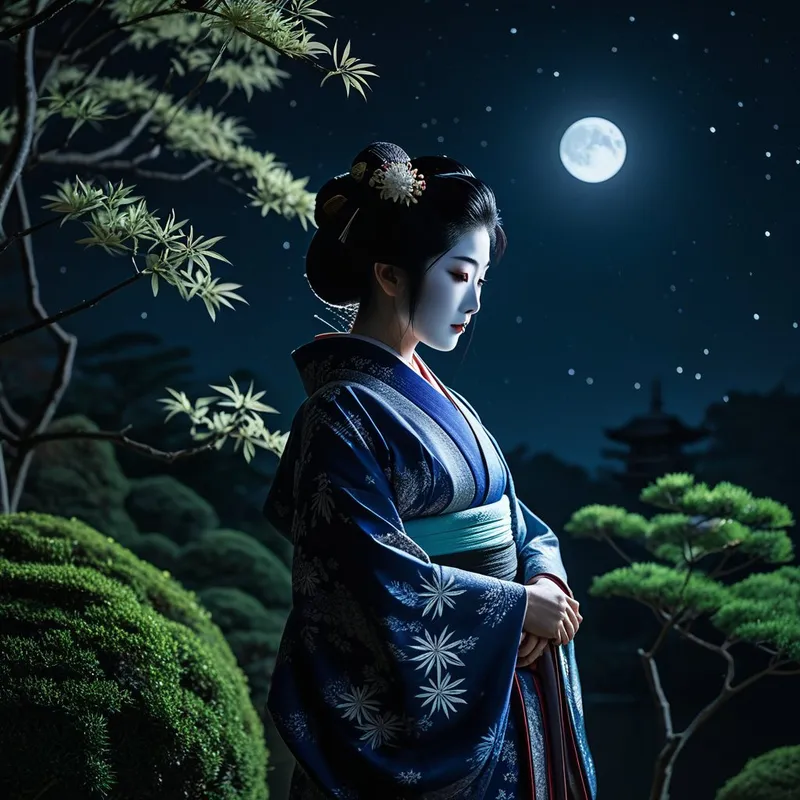
Geisha Communication Myth Meaning & Symbolism
A myth of a geisha who masters the art of wordless communion, becoming a vessel for the unspoken truths between heaven, earth, and the human heart.
The Tale of Geisha Communication
Listen, and hear the story not told in words, but felt in the space between heartbeats.
In the old capital, under a moon veiled by cherry blossom mist, there lived a [geisha](/myths/geisha “Myth from Japanese culture.”/) named Koe Nashi Kane. She was not the most famed for song or dance, but a peculiar silence clung to her like the scent of night-blooming [jasmine](/myths/jasmine “Myth from Persian culture.”/). It was said she could hear the unspoken—the sigh trapped in a lord’s chest, the regret buried beneath a merchant’s boast, the lonely echo in a poet’s clever verse.
Her world was the karyūkai, the “flower and willow world,” a realm of exquisite surfaces. Yet, Koe Nashi Kane perceived its undercurrents: a torrent of hidden desires, unvoiced shames, and silent prayers flowing beneath the polished floors. Her conflict was not with a villain, but with the very nature of human isolation. She saw guests as islands in a sea of formal speech, never touching.
Her art became a quiet rebellion. She learned that a precisely timed lowering of the gaze could feel like absolution. The angle of a poured cup of sake could ask a question more piercing than words. The faintest shift in her posture, the subtle rustle of silk, could mirror a guest’s inner weather—a storm of anger, a drizzle of sorrow—before they themselves knew it. She became a living [kagami](/myths/kagami “Myth from Japanese culture.”/), not to show them their face, but their soul.
The rising action was a night of profound tension. A powerful, stoic [samurai](/myths/samurai “Myth from Japanese culture.”/), a man carved from granite and duty, visited her okiya. He spoke of trivialities, but the air grew thick with the unsaid. Koe Nashi Kane did not probe. She simply was. She mirrored his rigid stillness in her own poised calm. She served tea with a slowness that honored his unspoken fatigue. When he faltered mid-sentence, she filled the silence not with chatter, but with the gentle, deliberate sound of charcoal settling in the brazier—a sound of warmth and continuity.
And then, the resolution. He did not confess. He did not weep. But as the dawn light tinged the [shoji screens](/myths/shoji-screens “Myth from Japanese culture.”/), the samurai, without a word, placed his closed fan on the [tatami](/myths/tatami “Myth from Japanese culture.”/) between them—a gesture of ultimate trust and concluded business. In that silent offering was a universe of communication: gratitude, understanding, a burden shared and lightened without ever being named. Koe Nashi Kane bowed deeply, her silence accepting the gift. The myth tells us that when he left, he walked straighter, as if a weight had been lifted not from his shoulders, but from his spirit. And the geisha, [the vessel](/myths/the-vessel “Myth from Alchemical culture.”/) of the unspoken, remained, filled yet empty, ready to listen to the next silent song.
Cultural Origins & Context
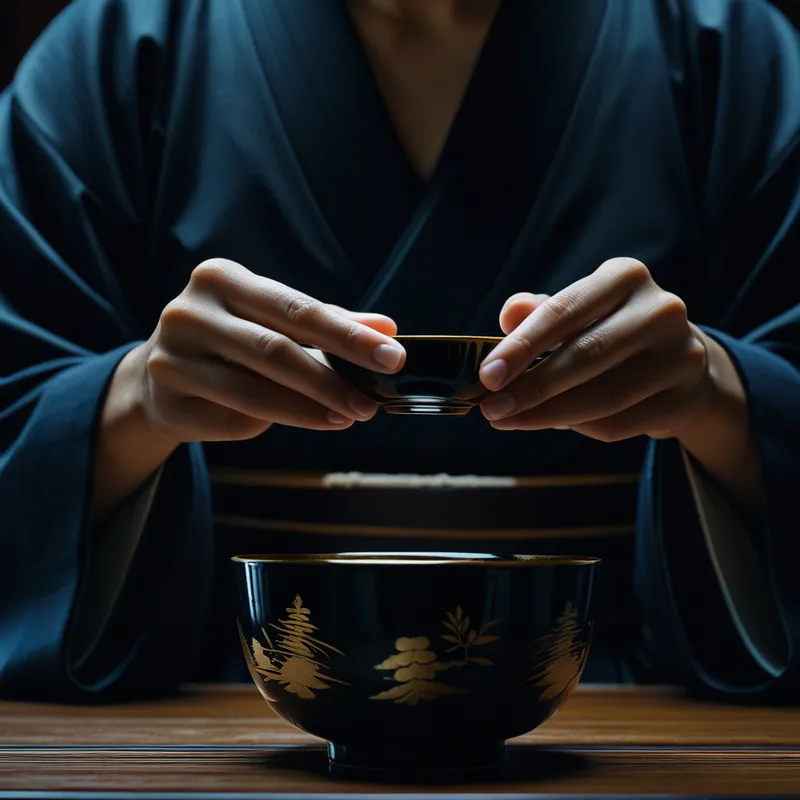
This is not a myth inscribed on ancient scrolls, but one woven into the very fabric of iki and social conduct. It emerges from the historical world of the geisha, artist-entertainers who were, at their zenith, masters of a highly codified social realm. The “myth of Geisha Communication” is a folkloric idealization of their highest function, passed down through oral tradition, literature, and popular memory.
Its societal function was multifaceted. For the predominantly male clientele of the pleasure quarters, it offered a narrative of refined, non-physical intimacy and psychological release. It presented the geisha not merely as an entertainer, but as a monogatari-ki—a keeper of stories never told. For the geisha themselves, it established a powerful professional ethos: that their true artistry lay in emotional and social intelligence, in the cultivation of kokoro. This myth reinforced the idea that the most powerful communications often bypass language, residing in the shared, cultivated space of mutual presence and aesthetic sensitivity.
Symbolic Architecture
At its core, this myth is a profound exploration of communion over communication. It symbolizes the [human](/symbols/human “Symbol: The symbol of a human represents individuality, complexity of emotions, and social relationships.”/) yearning to transcend the [isolation](/symbols/isolation “Symbol: A state of physical or emotional separation from others, often representing a need for introspection or signaling distress.”/) of the individual [psyche](/myths/psyche “Myth from Greek culture.”/) and achieve a state of wordless understanding.
The geisha, Koe Nashi Kane, symbolizes the [anima](/symbols/anima “Symbol: The feminine archetype within the male unconscious, representing soul, creativity, and connection to the inner world.”/) in her highest form: not as a romantic [projection](/symbols/projection “Symbol: The unconscious act of attributing one’s own internal qualities, emotions, or shadow aspects onto external entities, people, or situations.”/), but as the mediating function that connects the conscious [persona](/symbols/persona “Symbol: The social mask or outward identity one presents to the world, often concealing the true self.”/) (the social mask of the [guest](/symbols/guest “Symbol: A guest in a dream can symbolize new experiences, unexpected situations, or aspects of oneself that are being revealed.”/)) to the [unconscious depths](/symbols/unconscious-depths “Symbol: The hidden, primordial layers of the psyche containing repressed memories, instincts, archetypes, and collective wisdom beyond conscious awareness.”/). She is the [vessel](/symbols/vessel “Symbol: A container or structure that holds, transports, or protects something essential, representing the self, emotions, or life journey.”/), [the empty cup](/myths/the-empty-cup “Myth from Zen Buddhism culture.”/) that must be hollow to receive. Her silence is not [absence](/symbols/absence “Symbol: The state of something missing, void, or not present. Often signifies loss, potential, or existential questioning.”/), but a cultivated [space](/symbols/space “Symbol: Dreaming of ‘Space’ often symbolizes the vastness of potential, personal freedom, or feelings of isolation and exploration in one’s life.”/)—a ma—where the unformed can take shape.
True listening is not an auditory act, but a somatic surrender. It is to become a still pool in which another can finally see their own reflection, undistorted by the ripples of their own speech.
The [samurai](/symbols/samurai “Symbol: The samurai represents discipline, honor, loyalty, and mastery in martial and spiritual arts, embodying the highest values of the warrior class.”/)’s unspoken burden represents the [shadow](/symbols/shadow “Symbol: The ‘shadow’ embodies the unconscious, repressed aspects of the self and often represents fears or hidden emotions.”/)—all that is felt but cannot be integrated into one’s public [identity](/symbols/identity “Symbol: Identity represents the sense of self, encompassing personal beliefs, cultural background, and social roles.”/). The ritualized exchange—the silent service, the offering of the fan—models a sacred container where [shadow](/symbols/shadow “Symbol: The ‘shadow’ embodies the unconscious, repressed aspects of the self and often represents fears or hidden emotions.”/) [material](/symbols/material “Symbol: Material signifies the tangible aspects of life, often representing physical resources, desires, and the physical world’s influence on our existence.”/) can be acknowledged without being violently exposed, witnessed without being judged, and thereby integrated without [shame](/symbols/shame “Symbol: A painful emotion arising from perceived failure or violation of social norms, often involving exposure of vulnerability or wrongdoing.”/).

The Dreamer’s Resonance
When this myth pattern surfaces in modern dreams, it signals a profound somatic and psychological process: [the ego](/myths/the-ego “Myth from Jungian culture.”/)’s confrontation with the limits of language and its deep need for attunement.
To dream of being the silent geisha suggests you are in a phase of intense receptivity. You may be the confidant, the therapist, the supportive partner—the one who “holds space.” The dream asks: Are you a clean vessel, or are you filling the silence with your own interpretations? Is your listening an act of empathy, or a covert form of control? There is a warning here of psychic overload, of becoming a repository for others’ unprocessed emotions.
To dream of being the samurai guest indicates a struggle with inexpressible inner content. You carry a weight that feels unspeakable—a grief, a passion, a truth—that your waking, social self cannot articulate. The dream geisha represents the part of your own psyche capable of holding this tension with compassionate neutrality. The dream is an invitation to find or create that inner and outer “sacred space” where you can lay down your fan—your unspoken truth—and have it witnessed, if not solved.
Alchemical Translation
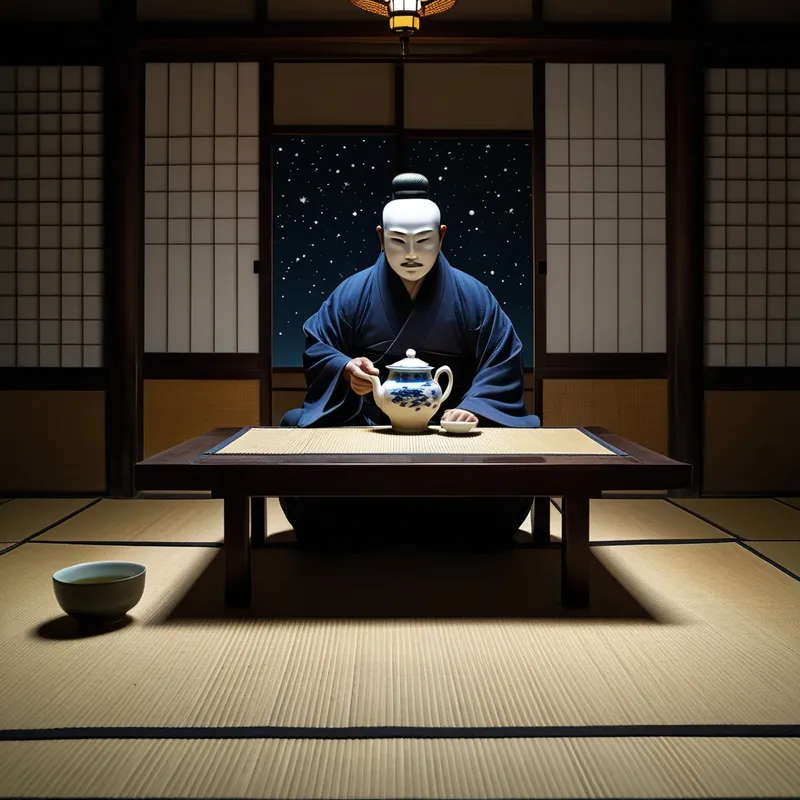
The myth models the alchemical process of individuation—the journey toward psychic wholeness—as a ritual of silent transmutation. The base material is the leaden weight of isolation and unexpressed self. [The alembic](/myths/the-alembic “Myth from Alchemical culture.”/) is the ritually prepared space of the chashitsu, which in psychological terms is the therapeutic container or the sacred space of inner work.
The geisha’s art—chadō, music, dance—are not mere performances but the [prima materia](/myths/prima-materia “Myth from Alchemical culture.”/) of [the opus](/myths/the-opus “Myth from Alchemical culture.”/). They are the structured rituals that make the unstructured chaos of emotion approachable. The samurai’s gradual unfolding is the dissolution ([solutio](/myths/solutio “Myth from Alchemical culture.”/)) of the hardened [persona](/myths/persona “Myth from Greek culture.”/). His final, wordless gesture is the coagulation (coagulatio)—the new, integrated understanding that emerges not as a loud proclamation, but as a silent, solid knowing.
Individuation is not a heroic declaration of self, but often a quiet agreement reached between the speaking ego and the silent self in the inner teahouse of the soul.
For the modern individual, the “Alchemical Translation” is this: Our transformation often hinges not on finding the right words, but on cultivating the right silence. It is about developing the inner geisha—the observant, receptive, non-judgmental witness within us—who can host our own inner samurai with all his unspoken conflicts. The [triumph](/myths/triumph “Myth from Roman culture.”/) is not in a battle won with words, but in a communion achieved beyond them. We learn that the most profound communication, and thus the deepest healing, occurs in the sacred ma where nothing needs to be said, and everything is understood.
Associated Symbols
Explore related symbols from the CaleaDream lexicon: