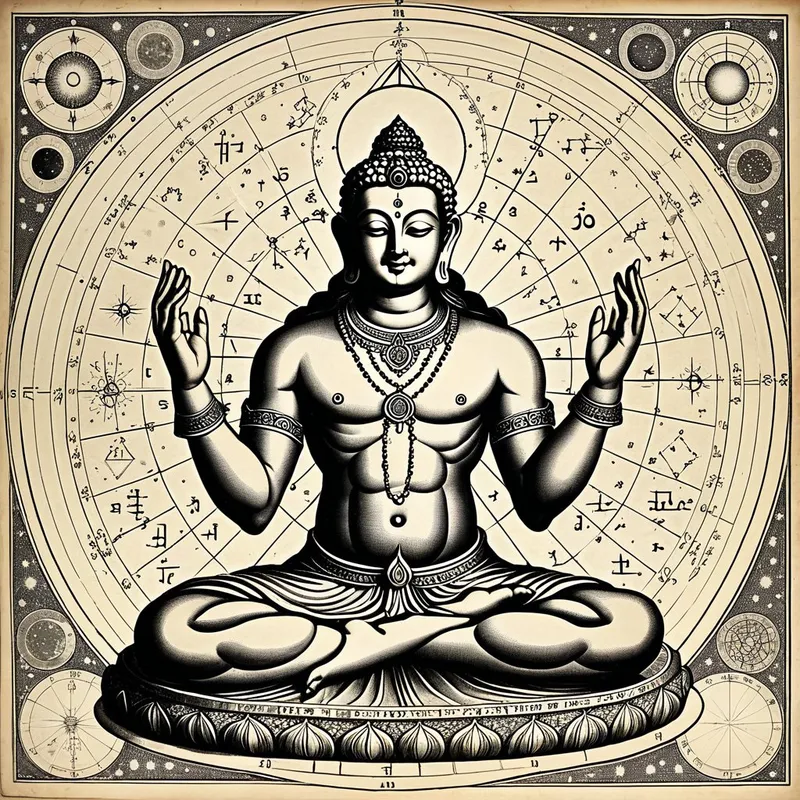
Ganita Myth Meaning & Symbolism
A myth of the divine mathematician who calculates the cosmos, embodying the sacred patterns underlying creation, order, and the soul's destiny.
The Tale of Ganita
Listen. Before the first note of the cosmic Om vibrated, there was a silence so profound it was a presence. And in that presence, the mind of Brahma stirred. But creation is not mere will; it is design. It requires a blueprint, a sacred calculation. And so, from the stillness of divine contemplation, Ganita was born.
He did not emerge with a roar, but with the soft, inevitable click of a perfect thought locking into place. His form was neither young nor old, but of an ageless precision. Four arms held his tools: a scroll of boundless potential, a stylus forged from the light of the first star, a perfect sphere representing the unmanifest whole, and a hand held in the chin mudra, the seal of consciousness. His eyes were not eyes of flesh, but pools of swirling constellations, perpetually measuring, comparing, solving.
He was given a chamber at the dawn of time—a celestial observatory that was also a forge of ideas. Its floor was the grid of spacetime itself; its dome was the skull of the cosmos. And his task? To calculate the architecture of all that would be. Not just the orbits of planets, but the curve of a spider’s web, the branching of a river delta, the rhythm of a heartbeat, and the hidden proportion in a human smile. Every leaf, every galaxy, every fleeting emotion required its unique equation, its place in the grand balance sheet of existence.
For eons, Ganita worked. The sound of his labor was the music of the spheres—a sublime, silent hum of computation. He plotted the dance of the Navagrahas. He solved for the variables of life and death, joy and sorrow, ensuring the cosmic ledger always, ultimately, balanced. His calculations were the invisible threads holding the tapestry of Maya together.
But then came the prayers. The desperate, fervent prayers of beings caught in the web he had designed. A king prayed for victory, tilting the scales of fate. A lover prayed for reunion, bending the arc of probability. Each prayer was a new variable, an emotional integer inserted into his flawless equations. Ganita’s celestial scrolls began to shimmer with instability. The numbers bled. The constants wavered.
The conflict was not against a demon, but against chaos—the chaos of free will clashing with divine order. Ganita saw that to merely calculate was not enough. The system had to account for the incalculable: the human heart. In a moment of profound resolution, he did not delete the erratic variables of prayer and desire. Instead, he integrated them. He created a new, dynamic calculus where destiny was not a fixed line, but a probability wave, shaped by choice and devotion. He inscribed the greatest formula of all: an equation for grace, where the unknown could be met not with frustration, but with the faith that even the unsolvable has its place in the whole. His work was no longer just about mapping creation, but about leaving room within it for the sacred mystery.
Cultural Origins & Context
The figure of Ganita is not the protagonist of a single, canonical epic like the Mahabharata or Ramayana. He is a wisdom deity, a devata who emerges from the philosophical and scientific traditions of ancient India. His roots are deeply entwined with the astonishing advancements in mathematics and astronomy made by scholars like Aryabhata, Brahmagupta, and Bhaskara II. In a culture where the pursuit of Jnana was a supreme path, mathematics (Ganita itself) was never seen as a merely secular tool. It was a sadhana, a way to perceive the inherent order (Dharma) of the universe.
Stories of Ganita would have been passed down in ashramas and courts, told by teachers (gurus) to students. His myth served a crucial societal function: it sanctified logic and reason. It taught that to study the stars, to solve an equation, to measure the land, was to participate in a divine activity. It bridged the perceived gap between the rational and the spiritual, asserting that the cosmos itself is the ultimate treatise of a divine mathematician. The myth provided a cosmological framework for India’s scientific genius, framing it not as invention, but as discovery of a pre-existing, sacred code.
Symbolic Architecture
Ganita is the archetype of the Cosmic Architect, the personification of the Logos—the rational principle governing the universe. He symbolizes the innate, structural intelligence that precedes and underlies all form.
The universe is not a random story; it is a poem written in the language of mathematics, and Ganita is its silent, perpetual scribe.
His four arms represent the multifaceted application of this intelligence: measurement (scroll), active creation (stylus), contemplation of the whole (sphere), and enlightened consciousness (mudra). The celestial observatory is the mind itself—the interior space where reality is parsed and understood. The central conflict—prayers disrupting perfect equations—is the eternal tension between fate (Karma) and free will (Purushartha).
Psychologically, Ganita represents the human mind’s drive to find pattern, causality, and meaning. He is the cognitive function that seeks to map the chaos of experience onto a grid of understanding. His struggle is our struggle: how to maintain our inner order when confronted with the unpredictable, emotional, and irrational elements of life. His resolution—integrating the variable—is the pinnacle of wisdom: the recognition that true order is not rigid control, but a dynamic, adaptive system that can accommodate the unknown.
The Dreamer's Resonance
When the pattern of Ganita stirs in the modern unconscious, it often manifests in dreams of urgent calculation, impossible puzzles, or vast, intricate systems. You may dream of being late for a cosmic exam you didn’t study for, of trying to balance a ledger where the numbers keep changing, or of discovering hidden formulas etched into the walls of your own home.
These are not mere anxiety dreams. They are somatic signals of a psyche attempting a profound integration. The dream-ego is playing the role of Ganita, tasked with "figuring it all out." The somatic feeling is often one of pressured urgency, a tightening in the chest or a racing mind—the body’s echo of a cognitive overload. The psychological process at work is the confrontation between the ego’s desire for control, prediction, and a neat, solvable life, and the soul’s messy, emotional, and unpredictable reality. The dream is the psyche’s workshop, where it labors to compute the new data of a life change, a trauma, or a burgeoning creativity that defies old logic.

Alchemical Translation
The individuation process modeled by Ganita is the alchemy of the mind. It begins in the nigredo, the blackening: the chaotic, uncalculated raw material of the psyche—our instincts, wounds, and chaotic desires. The ego, identifying with Ganita, attempts to apply its old formulas, its rigid patterns of thinking and defense, to this prima materia. It fails. The equations bleed.
The albedo, the whitening, is the moment of insight: the realization that the psyche cannot be solved like a theorem. This is the crisis in the celestial observatory. The old, rigid rationality must die. The rubedo, the reddening, is the creation of the new calculus. This is the psychic transmutation: the development of a dynamic intelligence. It is the ability to hold logic and intuition, plan and spontaneity, structure and emotion, in a creative tension.
Individuation is not about finding the one right answer to the soul's equation; it is about learning to hold the entire beautiful, contradictory, unsolvable problem in consciousness, and calling that wholeness "Self."
The modern individual completes Ganita’s work not by mastering all variables, but by developing what the alchemists called the coincidentia oppositorum—the coincidence of opposites. We become the sage who can use reason to navigate the world, yet also kneel before the incalculable mystery within and without. We learn that the final, most important variable in the equation of our life is not a number, but a quality: the grace to accept that some answers are lived, not solved, and that the deepest patterns are felt in the heart long before they are understood by the mind. In doing so, we stop being mere calculators of our destiny and become, at last, co-creators of its unfolding poetry.
Associated Symbols
Explore related symbols from the CaleaDream lexicon: