
Gadfly Myth Meaning & Symbolism
Hera sends a relentless Gadfly to torment the transformed Io, a myth of divine persecution, maddening consciousness, and the painful journey to self.
The Tale of Gadfly
Hear now the tale of a torment born from divine envy, a story not of a hero’s sword, but of a pestilence’s sting. It begins not in the sun-drenched fields of mortals, but in the shadowed heart of Olympus, where the air is thick with the scent of ambrosia and suspicion.
Zeus, whose gaze falls like lightning, desired the river nymph Io. Knowing the all-seeing eye of his wife, he cloaked the world in a thick, grey mist and sought Io in secret. But Hera, whose intuition is sharper than any mortal blade, felt the disturbance in the order of her domain. She descended from the heights, scattering the concealing fog with a sweep of her hand. Zeus, in a panic of preservation, transformed the trembling Io into a creature of pristine white—a beautiful, wide-eyed heifer.
Hera approached, the stones growing cold beneath her feet. “A fine beast,” she said, her voice honeyed with false delight. “A fitting gift for your devoted wife, is it not?” Trapped by his own ruse, Zeus could only assent. Hera claimed the heifer and placed her under the unblinking guard of Argus Panoptes. Day and night, his countless eyes watched, and Io, trapped in a form not her own, could only low in despair, her human mind screaming inside a bovine skull.
Zeus, stung by guilt and desire, commanded Hermes to liberate her. With stories and the music of his pipes, Hermes lulled all one hundred eyes to sleep and slew the guardian. But Hera’s wrath was not so easily dispatched. From the fallen Argus, she took his eyes and set them into the tail-feathers of her sacred bird, the peacock—a permanent, watchful memorial. And for Io, she devised a punishment far more exquisite and cruel.
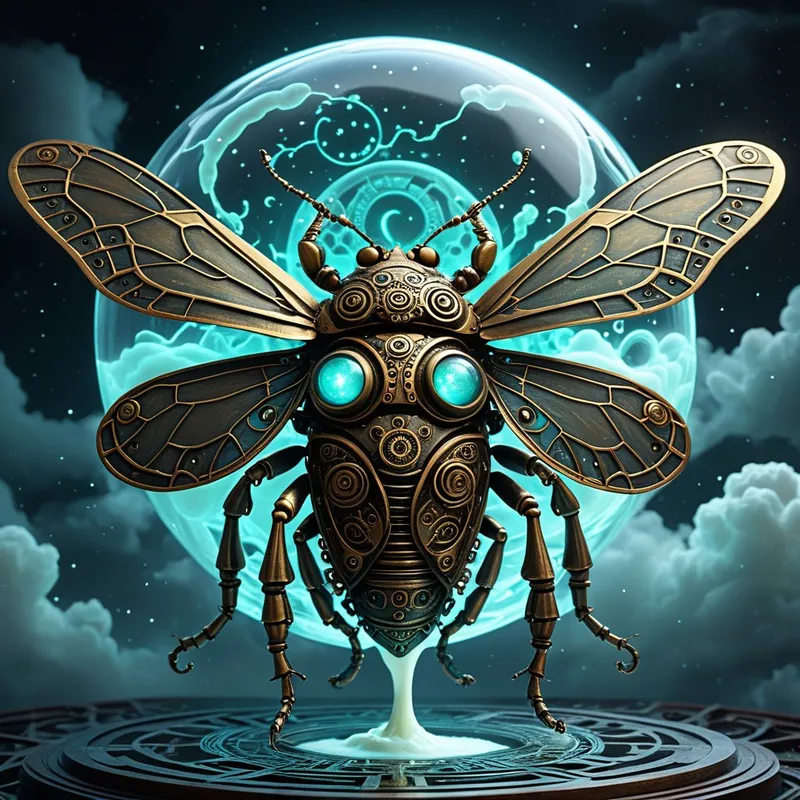
She summoned from the depths of Tartarus a spirit of pure, relentless agitation. She shaped it not as a monster of scale and tooth, but as a common, hateful thing given divine power: the Gadfly. Its body was forged of shadow and irritation, its buzz the sound of a mind unraveling, its sting a needle of fiery madness.
She sent it down to the earth. Wherever the white heifer stood, the Gadfly found her. Its sting was not meant to kill, but to move. To exile. With each piercing jab, Io would jerk, bolt, and flee in a frenzy of pain. The sting drove her from her homeland, across the strait that would bear her name—the Ionian Sea—and into the unknown wilds. For years, she ran. She traversed rocky crags where the wind howled her name, forded icy rivers that numbed her hooves, and crossed deserts where the sun burned her white hide. The Gadfly was her constant shadow, her personal Fury, a buzzing, stinging manifestation of a goddess’s unforgiving gaze. Her journey was a map of anguish, from Greece to Egypt, where, at last, broken and transformed by her suffering, she was restored to her form by the touch of Zeus along the Nile’s forgiving bank. The Gadfly, its divine purpose spent, vanished. But the memory of its sting was etched into the soul of a continent, and into the lineage of heroes she would bear.

Cultural Origins & Context
This episode is woven into the epic tapestry of Homer’s world and later elaborated by poets like Hesiod and the Roman Ovid. It was not a standalone myth but a crucial link in a genealogical chain, explaining the origins of later figures like Cadmus and Minos. Its primary function was etiological—to explain the name of the Ionian Sea and to connect Greek ancestry to the ancient, mysterious land of Egypt.
More profoundly, it served as a paradigm for understanding suffering. For the ancient Greek listener, Io’s torment was not random. It was a direct consequence of divine conflict, a demonstration that the gods used the natural world (even its smallest, most irritating parts) as instruments of their will. The Gadfly gave a face, a sound, and a sensation to the concept of a curse—a persecution that was active, intelligent, and inescapable. It was a story told to make sense of inexplicable hardship, of plagues of locusts, of fevers that drove men to madness, and of the feeling of being pursued by an unseen, relentless fate.
Symbolic Architecture
The Gadfly is one of mythology’s most potent and uncomfortable symbols. It represents consciousness itself, but of a maddening, persecutory kind. Io’s transformation into a heifer is a state of unconsciousness, a beautiful but trapped existence. The slaying of Argus liberates her from external surveillance, but it is the Gadfly that forces upon her an internal crisis. It will not let her rest, graze, or forget.
The Gadfly is the sting of reality that prevents escape into blissful ignorance. It is the painful awakening that demands movement, however agonizing.
It is the embodied voice of Hera’s sacred law—the law of boundaries, contracts, and consequences—violated by Zeus’s infidelity. Thus, it also symbolizes the return of the repressed. The secret affair, hidden by mist and transformation, must be exposed and its price paid through a very public, very physical ordeal. The Gadfly ensures the secret cannot stay buried; it chases it across the known world.
Psychologically, the Gadfly is the archetypal persecutor within the psyche. It is the nagging doubt, the obsessive thought, the neurotic symptom, the anxiety that will not let us be comfortable in our self-deceptions. It is the part of the Self that, like Hera, insists on truth and order, even if that truth is devastating.
The Dreamer's Resonance
When the pattern of the Gadfly arises in modern dreams, it rarely appears as a literal insect. Its presence is felt somatically and situationally. The dreamer may be fleeing an unseen pursuer, feeling a persistent, irritating buzz in their ears, or experiencing a series of frustrating, small obstacles that prevent rest or completion of a task. They may dream of being trapped in a role or body that feels alien (the heifer), while their mind screams in protest.
This dream motif signals that the psyche is in a state of forced individuation. A comfortable, perhaps inauthentic, state of being (a job, a relationship, a self-image) has been shattered by an incursion of uncomfortable truth or desire (Zeus’s touch, the secret). The conscious ego has tried to hide this change, to transform it into something more acceptable. But the Self’s integrative, ordering principle (Hera) has sent an agent to disrupt this false peace.
The dream is a reflection of the psychological “sting” that is actively preventing regression. It is unpleasant, even torturous, but its function is to drive the dreamer forward out of a stagnant, unconscious condition. The somatic feeling of irritation, itch, or prickling anxiety upon waking is the bodily echo of this psychic goad.

Alchemical Translation
The alchemical journey is one of solve et coagula—dissolution and coagulation. Io’s myth is a perfect model. Her original form is dissolved (into mist, then into beast). She is then subjected to the nigredo, the blackening: the torment of the Gadfly, a period of chaotic, painful wandering that feels like madness. This is not a punishment in the alchemical view, but a necessary purification.
The Gadfly performs the alchemical function of the separatio. It separates Io from her homeland, her old identity, and any illusion of safety, forcing her essential nature to be refined in the crucible of exile.
Her frantic journey across land and sea is the arduous, often aimless-seeming stage of transformation where the old self is broken down. The Gadfly is the relentless heat of the alchemist’s furnace. It does not allow the material to cool and revert; it maintains the pressure of transformation.
Finally, reaching Egypt—a ancient symbol of wisdom, the underworld, and rebirth—represents the albedo, the whitening. She emerges from the ordeal, not simply returned to her old nymph-self, but fundamentally changed by the journey. She gives birth to a dynasty. The psychic transmutation is complete: the unconscious, persecuted creature (the heifer) has been united with the spirit of transformative suffering (the Gadfly’s journey) to produce a new, more complex, and resilient consciousness. For the modern individual, the myth teaches that the very thing that torments and pursues us—the anxiety, the crisis, the unbearable truth—may be the exact, ruthless agent required to drive us out of our personal Egypts and toward our own, hard-won Nilebanks of self-reclamation. The goal is not to kill the Gadfly, but to understand its divine, if terrible, purpose, and to complete the journey it insists we take.
Associated Symbols
Explore related symbols from the CaleaDream lexicon: