Fountain of Youth Myth Meaning & Symbolism
A timeless myth of a hidden, life-renewing spring, representing humanity's quest for immortality and the deeper alchemy of the soul.
The Tale of the Fountain of Youth
Listen. Beyond the maps, past the edge of the known world, where the sun drowns in a sea of whispers, it waits. It is not a place for the faint of heart or the clear of purpose. It is a rumor carried on salt-stained lips, a glimmer in the eye of a dying king, a sigh in the wind that rustles through palms older than empires.
They say the land itself conspires to hide it. Rivers run backward to mislead. Paths fold in upon themselves at dusk. Beasts with eyes of molten gold guard passes that lead only to precipices of despair. The seeker must navigate not just swamp and mountain, but the labyrinth of their own longing. Some seek it for glory, to return un-aged to a kingdom that forgot them. Others seek it for love, to preserve a moment of bliss untouched by decay. Most seek it simply because they cannot bear the weight of the moon's relentless cycles on their skin.
One such seeker, bones aching with years not yet lived, followed the star that falls but never lands. Through jungles that sang with the voices of forgotten things, across deserts where the sand held the memory of ancient oceans, they journeyed. Their guide was a dream of water that did not merely quench, but remembered. Their companions were doubt and a hope so fragile it was like carrying a candle through a hurricane.
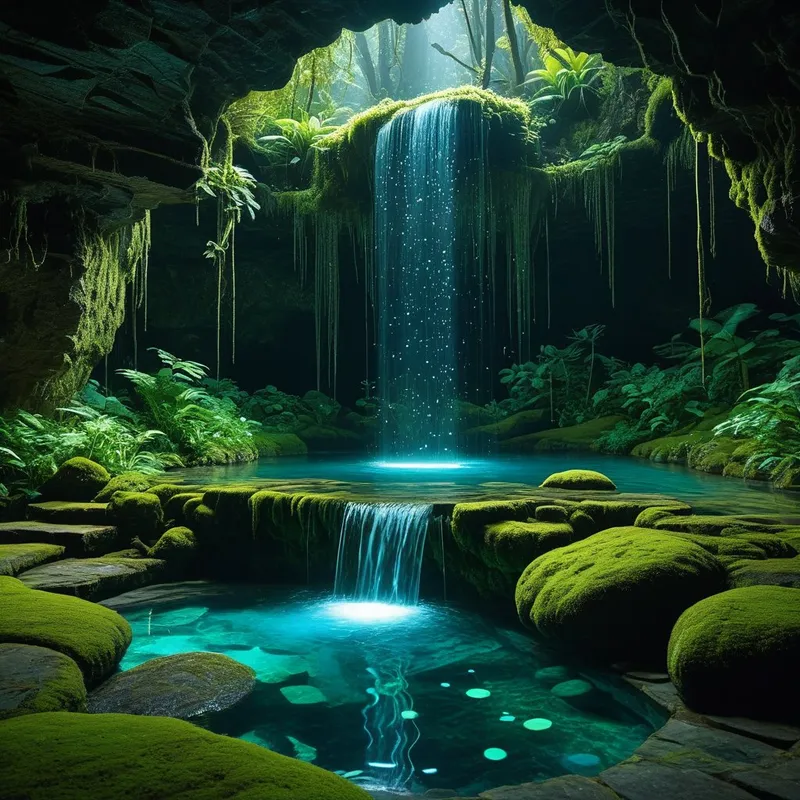
And then, one evening, when the veil between worlds grew thin, they found it. Not with a fanfare, but with a silence so profound it had a sound. A clearing, bathed in the light of a permanent, gentle dawn. In its heart, a spring bubbled from a cleft in a stone veined with silver and lapis. The water was not blue, nor clear, but held the color of time itself—a shimmering, depthless opal. The air smelled of rain on the first day of creation, and of deep, damp earth. To drink, the stories whisper, was not to feel a change, but to feel the absence of all change. The weary body forgot its weariness; the anxious mind forgot its tomorrows. It was a return to the source, a moment outside the current.
But here the tale forks, like the roots of the great tree that shades the spring. Some say the seeker drank deeply and walked back into the world, a stranger to time, forever out of step with the dance of life and death. Others say that as they bent to drink, they saw their reflection—not as they were, nor as they wished to be, but as a ripple of pure, unbounded potential. And in that seeing, they understood. They cupped their hands, let the water touch their lips, and then let it fall back, its gift not taken but acknowledged. They turned and left the glade, and the path home felt different underfoot. The journey had changed the destination.

Cultural Origins & Context
The Fountain of Youth is a myth without a single birthplace, a story that has sprung independently from the deep, shared aquifer of human fear and desire. Its most famous literary association is with the 16th-century Spanish explorer Juan Ponce de León, who was purported to have sought it in Florida. This version, blending European medieval lore of the Earthly Paradise with New World exploration narratives, served colonial ambitions, framing the unknown continent as a repository of magical resources.
But the archetype is ancient and global. In the Mahabharata, there is mention of a "Water of Life." Alexander the Great, in the Alexander Romance, searches for the "Water of Life" in the Land of Darkness. Chinese Taoist legends speak of sacred peaches or springs on the mythical Penglai that confer longevity. These stories were not mere fantasies; they functioned as cosmological anchors. They placed the ultimate prize—freedom from humanity's most fundamental limitation—within the geography of the possible, however remote. They were told by bards to kings, by shamans to initiates, and by sailors around dim lanterns, serving as a narrative compass pointing toward hope, a reason to venture beyond the horizon, and a metaphor for the spiritual quests embedded within their own cultural practices.
Symbolic Architecture
The Fountain is perhaps the ultimate symbol of the prima materia of the soul—the unmanifest source of life before it enters the stream of temporal existence.
The Fountain does not grant more time; it offers an escape from time's river, a return to the timeless ocean from which all rivers flow.
Psychologically, it represents the ego's desperate, often literal-minded, attempt to solve the problem of mortality and decay. The "youth" it promises is not merely biological, but a state of psychic innocence, energy, and potential untouched by the scars of experience. The arduous journey to find it symbolizes the necessary descent into the unconscious—the swamps and shadows of one's own psyche—to confront what one truly seeks. Is it endless physical life, or is it the vitality that comes from being fully, authentically alive?
The Fountain itself is an archetype of the Self. It is the central, nourishing, and renewing core of the psyche. The common narrative fork—drinking and becoming immortal versus recognizing and turning away—maps a critical psychological crossroads. The first is inflation, the ego identifying with the eternal and thus severing its connection to human life, leading to a cursed, isolated existence. The second represents integration; the ego touches the transcendent Self, receives its renewing energy, and returns to the human world transformed, carrying that vitality within the cycle of life and death.
The Dreamer's Resonance
When the Fountain of Youth appears in modern dreams, it rarely manifests as a literal spring. It may be a hidden room in a house with a special tap, a vial of glowing liquid in a laboratory, or a secret website with a "reset" button for the body. The dreamer is often in a state of transition, loss, or feeling "stuck" in a life stage. The somatic feeling is one of acute yearning mixed with frantic searching.
This dream motif signals a profound psychological process: the soul's craving for renewal. The dreamer may be confronting aging, the end of a relationship, a career plateau, or a loss of passion. The unconscious is presenting the archetypal solution—a return to the source. The conflict in the dream (finding it but being unable to reach it, or the water turning to sand) often mirrors the dreamer's inner conflict between a regressive fantasy (wishing to go back to a simpler time) and the more challenging path of forward integration (finding new sources of vitality appropriate to their current stage of life). The dream is an invitation to ask: "What in me feels old, dry, or depleted? And what is the true source of renewal I am seeking?"

Alchemical Translation
The alchemical journey of the Fountain of Youth myth is not about preserving the lead of our youthful form, but transmuting the lead of our fear of time into the gold of timeless presence. It models the individuation process perfectly.
The initial nigredo, or blackening, is the despair of mortality, the feeling of decay, the midlife crisis that sends the ego on its desperate quest. The albedo, or whitening, is the glimmer of hope, the rumor of the Fountain, the beginning of the inward/outward journey of self-discovery. The crucial stage is the citrinitas, or yellowing, often represented by the moment at the Fountain's edge. Here, the seeker must dissolve the literal goal (eternal youth) in the waters of deeper understanding.
The true elixir is not consumed; it is realized. It is the recognition that the Self, the core of one's being, is already eternal, and that personal wholeness comes from aligning the mortal ego with that immortal center.
The final rubedo, or reddening, is the return. The seeker does not return with a younger body, but with a renewed spirit. The vitality of the Fountain is integrated. This is the alchemical "elixir of life"—not a substance that halts time, but a state of consciousness that can find depth, meaning, and vibrant engagement within time's flow. The myth teaches that our quest should not be to find a spring that stops the clock, but to become a wellspring ourselves, from which authentic life, in every season, can continually flow.
Associated Symbols
Explore related symbols from the CaleaDream lexicon: