Flower Bride Myth Meaning & Symbolism
A tale of a king who must win a goddess of spring, disguised as a hag, to secure his throne and the land's fertility through love, not force.
The Tale of Flower Bride
Listen now, and let the fire’s crackle become the rustle of leaves in the sacred grove. In the days when kingship was a covenant with the land itself, there lived a king named Eochaid. He was strong, his rule just, but the land beneath his feet grew weary. The wells ran low, the cattle bore thin milk, and a subtle chill lingered in the air even as the sun climbed high. The kingdom was a body, and its spirit was fading.
In his hall, his advisors spoke in hushed tones of an old law, a deeper magic. The true king must be wed to the land, personified in the Flower Bride. She was Étaín reborn, the very essence of spring’s promise, but she was hidden, her form a riddle. She would appear not in glory, but in disguise, testing the heart that sought the crown.
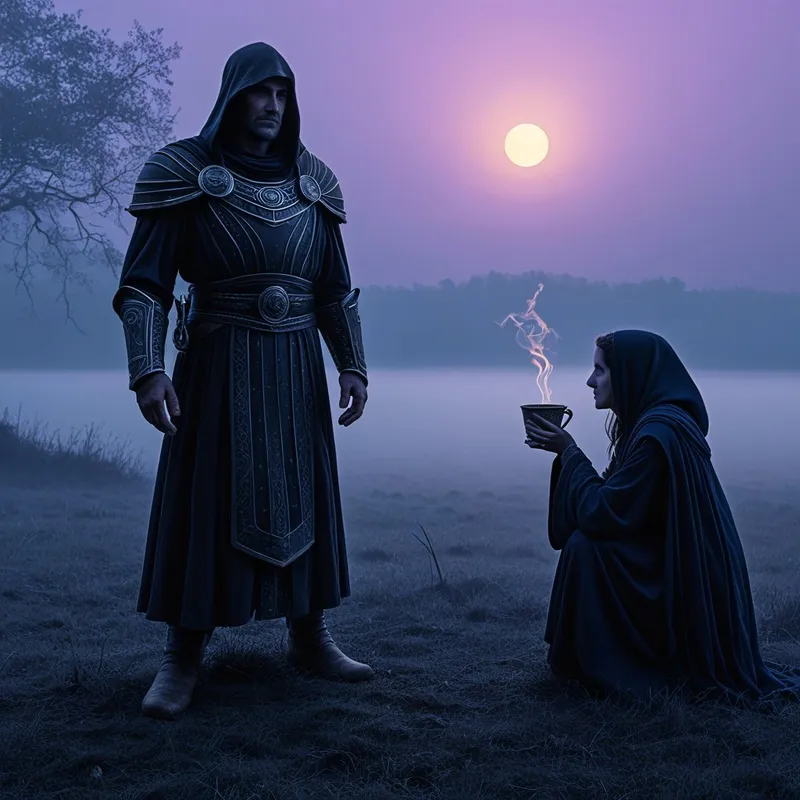
Driven by a thirst he could not name, Eochaid rode out from his stone fort. He forded rivers where the salmon slept and climbed hills where the wind spoke in tongues. And there, at a lonely crossing where the water ran silver over dark stones, he found her. Not a maiden crowned with blossoms, but a hag of such profound wretchedness it stole his breath. Her cloak was rags, her hair like frost-bitten reeds, her skin mapped with the lines of countless winters. She sat by the ford, a creature of the threshold, watching him with eyes that held the depth of a bog pool.
“Who seeks to pass the sidhe mound’s shadow?” she croaked, her voice the sound of dry leaves. The warriors behind Eochaid recoiled, muttering of ill omens. But the king, in that moment, felt the weight of his barren kingdom. He saw not a monster, but a profound loneliness. Dismounting, he knelt in the cold stream, his fine cloak soaking in the water. He offered not a command, but his own drinking horn, filled from the clear current.
“I seek nothing but to offer you drink, mother of the ford,” he said, his voice steady. “The journey is long, and the water is cold.”
A change, subtle as the first shift from night to dawn, flickered in her ancient eyes. She took the horn, her gnarled fingers brushing his. As she drank, Eochaid did the unthinkable. He leaned forward and placed a kiss upon her withered cheek. It was not an act of desire, but of radical, compassionate recognition—an acknowledgment of a dignity unseen.
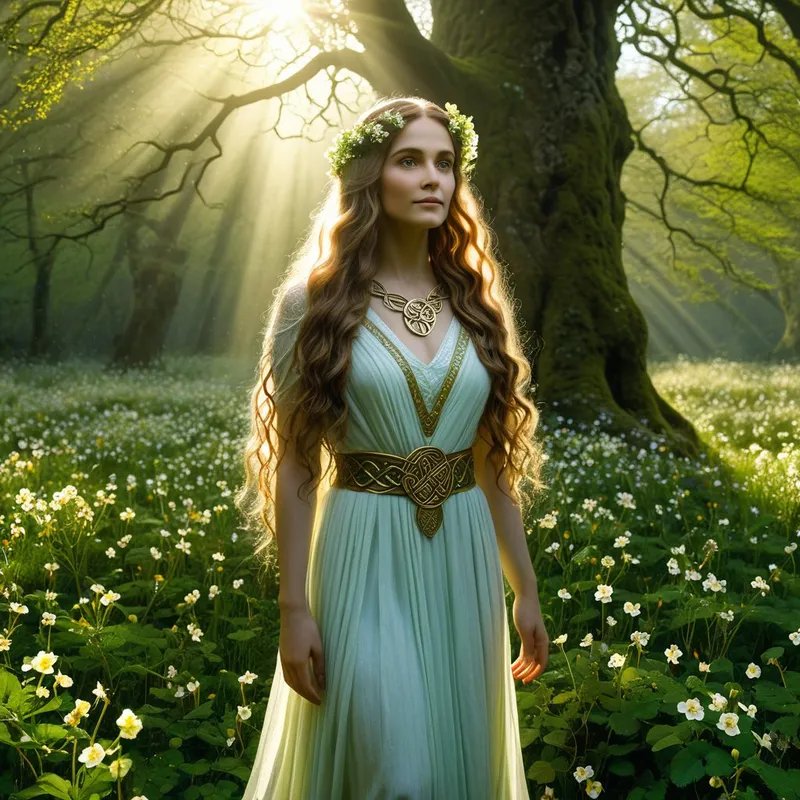
The world held its breath. Then, a sound like the snapping of a thousand brittle twigs. The ragged cloak fell away, not to the ground, but into a swirl of light and petals. Where the hag had crouched now stood the Flower Bride in her terrible beauty. Her hair was a cascade of gold woven with primrose and hawthorn, her skin as fresh as apple blossom, and her eyes held the shifting green of the forest canopy. The air warmed, and the scent of crushed herbs and rich earth rose around them.
“You have looked upon the face of the land in its winter,” she said, her voice now a melody of streams and birdsong. “And you did not turn away. You offered sustenance and honor. Therefore, you shall have me in my summer.” She took his hand, and where their fingers touched, the grass at the ford’s edge burst into flower. “With me comes the sovereignty of this land. Rule not over it, but with it, and it will give you its abundance.”
And so Eochaid, who had knelt as a supplicant, rose as the true king, his queen the very spirit of the blossoming earth beside him. The wells bubbled forth, the herds grew fat, and the people knew the long winter of the spirit was over.
Cultural Origins & Context
This myth, in its many variants, is a cornerstone of the Irish sovereignty cycle. It was not mere entertainment but a sacred charter for kingship, recited by fili (poet-seers) during inauguration rites. The story encoded a fundamental Celtic principle: the king’s legitimacy was not derived from bloodline or conquest alone, but from a sacred marriage to the Sovereignty Goddess.
The “Celtic” world was animistic, perceiving the land as a conscious, feminine entity. Prosperity—good harvests, healthy animals, victory in battle—was a direct result of her favor. The myth of the Flower Bride served as a powerful societal check. It taught that true power (imbas) came from respect, reciprocity, and the ability to perceive the sacred in the seemingly desolate. The hag at the ford is the land in its raw, untamed, and demanding state; the king who recognizes her worth is worthy of her transformed, fertile aspect. The story was a living map of the relationship between humanity and the wild, divine world.
Symbolic Architecture
At its core, the myth is a profound allegory for the integration of opposites and the nature of authentic power.
The true king is not he who conquers the wilderness, but he who recognizes the goddess within it.
The Ford is the ultimate symbol of the liminal—a place “in-between” worlds, conscious and unconscious, human and Otherworld. All true transformation happens at such thresholds. The Hag/Flower Bride duality represents the full cycle of nature (death and rebirth) and the full spectrum of the feminine archetype: the Cré (earth) and the Cailleach. To gain one, you must willingly embrace the other.
Eochaid’s journey is an internal one. His initial kingdom’s barrenness reflects a psychic state of disconnection from the animating, life-giving principle (the anima). His actions at the ford—kneeling, offering drink, kissing—are not heroic feats of strength, but rituals of humility, sustenance, and love. He exchanges the paradigm of dominance for one of relationship. The transformation he witnesses is not something he does to the hag, but something that unfolds through his correct perception and action.
The Dreamer's Resonance
When this mythic pattern stirs in the modern dreamer, it signals a profound crossroads in relating to one’s own inner “landscape”—the psyche, the body, or a creative endeavor. Dreaming of a neglected, ugly, or desolate figure in a transitional space (a shore, a bridge, a hallway) often points to an aspect of the self or a relationship that has been rejected for its perceived worthlessness or difficulty.
The somatic feeling is often one of revulsion mixed with a pull of fate. The dream ego, like Eochaid, is confronted with a choice: to recoil into familiar, sterile control, or to move toward the reviled figure with an offering of attention. This is the psyche’s invitation to shadow-work. The “hag” may represent repressed creativity, a denied vulnerability, a physical ailment ignored, or the raw, untamed parts of one’s nature deemed unacceptable. The act of “offering drink” in the dream—perhaps a simple gesture of aid, a word spoken, or even just staying present—is the first step in rehydrating a parched soul-territory.
Alchemical Translation
The myth models the alchemical process of individuation, specifically the conjunctio or sacred marriage. The goal is not to defeat the shadow (the hag) but to unite with it, thereby unleashing its latent, transformative power.
The gold of the psyche is not found by mining only the bright quartz, but by embracing the whole, dark ore of the self.
Eochaid’s Barren Kingdom is the ego-consciousness ruling in isolation, effective but ultimately lifeless and unsustainable. The Quest is the call from the Self, the central archetype of wholeness, disturbing this stagnant equilibrium. The Hag at the Ford is the prima materia—the despised, rejected, yet utterly essential raw material of transformation. She is the unintegrated anima/animus, the complex, the symptom.
The Kiss is the critical operation. In alchemy, it is the rubedo, the reddening, an act of passionate commitment to the process. Psychologically, it is the full, conscious engagement with what we have feared or despised. It is accepting depression as a messenger, listening to anxiety as a guide, or honoring the body’s breakdown as a demand for change. This conscious, loving engagement (amor in alchemy) is the catalyst.
The resultant Transformation is not just the appearance of the “Flower Bride” (the integrated, life-giving anima, creative flow, or psychological fertility) but the birth of the Sovereign Self. The individual no longer rules over their inner world with brute willpower, but enters into a collaborative, respectful relationship with its depths. The “land” of the psyche becomes fertile: insights bloom, energy flows, and one’s outer life becomes an authentic expression of this inner sacred marriage. The myth teaches that our deepest power and vitality are always accessed through the gate of compassionate recognition—first of the forsaken parts within ourselves.
Associated Symbols
Explore related symbols from the CaleaDream lexicon: