
Fisher King's Feast Myth Meaning & Symbolism
A wounded king, a barren land, and a hero who fails to ask the vital question, revealing the deep link between sovereign consciousness and collective vitality.
The Tale of Fisher King's Feast
Listen, and hear a tale not of glorious battle, but of a silence that screams. In the heart of the realm of Logres, a sickness had taken root. The rivers ran thin and bitter, the trees bore no fruit, and the people moved as shadows, their laughter a forgotten memory. This was the Wasteland.
At its silent center lay the castle of Carbonek. Its lord was known only as the Fisher King. Once a mighty warrior, he now sat, day upon day, in a small boat upon the castle’s dark, interior mere, fishing with quiet despair. A wound from a poisoned spear festered in his thigh, a wound that would not close, a wound that bled the vitality from the very soil.
Into this twilight realm came a seeker. Sometimes he is called Perceval, the naive youth; sometimes he is Galahad, the destined one. Guided by fate and folly, he finds the castle where all others see only barren hills. He is welcomed as if long-awaited. The Fisher King, pale and regal in his suffering, bids him sit.
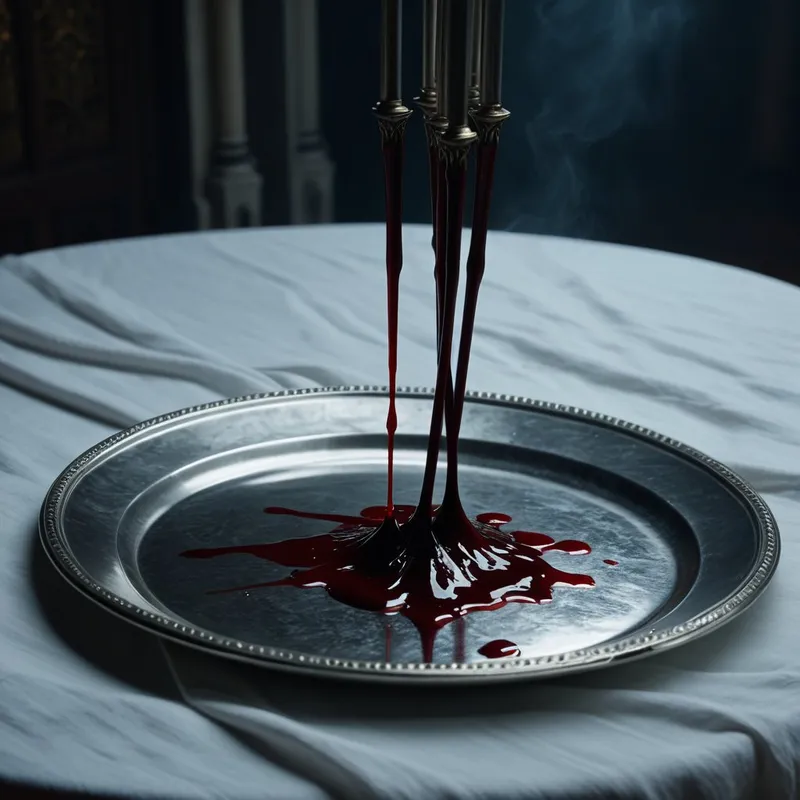
Then begins the Feast. But it is a feast of ghosts. The hall is filled with knights and ladies, yet their eyes are hollow. A profound, aching silence hangs over the table. The food is scant, the wine tastes of dust. Then, a procession enters, a vision that pierces the gloom: a maiden carries a Grail that shines with its own celestial light, so radiant that the candles dim in shame. Behind her, a youth bears a Lance, from whose silver tip a single, perfect drop of blood wells and falls. Another carries a platter of silver.
They pass through the hall, and the air thrums with unasked potential. The seeker’s heart pounds. He senses a mystery so vast it steals his breath. He knows, in the marrow of his soul, that a question hangs in the air, a key that could turn the lock. Whom does the Grail serve? The words form in his mind. But a false courtesy, a knightly training that values silence over salvation, seals his lips. He fears to offend. He remains mute.
The procession departs. The feast ends. He is given a bed for the night. But when dawn’s grey light filters in, he finds himself alone on the windswept moors. The castle of Carbonek has vanished. The opportunity has passed. The Wasteland remains, and he learns, from a weeping maiden, the terrible cost of his silence: had he asked the healing question, the King would have been whole, and the land restored. His failure is the land’s perpetual winter.
Cultural Origins & Context
This haunting core of the Fisher King myth emerges from the rich tapestry of the Arthurian cycle, most profoundly in the 12th-century French verse romance Perceval, or the Story of the Grail by Chrétien de Troyes, and later elaborated in the Welsh Peredur and the vast German Parzival by Wolfram von Eschenbach. It was not a fixed dogma but a living story, shaped by the troubadours and conteurs who carried it from court to court.
Its societal function was multifaceted. For a feudal society, it was a stark parable about the health of the ruler and the health of the realm—the king’s body was the land’s body. For a culture steeped in Grail mysticism, it framed the ultimate spiritual quest not as a physical battle but as an act of compassionate consciousness. The story was told to awaken, to unsettle, and to pose the eternal, uncomfortable question to the listener: What vital inquiry are you failing to make in your own life and community?
Symbolic Architecture
The myth is a perfect symbolic engine of the wounded psyche. The Fisher King is the archetypal Wounded Sovereign. His injury is not merely physical; it is a psychic stagnation, a trauma that has arrested the flow of life-energy (libido). The Wasteland is the externalized reality of this inner condition—a life rendered sterile, repetitive, and devoid of meaning.
The Grail is not an object to be possessed, but a process to be served. It represents the transcendent function, the mysterious center of the psyche that calls for integration.
The Lance is its dynamic counterpart, the piercing, masculine principle of spirit and will that has become destructive, turned against the self. The silent feast is the collective psyche, the "court" of our inner figures, waiting in paralyzed anticipation for a new command from the center. Perceval’s failure is the ego’s failure to engage the Self. He observes the mystery but does not relate to it. He sees the symbol but does not ask what it means, what it requires.

The Dreamer's Resonance
When this myth stirs in the modern dreamer, it often manifests as dreams of profound, frustrating omission. You dream of being in a crucial meeting but your voice is gone. You are handed a vital key but drop it. You see a loved one in distress but are frozen, unable to ask if they are okay. The somatic feeling is one of constriction in the chest and throat—the unasked question lodged as physical tension.
Psychologically, this signals a critical moment of individuation where the conscious attitude (Perceval) has encountered a deep, transformative content from the unconscious (the Grail procession) but has defaulted to an old, adaptive pattern ("I must not be rude," "It's not my place"). The dream is diagnosing a failure of nerve, a reluctance to bear the responsibility that consciousness demands. The Wasteland in the dream may be a job, a relationship, or a creative life that has become arid and joyless, directly linked to an unattended inner wound.

Alchemical Translation
The alchemical work modeled here is the solve et coagula—the dissolution of the old, mute king and the coagulation of a new, questioning consciousness. The first, failed visit to Carbonek is the nigredo, the blackening. It is the necessary, humiliating recognition of one’s own unconsciousness, the realization that one has been asleep at the most important moment.
The long, wandering quest that follows for Perceval is the albedo, the whitening, a purification through suffering and the slow cultivation of true compassion—not polite silence, but engaged inquiry. The healing question, "Whom does the Grail serve?" is the philosopher's stone itself. It transmutes the situation because it reorients the ego’s stance from one of passive observation or greedy acquisition to one of service and relationship.
The cure is not in the answer, but in the courage to ask. The question itself is the lance that pierces the stagnation, allowing the waters of life to flow again.
To ask "Whom does the Grail serve?" is to ask: What is the purpose of this deep, mysterious life-energy in me? What in my kingdom (my psyche, my life) is it meant to nourish? This act of conscious questioning reintegrates the wounded sovereign (the neglected Self) with his realm. The bleeding stops. The fisher becomes a king again. And the land, the lived experience, blooms. The feast becomes real, nourishing, and shared. The myth teaches that our personal vitality and the vitality of the world we inhabit are not separate. They are healed by the same courageous, compassionate act of conscious engagement.
Associated Symbols
Explore related symbols from the CaleaDream lexicon: