
Fili Myth Meaning & Symbolism
A poet's perilous journey to the Well of Wisdom, facing the guardian's challenge to drink from the source of all knowledge and inspiration.
The Tale of Fili
Listen now, and let the fire’s crackle become the rustle of oak leaves in a sacred grove. Let the smoke carry you to a time when the world was thinner, and the veil between the seen and the unseen was a mere breath.
In the land of the Tuatha Dé Danann, before the coming of iron, there lived a young man whose heart beat in time with the wind through the reeds and the sighing of the hills. His name is lost to us, for he had not yet earned one that would echo in the halls of kings. He was but an apprentice, a seeker of the craft of the Fili. For seven years he had studied the complex meters, memorized the genealogies of gods and heroes, and learned to trace the secret history of the land in the patterns of stars and stones. Yet, his verses were clever, not inspired; they were correct, but they held no fire. They could not heal a chieftain’s sickness or blight an enemy’s crops. They lacked the imbas, the all-knowing poetic frenzy that flows from the source.
Driven by a hollow yearning, he sought his master, an old Fili whose eyes were like deep pools. “Master,” he said, his voice trembling, “I have the words, but not the Word. I have the tune, but not the Truth.” The old seer regarded him, not with pity, but with a grave knowing. “You seek the Imbas Forosnai,” he whispered. “It is not taught; it is drunk. You must go to the source.”
And so, guided by riddles and star-lore, the apprentice journeyed for nine days and nights. He passed through forests where shadows whispered, and over mountains that remembered the footsteps of giants. His final guide was the sound of water—not a roar, but a deep, silent hum that vibrated in his bones. It led him to a cavern mouth, hidden by thorn and mist. Within lay the Well of Segais.
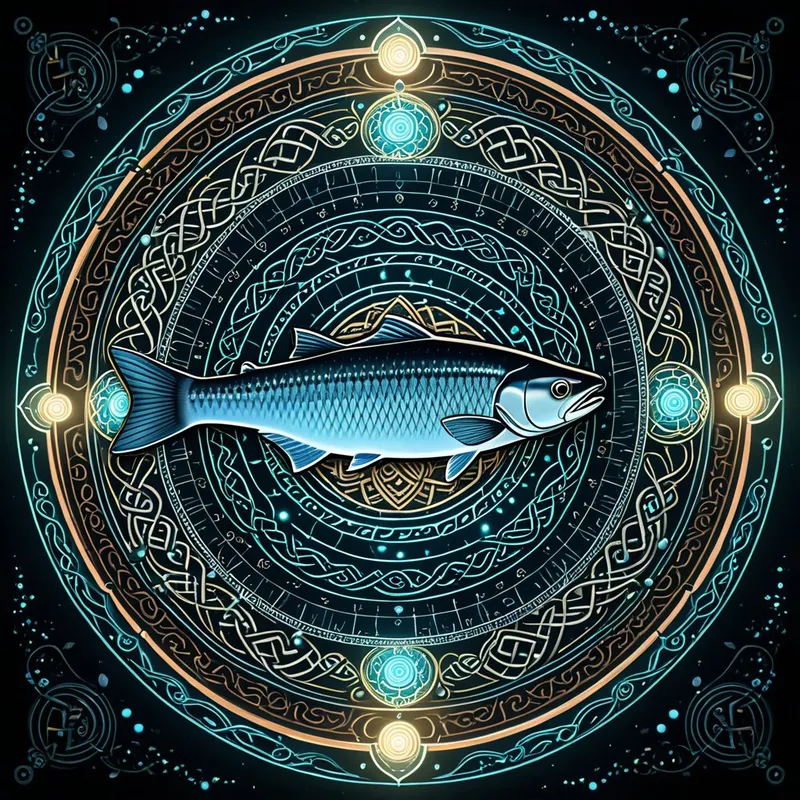
The pool was black and still, a mirror to the stone ceiling. Over it grew nine sacred hazel trees of Buan, their branches heavy with crimson nuts. As the nuts dropped into the water, they were consumed by the Salmon of Wisdom, whose spotted side flashed like lightning in the gloom. This was the source: every ripple contained a history, every bubble a prophecy.
But the well was guarded. Not by a monster of claw and fang, but by a presence—the Boann, or perhaps the spirit of the well itself. A voice, liquid and ancient, echoed from the stones. “To drink is to know. To know is to be responsible. The waters do not grant skill; they grant sight. And sight can be a curse. Will you drink, knowing you may see the sorrow woven into every joy, the death seed in every birth? Will you carry the weight of the world’s truth?”
The apprentice stood at the brink, his thirst a physical pain. He saw his future: not fame, but solitude; not just praise, but the burden of speaking unbearable truths. He hesitated. Then, he thought not of the glorious verses he would craft, but of the old, blind king at home who needed a prophecy to save his people from famine. He thought of the land itself, suffering in silence. His desire shifted from personal glory to a vessel’s duty.
“I will drink,” he said, his voice now steady. “Not for myself, but for the song that needs to be sung.”
He cupped his hands, broke the obsidian surface, and brought the water to his lips. It was cold as a winter stream and sweet as summer mead. As it touched his tongue, the cavern dissolved. He did not learn new facts; he remembered. He remembered the birth of rivers, the conversations of stones, the love and fury of the gods. The knowledge flooded him, not as words, but as a direct, somatic knowing. He gasped, and his gasp became his first true poem—a spontaneous incantation that made the stones glow and the water churn. The salmon leapt, and in its eye, he saw his own reflection, now ancient and young simultaneously. He had passed the test. He was no longer an apprentice. He was a Fili.

Cultural Origins & Context
The figure of the Fili (plural: filid) was central to the Gaelic world, particularly in early Ireland. More than a mere poet, the Fili was a seer, historian, judge, and custodian of sacred law (senchas). Operating within a rigorous oral tradition, they underwent up to twelve years of training to master hundreds of complex poetic forms, genealogies, and legal precedents. Their role was societal and cosmological: to maintain the memory of the people, to offer counsel to kings (whose legitimacy they could bless or undermine), and to mediate between the human community and the Sídhe.
The myth of the quest for imbas reflects the initiatory structure of this path. Inspiration was not considered a passive muse but a dangerous, ecstatic state accessed through techniques like the "illumination of song" or, as in the tale, a direct encounter with a numinous source like the Well of Segais. This well, often associated with the river Boyne and the goddess Boann, is a core Celtic symbol of the source of all wisdom, guarded and given only to those who prove their worth. The myth was not just a story but a map of the psychic ordeal required to hold the prestigious and perilous office of the truth-speaker.
Symbolic Architecture
At its heart, this myth is about the transformation of information into wisdom, and of ego into vessel. The apprentice begins with knowledge (fios) but seeks inspiration (imbas). This is the journey from the head to the heart, and finally, to the gut—the seat of true, embodied knowing.
The hazelnut is condensed potential; the water is the fluid medium of consciousness; the salmon is the psyche that integrates them. To eat the nut is to consume knowledge; to become the salmon is to be transformed by it.
The nine hazel trees signify the completeness and sacred nature of this knowledge (nine being a potent Celtic number). The guardian’s challenge is the critical pivot: it transmutes the seeker’s motivation from personal acquisition ("I want to be a great poet") to sacrificial service ("The truth must be spoken"). This is the alchemy of vocation. The wisdom does not belong to the Fili; the Fili belongs to the wisdom. He becomes a conduit for a voice larger than his own.
The Dreamer's Resonance
When this myth stirs in the modern unconscious, it often manifests as dreams of seeking a hidden source—a forgotten spring, a sealed book, a encrypted file. The dreamer feels a profound thirst for meaning, a sense that their current knowledge is hollow or insufficient. They may dream of being tested at the threshold of a library, a data center, or a therapist's office, faced with a choice that feels immensely consequential.
Somatically, this process can feel like a tightening in the throat (the unspoken truth), a pressure in the third eye, or a deep, restless yearning in the chest. Psychologically, it is the Self prompting the ego to surrender its claim to "knowing it all" and to open itself to a more terrifying, holistic form of intelligence. The guardian in the dream—whether a stern figure, a locked door, or a simple, daunting question—represents the psyche’s own integrity test: "Are you seeking this for your resume, or for your soul?"
Alchemical Translation
The myth of the Fili is a precise model for the Jungian process of individuation, specifically the acquisition of the Senex or Sage archetype. The initial stage is the apprenticeship of the persona: mastering societal skills and forms. The crisis is the realization of the persona’s emptiness, what Jung called the "spirit of the times" failing, necessitating a turn to the "spirit of the depths."
The journey to the well is the descent into the unconscious, the confrontation with the psychoid realm where archetypes dwell. The guarded well is the Self, the central archetype of order and totality, which does not give up its treasures lightly.
The pivotal moment—the guardian’s question—is the transcendent function in action. It is the point where the conscious attitude (ambition) is confronted by the unconscious value (service), and a new, third position is synthesized.
To drink after this confrontation is to integrate the contents of the unconscious, not as a possession, but as a sacred duty. The individual is forever altered; they can no longer see the world naively. They carry the "burden of truth," which in psychological terms is the responsibility of consciousness. The inspired Fili who returns is the individuated person, whose speech and actions are now aligned not with personal ambition, but with a dialogue with the deeper Self. Their poetry is their authentic life, crafted from the raw, often difficult, truths of their own experience and the archetypal patterns that give it universal resonance. They have learned the ultimate lesson: true wisdom is not about having answers, but about being a clear vessel for the question that the soul is asking of the world.
Associated Symbols
Explore related symbols from the CaleaDream lexicon: