Fern Seed Myth Meaning & Symbolism
A myth of a magical, invisible seed that grants true sight, guarded by otherworldly forces, revealing the cost and power of hidden knowledge.
The Tale of Fern Seed
Listen, and let the veil thin. In the time when the world was younger and the borders between the green earth and the Sídhe were but a breath apart, there grew a secret. It was not a secret of words, but of sight. It was the Fern Seed.
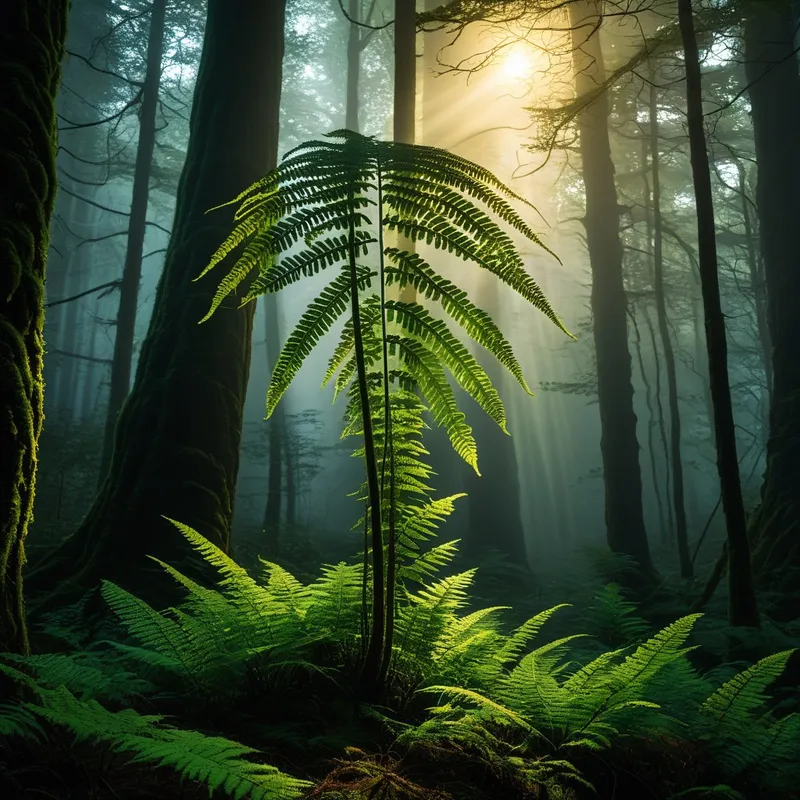
The fern, you see, is a humble plant, carpeting the damp, shadowed floors of the oak woods. It flowers not, nor does it bear fruit as other plants do. It whispers its lineage to the wind through invisible spores. But the elders knew—and the bards sang in hushed tones—that once a year, on the hinge of the world at Midsummer's midnight, the most ancient of ferns would perform a miracle. From its heart, it would bring forth a single, luminous seed. This seed did not glow with a light for the eyes, but with a sight for the soul. To possess it was to see the world as it truly is: to perceive the Aos Sí dancing in their rings, to understand the speech of beasts and the groaning of stones, to behold the threads of fate woven between all living things.
But such a gift was not lightly given. The seed was fiercely guarded. Not by dragons of scale and fire, but by the guardians of the threshold themselves. The Púca would lead the seeker astray with laughter and false paths. The Bean Nighe would wail a warning of sorrows to come. The very air would grow thick with glamour and dread, for the gods do not yield their mysteries to the casual glance.
The seeker had to go alone, armed with nothing but a heart purified by intent and a will tempered like iron. They had to find the sacred fern in the deep wood, blind to everything but faith. At the precise moment, as the old day died and the new was born, they had to spread a pure white cloth beneath the frond and wait. The seed, falling, would be caught—not by hand, for mortal touch would dispel it—but by the sanctified fabric. And in that catching, a pact was made. The world would open its eyes to the seeker, but the seeker, in turn, would forever carry the weight of that vision. The mundane would become a pale ghost of the vibrant, terrible, beautiful truth now permanently unveiled.

Cultural Origins & Context
The belief in Fern Seed is woven deeply into the folk traditions of Ireland, Wales, Scotland, and other Celtic regions. It belongs not to the grand cycles of epic heroes, but to the Dindsenchas, the lore of place, and the practical magic of the common folk. It was a secret held by cunning men and wise women, passed in whispers, a fragment of the old pagan understanding of the world that survived in the hedgerows and hearths long after the coming of new faiths.
Its societal function was dual. On one hand, it was a literal folk belief; instructions for harvesting the seed on Midsummer's Eve (or sometimes St. John's Eve, showing the Christian overlay) were treated as serious, if perilous, magical procedure to gain invisibility or fortune. On a deeper level, it served as a narrative container for a profound cultural value: that true knowledge—spiritual insight, hidden truths—is not academic, but experiential and earned. It is a treasure guarded by the natural and supernatural world, accessible only through ritual, right timing, and personal ordeal. The myth reinforced the idea that the landscape itself was alive with consciousness and that humanity's relationship with it was one of respectful, and often treacherous, negotiation.
Symbolic Architecture
At its core, the Fern Seed is a symbol of latent potential and invisible truth. The fern plant itself, reproducing via unseen spores, is a perfect natural metaphor for hidden processes and the unconscious. Its "flowering" is a reversal of its nature, a miraculous exception that reveals what is always present but never ordinarily manifest.
The seed does not grant new sight, but removes the veil from sight that already exists. The truth was always there; the seeker undergoes the transformation to be able to bear it.
The guardians—the Púca, the Bean Nighe—represent the autonomous, protective mechanisms of the psyche and the world. They are not merely "evil" but are the necessary threshold guardians who test the ego's readiness. They embody the chaos, fear, and confusion that arise when one approaches the core of the Self or a deep truth; they are the resistance of the unconscious to being made conscious without proper preparation.
The ritual—the white cloth, the precise timing—symbolizes the need for a temenos, a sacred and purified space (both externally and internally) to receive a revelation. The seed cannot be grasped by the "hand" of the greedy, controlling ego; it must be received by the "cloth" of a surrendered, receptive soul.
The Dreamer's Resonance
When this myth stirs in the modern dreamer, it often signals a crisis or calling related to perception and hidden knowledge. To dream of ferns, especially glowing or oversized ferns in a deep forest, points to an encounter with the fertile, shadowy ground of the unconscious. Searching for something small, precious, and elusive in such a landscape reflects the soul's quest for a specific, transformative insight—perhaps the true nature of a relationship, one's authentic vocation, or a buried traumatic memory.
The somatic experience in such dreams is often one of acute tension, watchfulness, and a mix of awe and dread. The dreamer may feel they are on the verge of a monumental discovery that is simultaneously desired and feared. Encountering strange, shape-shifting, or ominous figures in the dream are the psyche's Púca—the manifestations of internal resistance, old defense mechanisms, and shadow content that activate to protect the status quo. The psychological process is one of approaching a core complex or a piece of the Self that has remained invisible. The dream is the Midsummer wood; the dreamer is undergoing the initial tests of the guardians.
Alchemical Translation
The myth of the Fern Seed is a precise map for the alchemical stage of illumination within the individuation process. The "lead" of ordinary, conditioned consciousness is to be transmuted into the "gold" of unmediated perception and Self-knowledge.
The first step is nigredo: the darkening, the solitary journey into the forest of the unconscious, often precipitated by a feeling that conventional life has lost its meaning. The seeker feels called to something they cannot see. The confrontation with the guardians is the mortificatio—the dying of the old, naive ego that believes knowledge can be taken without cost. The ego is led astray, frightened, and humbled.
The precise ritual at midnight is the albedo: the purification. The white cloth represents the creation of a conscious, disciplined vessel (the observing ego) strong enough to contain the luminous, autonomous content of the unconscious (the seed). Midsummer represents the conjunctio, the sacred marriage of opposites—the longest day meeting the darkest part of night, consciousness fully engaging with the unconscious.
The final, permanent transformation is not in possessing the seed, but in being seen by the truth. One does not own the vision; one becomes a person for whom the vision is possible.
The resolution—carrying the weight of the vision—is the rubedo, the reddening. This is the integration. The seeker returns to the ordinary world, but it is forever changed. They must now live with the burden and gift of their expanded perception, finding a new way to be in a world that now speaks a more complex, terrifying, and beautiful language. The invisible has become the fundamental reality, completing the psychic transmutation.
Associated Symbols
Explore related symbols from the CaleaDream lexicon: