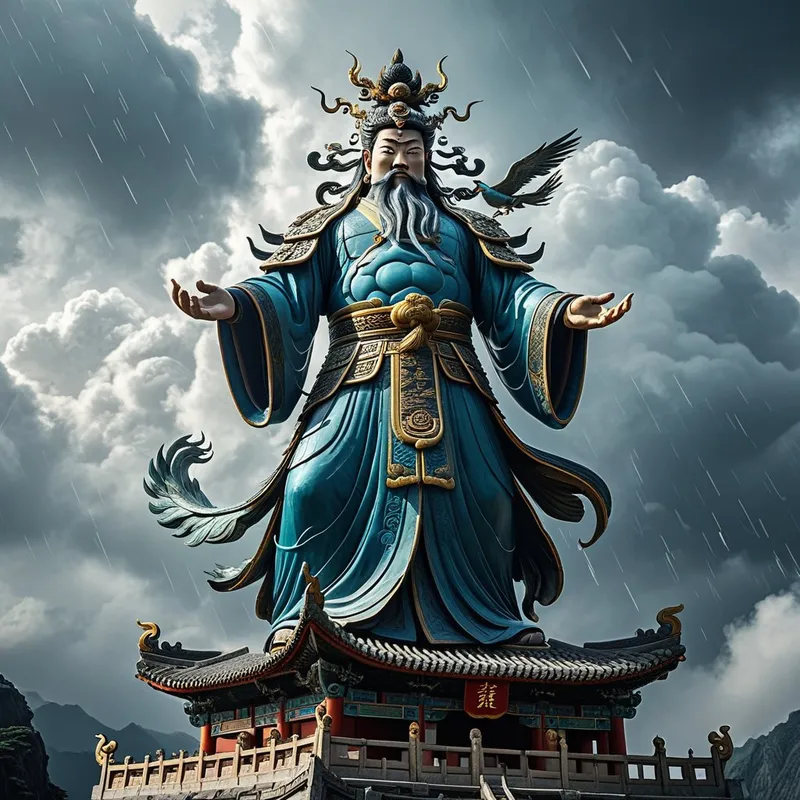
Feng Zheng Myth Meaning & Symbolism
The myth of Feng Zheng, the wind god, tells of a primal force tamed by the Yellow Emperor, symbolizing the integration of wild nature into cosmic order.
The Tale of Feng Zheng
In the time before time was measured, when the world was a canvas of raw elements, the winds were not a gentle caress but a screaming, capricious fury. They answered to no law, bowing to no sovereign of earth or sky. From the deepest caverns of the Kunlun to the farthest eastern shores, chaos rode on every gale. And at the heart of this tempest was Feng Zheng.
He was not a god as we conceive of gods now—benevolent, distant, enshrined. He was a force made manifest: a being with the body of a man but the fierce, unblinking head of a bird, his feathers the color of storm clouds and ash. His voice was the shriek that fells ancient trees; his breath, the cyclone that scours the plains bare. He danced upon the peaks, and mountains trembled. He slept in the valleys, and the air grew thick and still with dread. The people huddled in their fragile homes, their prayers lost in the roar, their world subject to the whims of an entity who knew only the joy of unbound power.
But in the central plains, a different power was rising. Huangdi, the Yellow Emperor, had united tribes and brought the first sparks of order—agriculture, medicine, law. He looked upon a world where the rivers had courses and the stars had paths, yet the very air remained a realm of anarchy. The chaos of Feng Zheng was the final frontier of the untamed, a direct challenge to the celestial harmony Huangdi sought to embody. The conflict was inevitable, a clash not merely of strength, but of fundamental principles: wild nature against human culture, chaos against cosmos.
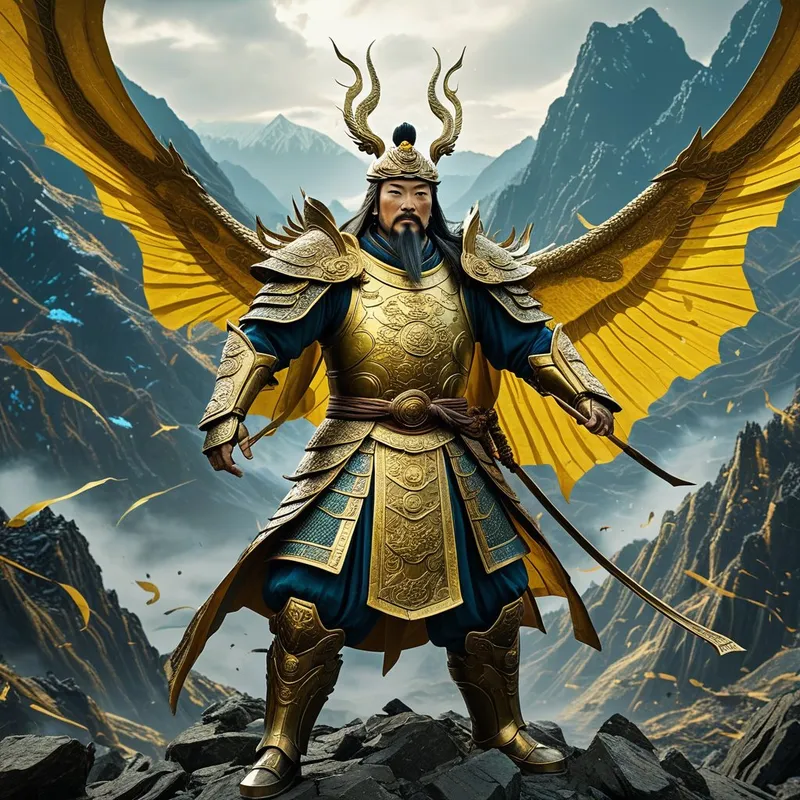
The confrontation was cataclysmic. Huangdi, clad in armor forged from divine bronze, marched to the lands where Feng Zheng held sway. The wind god descended not as a single foe, but as the storm itself. The sky blackened; the earth was torn asunder by howling vortices. Huangdi’s armies were scattered like leaves, their shouts swallowed by the tempest. Yet, the Emperor stood firm. He did not seek to destroy the wind, for he understood its necessity. He sought instead to direct it, to integrate its power into the great tapestry of the world.
The battle raged, a symphony of elemental fury against imperial resolve. In the end, through strategy and perhaps a fragment of divine mandate, Huangdi prevailed. He subdued Feng Zheng. But his victory was not execution; it was transformation. He appointed Feng Zheng as the official God of the Wind, giving him a place, a purpose, a duty within the ordered universe. He tasked him with the Winds of the Four Quarters, to blow in their proper seasons, to bring the rains in spring and the harvest winds in autumn. The screaming demon of the gale was given a throne in the celestial bureaucracy. The unruly breath of the world became a measured, conscious sigh.
Cultural Origins & Context
The myth of Feng Zheng finds its roots in the foundational texts of Chinese mythology and early cosmology, such as the <abbr title=""Classic of Mountains and Seas,” an ancient Chinese text compiling mythic geography and creatures.”>Shan Hai Jing and historical texts like the <abbr title=""Records of the Grand Historian,” a monumental history of ancient China.”>Shiji. It belongs to the mythic-historical era of the Three Sovereigns and Five Emperors, a time when narratives served to explain both natural phenomena and the origins of social order.
This story was not mere entertainment; it was a societal blueprint. Told by court historians and folk storytellers alike, it functioned as a powerful etiological myth, explaining why the winds changed with the seasons and were no longer a constant terror. More profoundly, it mirrored the centralizing political philosophy of early Chinese states. The taming of Feng Zheng by Huangdi is a direct allegory for the taming of chaotic, local nature spirits and the integration of diverse, often rebellious, tribal territories into a unified, hierarchical empire under a single, virtuous ruler. The wind’s submission symbolized the acceptance of a universal cosmic order (<abbr title=“The Chinese concept of the “Mandate of Heaven,” the right to rule granted by the celestial order.”>Tianming) and the civilizing process itself.
Symbolic Architecture
At its core, the myth of Feng Zheng is a profound drama of psychic integration. Feng Zheng represents the raw, untamed, and potentially destructive power of the unconscious—the primal psychic energy that precedes form and intention. He is pure affect, pure impulse: the sudden rage, the unbidden passion, the creative frenzy that threatens to overwhelm the conscious mind.
The untamed wind is the psyche before it knows its own name, a force that must be encountered, not escaped.
Huangdi, the Yellow Emperor, symbolizes the emerging force of consciousness, the <abbr title=“In Jungian psychology, the central organizing principle of consciousness, the “I”.”>ego, and the cultural superstructure. His goal is not annihilation, which is impossible, but relationship and governance. The conflict, therefore, is the essential human struggle: the ego’s necessary confrontation with the awesome, chaotic power of the inner world. The appointment of Feng Zheng as a god is the critical symbolic act. It represents the recognition and enlistment of this primal power. The unconscious is not defeated; it is given a dignified role. The wild wind is assigned a direction—East, West, North, South—just as raw emotion can be channeled into purposeful action, and chaotic inspiration can be structured into art or innovation.
The Dreamer’s Resonance
When the archetype of Feng Zheng stirs in the modern dreamer, it often heralds a period of intense inner turbulence. To dream of uncontrollable winds, of being buffeted by storms, or of a terrifying yet majestic bird-headed figure is to feel the “weather systems” of the unconscious breaking into conscious life.
This is not a sign of pathology, but of pressure for transformation. The somatic experience might be one of anxiety, restlessness, or a feeling of being “blown off course” in one’s life. Psychologically, it indicates that a powerful, instinctual, or emotional content—perhaps long-suppressed anger, a surge of creative potential, or a disruptive life passion—is demanding recognition. The ego feels threatened, much like Huangdi’s ordered kingdom. The dream is the battleground where this primal force makes itself known. The dreamer is experiencing the initial, chaotic stage of an encounter with what Carl Jung termed the shadow or the dynamism of the Self. The psychic “wind” is testing the boundaries of the conscious personality.
Alchemical Translation
The journey from Feng Zheng the chaotic demon to Feng Zheng the god of the four winds is a perfect map for the alchemical process of individuation. The first stage, nigredo, is represented by the initial chaos—the dark, swirling, uncontrolled state of the psyche where something raw and powerful is active but destructive.
Huangdi’s confrontation is the stage of confrontatio, the courageous engagement with this inner content. This is the most difficult work: facing the storm within without being annihilated by it, holding one’s ground like the Emperor. The victory is not suppression, but the realization that this power is a part of the whole self.
Individuation is the celestial appointment of our inner demons, granting them sovereignty over a quadrant of our soul so that the entire kingdom may function.
The final appointment is the stage of albedo and rubedo—whitening and reddening. The primal force is purified and integrated. Feng Zheng is given a sacred duty. In the individual, this translates to the conscious channeling of once-disruptive energies. Perhaps the fiery temper becomes the fuel for passionate advocacy. The restless, chaotic mind finds focus in a creative practice. The unpredictable emotional gusts become a nuanced empathy, able to blow from different directions with understanding. The wild wind becomes the breath of spirit, necessary and directed. The individual no longer fears the inner gale but understands they contain, and are responsible for, the very weather of their soul. They achieve a personal cosmos, where the once-rebellious elements now serve the sovereignty of the integrated Self.
Associated Symbols
Explore related symbols from the CaleaDream lexicon: