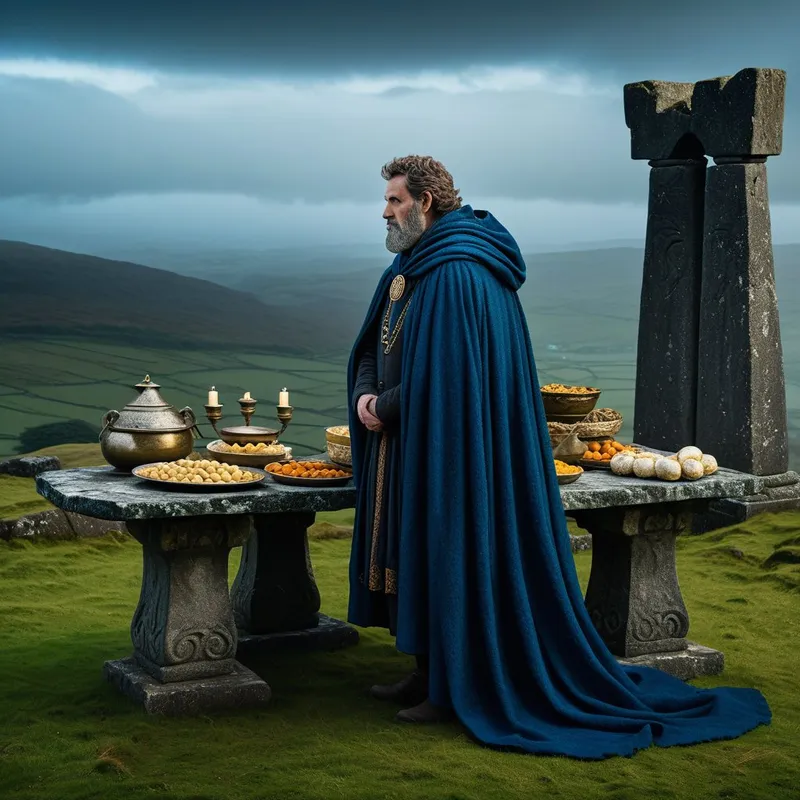
Feis Myth Meaning & Symbolism
A myth of a sacred king's ritual feast, binding him to the land through sacrifice, symbolizing the profound covenant between consciousness and the deep, nourishing earth.
The Tale of Feis
Listen now, and let the hearth-fire dim. Let the night outside the ráth grow deep and the wind carry the scent of damp earth and hawthorn. I will tell you of the Feis, not as a dry fact, but as it was known in the marrow of the bone and the whisper of the oak.
In the days when the High King’s word was law, and the land’s breath was the people’s breath, there came a time of turning. The old king’s strength waned like the winter sun. The rivers ran thin, the cattle grew restless, and a brittle silence lay upon the hills. The kingdom itself seemed to hold its breath, waiting. The druids gathered, their faces grave in the torchlight. The law was clear, written in the stars and the standing stones: the king must undertake the Feis.
So the king, his brow heavy with the weight of the crown, set aside his weapons and his pride. He was led to a place of power, a hall of ancient timber where the smoke of the central fire curled towards the roof like a prayer. There, at the head of a table of rough-hewn oak, he waited. The air was thick with the scent of roasting meat, of honeyed ale, and of the sweet, decaying perfume of autumn fruits.
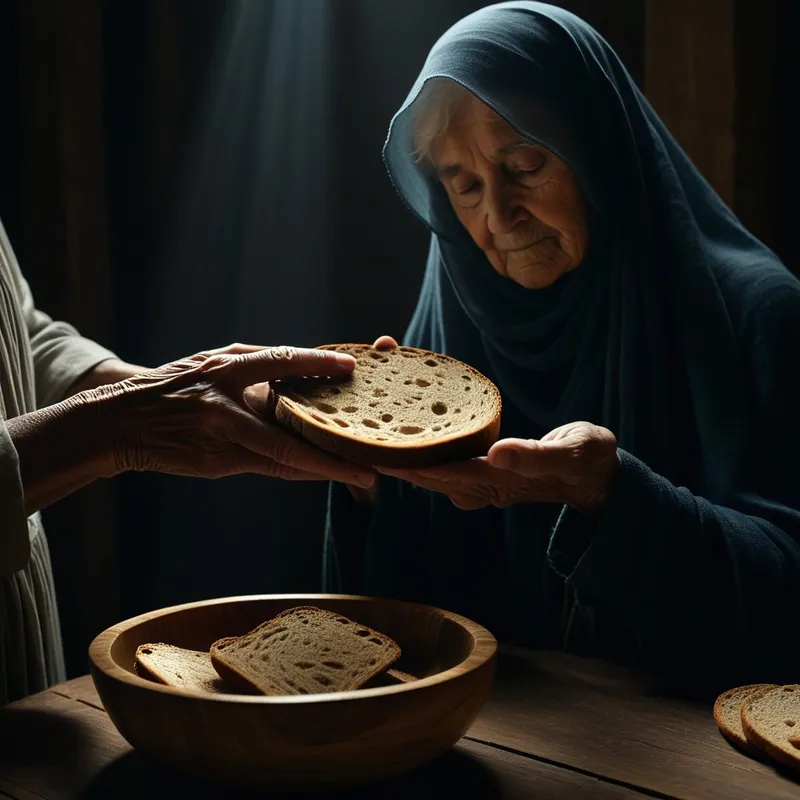
Then she entered. Not as a queen of court, but as the Cailleach, the veiled one, the Hag of Beara. Her form was bent, her cloak the grey of mountain stone, her eyes pools of deep, knowing shadow. She carried no scepter, but a simple wooden bowl and a cup of dark ale. Without a word, she sat opposite the king. The feast began.
It was not a feast of merriment. Each morsel of bread, each sip from the cup, was a sacrament. He ate the bread, coarse and tasting of the earth that bore it. He drank the ale, bitter and strong. And as he consumed the fare offered by the Hag, a transformation seeped into him. He did not see a beautiful maiden where the hag had sat; that is a later, softer tale. No. He saw the land itself in her weathered face—the craggy cliffs, the deep valleys, the patient, enduring strength of the old hills. He felt the hunger of the soil, the thirst of the rivers, the slow, grinding age of the stone.
In that silent communion, a covenant was forged. His kingship was no longer a right of blood or battle, but a marriage. He wed the land in that feast. His vitality for her fertility, his protection for her nourishment, his mortal life for her eternal cycle. When the last crumb was eaten, the last drop drunk, a shudder passed through the hall. The king rose, his eyes clear. The Hag nodded once, a gesture of terrible acceptance. And when the doors were opened at dawn, the people felt the change in the very air. The rivers ran full, a soft green misted the fields, and the kingdom exhaled, whole once more.
Cultural Origins & Context
The concept of the Feis is woven into the earliest strata of Irish tradition, less a single story than a foundational ritual pattern. It belongs to the world of the Tuatha Dé Danann and the mortal high kings who followed them. This was not mere ceremony; it was a cosmological and political necessity. The king’s fírinne (truth/justice) and his physical vigor were directly linked to the prosperity of the land—a concept known as fír flathemon.
These narratives were the province of the fili, the poet-seers. They preserved and recited the lore at royal gatherings, ensuring the king and tribe remembered the sacred contract. The Feis myth served as the ultimate template for legitimate sovereignty. It explained why a king could fail, why the land could sicken, and prescribed the profound, personal sacrifice required for renewal. It was a story that anchored power in responsibility, and rule in a terrifying, intimate relationship with the feminine, chthonic forces of the earth itself.
Symbolic Architecture
At its core, the Feis is a supreme symbol of sacred marriage, the hieros gamos. But this is no romantic union. It is the marriage of conscious, ordering principle (the king) to the unconscious, nourishing, and devouring ground of being (the land as Hag).
The feast is where the ego, starved of meaning, must sit and dine with the archetypal Shadow in its most primal, earthy form.
The king represents the differentiated self, the ruler of the personal realm. The Cailleach is the ultimate Anima figure, but not as youthful inspiration. She is the Anima as the Sapientia Dei, the wisdom of God in the form of the ancient, all-knowing Earth. She is the psyche’s own deep, often neglected, and “ugly” foundation—the instincts, the body’s wisdom, the collective memory of the species. The ritual food and drink are the substance of this unconscious. To ingest them is to consciously assimilate what is other, to make the foreign wisdom of the body and the ancestral soul part of one’s own substance. The king does not conquer the hag; he consumes her essence, and in doing so, is utterly transformed by it. His renewal is predicated on his willingness to be nourished by what he initially fears or devalues.
The Dreamer's Resonance
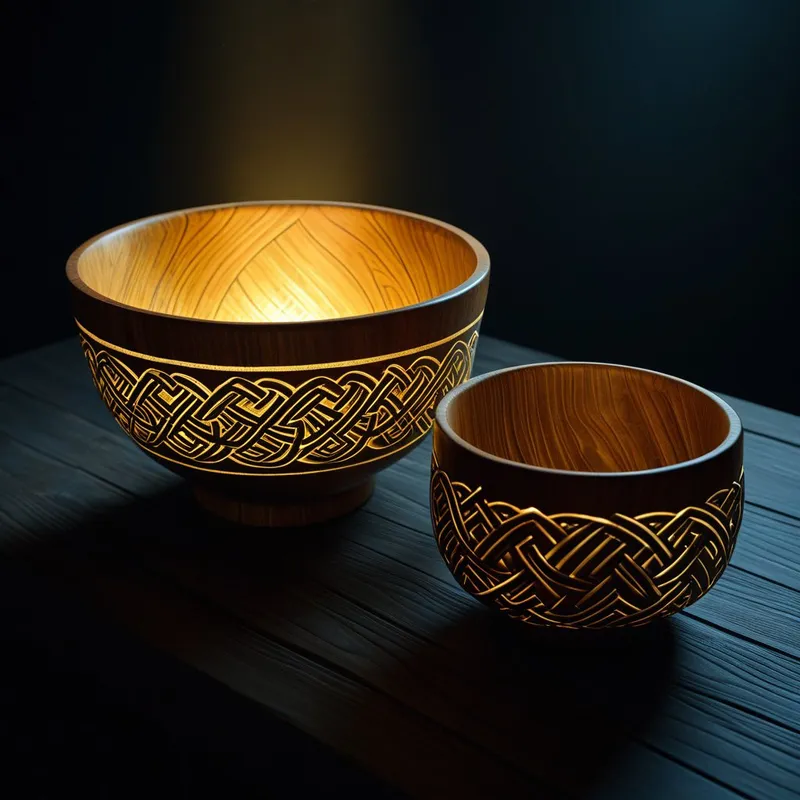
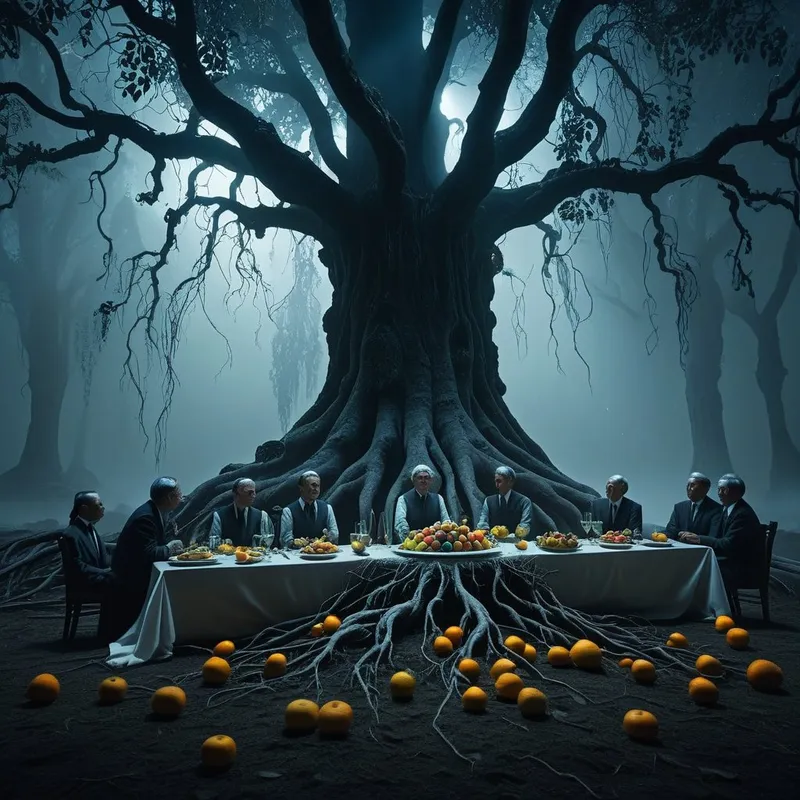
When this myth stirs in the modern psyche, it often manifests in dreams of fraught or significant eating. One may dream of being forced to eat something repulsive—mud, rotten fruit, ashes—at a solemn table. Or of a banquet where the food is magnificent but turns to dust in the mouth, signifying a spiritual hunger that worldly “feasts” cannot satisfy. The somatic feeling is crucial: a deep, gnawing emptiness in the gut, a literal hunger for something unnamed.
Psychologically, this signals a critical point where the conscious attitude has become sterile. The “land” of one’s life—creativity, relationships, vitality—is barren. The dream is presenting the necessary, dreaded nourishment. The “hag” at the table might appear as a despised aspect of oneself, a demanding older relative, or simply a profound, unsettling presence. The dreamer is being called to their own Feis: to sit with the unintegrated, perhaps aged or “ugly” parts of their history, their body, or their shadow, and to consciously, respectfully, take them in. The process feels like a sacrifice of pride, of a clean self-image, for the sake of a deeper, more fertile wholeness.
Alchemical Translation
The alchemical parallel is unmistakable: the Feis is the nigredo and the coniunctio in one potent ritual. The king’s journey into the ritual hall is the descent into the darkness of the prima materia, the base matter of the soul. The confrontation with the Hag is the facing of the shadow in its rawest form.
Individuation is not about becoming a perfectly polished ruler, but about becoming a sovereign who has feasted with the darkest, oldest parts of the territory he presides over.
The modern individual undergoing this psychic transmutation must identify what “kingdom” has grown fallow—their career, their art, their inner life. They must then willingly sit at the table of introspection and invite the “Hag.” This is the neglected talent, the buried trauma, the aging body, the instinctual life sacrificed to efficiency. The “feast” is the act of mindful integration: journaling about the shame, caring for the sick body with reverence, finally creating from the place of raw, “ugly” emotion. The food is bitter. The transformation is not into perpetual youth, but into authentic authority—an authority earned through humble communion with all that one is, especially the parts one wished to disown. The renewed fertility that follows is not mere happiness, but a profound creativity and resilience rooted in the deep, dark, and nourishing earth of the true self.
Associated Symbols
Explore related symbols from the CaleaDream lexicon: