Faust Myth Meaning & Symbolism
A brilliant scholar, disillusioned with earthly knowledge, makes a pact with a devil for infinite power and pleasure, only to face the ultimate reckoning.
The Tale of Faust
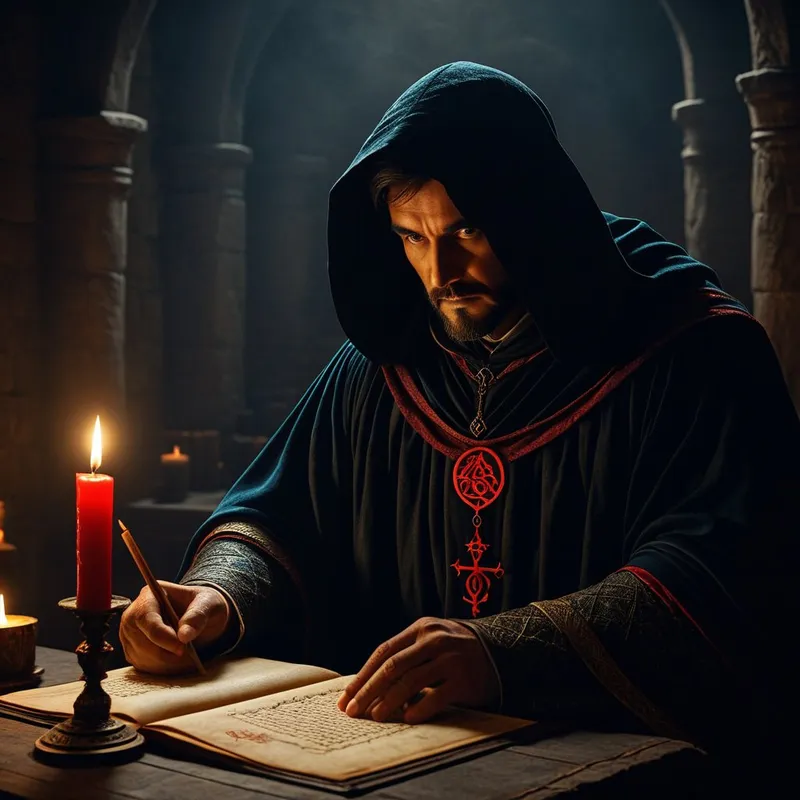
In the dim, smoke-choked heart of a German university town, where the bells tolled the hours like sentences from God, there lived a man named Johann Faust. He was a master of all the known arts—philosophy, medicine, law, divinity—and yet, his soul was a cavern of echoing emptiness. The books in his tower room were tombs of dead knowledge; the stars he charted were cold, distant points of light that spoke no secrets. A profound acedia, a spiritual despair, had taken root in him. The wisdom of men was ash on his tongue.
One night, in a fit of blasphemous desperation, he took a dagger and drew a circle upon the floor, filling it with potent signs and names of power. He called upon spirits not of heaven, but of the chthonic depths. The air grew thick and cold. A scent of sulfur and ozone bloomed. And from the shadows, a figure coalesced—not a monster of claws and fangs, but a gentleman. He was dressed in the rich red of a nobleman, his face sharp and intelligent, his smile a blade’s edge. He named himself Mephistopheles.
“What would you have, Doctor Faust?” the spirit asked, his voice like honey poured over iron. “I am a servant of Lucifer. All that the world holds—pleasure, knowledge, power—can be yours. For a price.”
Faust’s heart hammered against his ribs. Here was the answer to the prison of his intellect. “I would have it all,” he whispered, the words tasting of fire. “I would know the secrets that bind the universe. I would taste every delight, wield every power, until my soul is sated.”
Mephistopheles produced a contract. “Then sign. Serve my master in hell for all eternity. But here, on Earth, for four-and-twenty years, you shall be as a god. Your every wish, my command.”
With a trembling hand, Faust pricked his finger and signed his name in his own blood. The parchment seemed to drink the signature. At once, the world transformed. The dusty tower became a portal to wonders. Mephistopheles became his cunning familiar, spiriting him across the globe. He attended the Emperor’s court, conjured the phantoms of Helen of Troy and Alexander the Great. He seduced a pure-hearted maiden named Gretchen with devilish gifts, a liaison that would lead to her ruin, her mother’s death, and her own execution—a tragedy that left the first crack in Faust’s armor of ambition.
The years, fed by magic, fled like leaves before a storm. Faust built grand works, explored the cosmos, yet a ghost of dissatisfaction ever walked beside him. The pleasures turned hollow, the knowledge bitter. As the final day of his contract dawned, a terrible dread seized him. He begged for more time, for repentance, but the bargain was iron. That midnight, in a village outside Wittenberg, Mephistopheles came to claim his due. Hell’s minions descended. Faust’s final cries were not of a scholar, but of a terrified animal, as he was bodily torn from his study and dragged down to perpetual damnation, his soul forfeit, his grand quest ending in the ultimate negation.
Cultural Origins & Context
The Faust myth is not a single, ancient tale but a potent folk legend that crystallized in the Medieval and early Renaissance Germanosphere. Its roots are tangled with historical figures like Johann Georg Faust (c. 1480–1540), an itinerant alchemist, astrologer, and magician whose reputation for dubious miracles and scandalous boasts made him a perfect archetype for the prideful overreacher. The story first gained widespread form in the anonymously authored Faustbuch of 1587, a chapbook titled Historia von D. Johann Fausten. This was not high literature but popular print, a moralistic and sensationalist warning tale disseminated by the burgeoning press.
Told and retold by preachers and peddlers, the story functioned as a powerful societal narrative for a Europe undergoing seismic shifts. The Reformation had shattered religious unity, the Renaissance was exalting human potential, and early science was beginning to probe nature’s secrets. Faust embodied the terrifying shadow of this new, ambitious, inquiring spirit—the intellectual who, dissatisfied with divine revelation, seeks knowledge on his own terms, even if it means trafficking with demons. The myth served as a cautionary bulwark, reinforcing the medieval worldview that ultimate knowledge belonged only to God, and that human ambition, untethered from faith, led inexorably to hell.
Symbolic Architecture
At its core, the Faust myth is a supreme drama of the psyche’s polarities. Faust represents the boundless, aspiring Ego, the intellect that seeks to consume the world. Mephistopheles is not merely an external devil but the embodiment of the Shadow—the cynical, nihilistic, and destructive principle that arises when the ego rejects its natural limits and connection to the whole.
The pact is the moment the conscious mind, in its arrogance, believes it can hire the unconscious to do its bidding, forgetting it will demand payment in the currency of the soul itself.
The twenty-four years of power symbolize the inflation of the ego, a state of psychic possession where every wish is granted but meaning evaporates. Gretchen represents the Anima, the soul’s capacity for love, connection, and innocence, which is inevitably corrupted and destroyed when the ego is in league with the shadow. The ultimate damnation is not a theological fate but a psychological reality: the total isolation of the ego, severed from all transpersonal meaning, trapped in a self-created hell of endless, meaningless gratification.

The Dreamer's Resonance
When the Faustian pattern stirs in the modern dreamscape, it often manifests as dreams of signing contracts one doesn’t fully understand, of making irreversible deals, or of being in debt to a sinister, charismatic figure. The dreamer may find themselves in a gilded cage—a luxurious but soulless apartment, a high-status job that feels like a prison. These are somatic signals of a psychic bargain in progress.
The individual may be experiencing a state of “inflation”—their conscious ambitions, career drives, or thirst for experience (knowledge, pleasure, power) have become disconnected from the deeper needs of the soul. The Mephistopheles figure in the dream is the personified cost of this one-sided development: the cynicism, the burnout, the hidden addiction, the relational failures that are the price of the dreamer’s single-minded pursuit. Dreaming of Faust’s final terror is the Self’s urgent alarm, a confrontation with the looming deadline when the soul will demand a reckoning for being ignored, bartered, or sold.
Alchemical Translation
The alchemical journey is one of transmuting base lead into spiritual gold. The Faust myth charts the catastrophic failure of this process, providing a negative roadmap. Faust attempts to steal the gold—the philosopher’s stone of ultimate knowledge and power—without undergoing the necessary nigredo, the dark night of the soul where the ego is humbled and dissolved.
The true alchemical pact is not with a demon, but with the Self. It is the agreement to endure the darkness of the unknown within, so that one may emerge not as a inflated magician, but as a humble sage.
The individuation process requires a different kind of bargain. One must “contract” with the unconscious, not to command it, but to listen to it. The Mephistophelean shadow must be integrated, not served—its energy of skepticism and deconstruction used to break down outworn ego structures, not to destroy the soul’s innocence (Gretchen). The deadline is not damnation but the inevitability of transformation; if the ego will not submit voluntarily to the greater pattern of the Self, it will be broken by it.
For the modern individual, the “salvation” hinted at in later versions of the tale (like Goethe’s) lies in this shift. It is not in ceasing to strive, but in redirecting the striving. The quest moves from “What can the world give me?” to “What does the Soul require of me?” The power sought is not over life, but through it—a knowledge that comes not from conjuring phantoms, but from facing the reality of one’s own being, limits and all, and in that acceptance, finding a freedom no devil can grant or take away.
Associated Symbols
Explore related symbols from the CaleaDream lexicon: