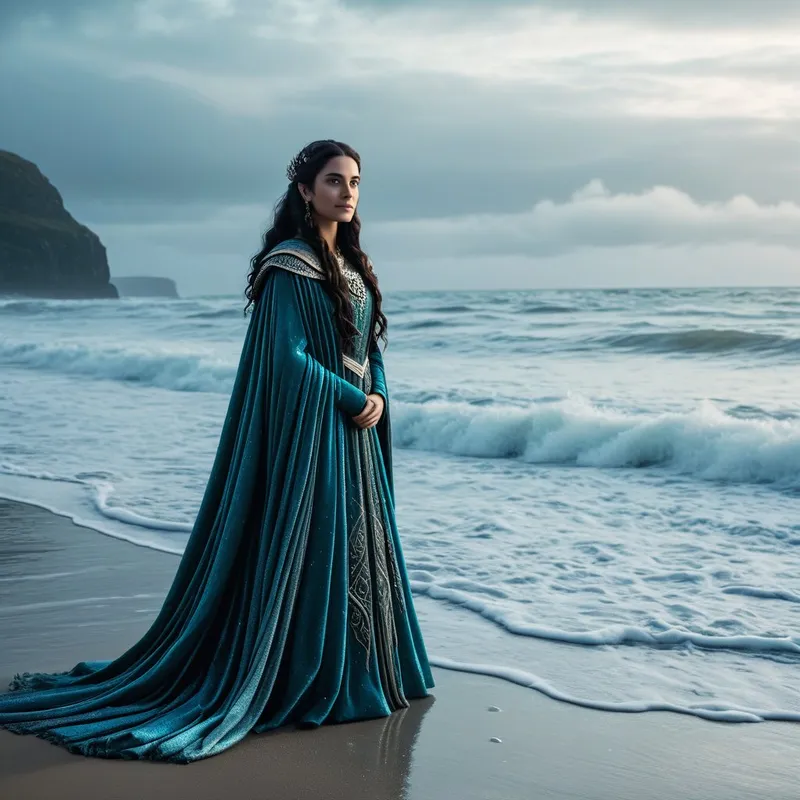
Fand Myth Meaning & Symbolism
A queen of the Sídhe offers a mortal hero a transcendent love, forcing a choice between two perfect worlds.
The Tale of Fand
Hear now a tale not of simple conquest, but of a longing that bridges worlds. It begins not with a hero’s shout, but with a queen’s silent sorrow.
In the Sídhe, the shimmering realm beyond the mortal veil, Fand ruled. Her name meant “Tear” or “Pearl of Beauty,” and like a pearl, she was born of a deep, quiet ache. She was wife to Manannán mac Lir, he who rides the chariot of the waves, his cloak the mist that hides the worlds. Yet, a distance had grown, vast as the sea he commanded. Fand, in her crystal hall, felt a loneliness no immortal splendor could soothe.
Across the veil, in the land of hard earth and fleeting lives, the hero Cú Chulainn lay stricken. Not by wound of spear, but by a wasting sickness, a poet’s malady of the spirit. He had seen too much war, too much blood; the light of his own world had grown dim.
It was then the messengers came. Not with threats, but with a plea. Fand’s sister, Lí Ban, was besieged by monstrous foes. Only the Hound of Ulster had the fury to save her. They offered a bargain: his aid for healing. Cú Chulainn, seeking any cure from his gloom, crossed over.
What he found was not a battlefield, but Fand. When he saw her, his sickness fell away like a rusted cloak. When she saw him, her immortal loneliness cracked. Together, they fought side-by-side, a dance of mortal fury and sidhe grace that scattered the monsters like mist. And in the victory’s quiet, they found a love more potent than any magic—a love that was, itself, a new world.
For a season that felt like an eternity, they dwelt in the Sídhe. Cú Chulainn was restored, not to his old self, but to a greater one. Fand was no longer lonely. It was perfect. But perfection between worlds is a fragile spell.
Word reached Ulster. Cú Chulainn’s mortal wife, Emer, proud and fierce with a love as deep as the earth, gathered the women of Ulster. They marched to the threshold of the Otherworld, not with swords, but with a terrible, righteous claim. Emer did not scream or plead. She stood, embodying the whole human world of duty, memory, and steadfast love, and she sang a song of such piercing truth that it shook the very gates of Faerie.
Fand heard it. And in that moment, the queen of the Sídhe understood the cost of her joy. To keep Cú Chulainn was to unravel him, to tear him from the root of his being. Her love, which was real, demanded an impossible sacrifice—not from him, but from her.
Heartbreak became her sovereignty. She released him. She turned away from the one who had filled her eternal silence. And Manannán mac Lir, seeing her profound grief, did something not of jealousy, but of mercy. He shook his cloak of mist between Fand and the mortal world, so that she and Cú Chulainn would never see each other again, and thus never be tormented by memory’s ghost. Cú Chulainn and Emer drank a draft of forgetfulness, their bond restored. Fand was left with her immortal kingdom, and the eternal, mist-veiled memory of a love that was, and could never be.

Cultural Origins & Context
This poignant story is preserved in the early Irish narrative Serglige Con Culainn (“The Wasting Sickness of Cú Chulainn”), part of the Ulster Cycle. These tales were the province of the filid, the elite poet-seers who functioned as historians, genealogists, and custodians of sacred lore. The myth would have been recited in the halls of chieftains, serving far more than entertainment.
Its function was deeply psychological and societal. In a culture where the boundary between this world and the Sídhe was perceived as thin and permeable, the myth explored the dangers and allure of the Other. It was a warning about the cost of transcendent experience and a meditation on the nature of sovereignty—not just of kingship, but of the self. Fand is a sovereignty goddess figure, but here, her gift is not a kingdom to a mortal man; it is an experience of wholeness that ultimately forces a crisis of identity. The story validates the mortal world (Emer’s claim) while acknowledging the devastating beauty of the transcendent (Fand’s love), refusing to wholly condemn either.
Symbolic Architecture
At its core, the myth of Fand is an exquisite map of a psychological crossroads. Fand represents the anima, the soul-image, in its most transcendent form. She is not a temptress, but a call to a deeper, more complete state of being. Cú Chulainn’s “wasting sickness” is a modern depression or ennui—the hero who has conquered the external world but finds his inner world barren.
The most profound choice is often not between good and evil, but between two perfect, yet mutually exclusive, manifestations of the good.
Their union symbolizes the healing that occurs when the conscious ego (Cú Chulainn) engages with its deepest, soulful counterpart (Fand). The Sídhe is the inner landscape of the unconscious, dazzling and restorative. Emer represents the legitimate, earned structures of the conscious life: marriage, duty, social identity, and a love that is familiar and grounding. The conflict arises because wholeness cannot be achieved by abandoning one for the other. True integration requires a sacrifice.
Manannán mac Lir’s mist-cloak is the ultimate symbol of this integration. It is not a punishment, but a merciful boundary. It represents the necessary psychic function that allows us to hold a transformative experience without being perpetually torn apart by nostalgia for a lost paradise. It is the ego’s acceptance of limitation, which is the very ground of conscious life.
The Dreamer's Resonance
When this myth stirs in the modern dreamer, it manifests as dreams of impossible choice. You may dream of two lovers, both perfect, and be forced to choose. You may find yourself in two beautiful houses, unable to decide which to live in. The somatic feeling is one of exquisite tension, a pulling in the chest, a paralysis at a threshold.
This is the psyche working through a moment of profound growth. The “Fand” dream appears when one has tasted a new potential self—a creative awakening, a spiritual insight, a love that expands the soul—but integrating it threatens to dismantle the existing, well-ordered life. The dream is not necessarily advising you to abandon your “Emer” (your career, your current relationship, your identity). It is making you feel the full weight of the choice itself, forcing you to consciously acknowledge what is at stake. The grief in the dream is the grief of necessary sacrifice, the price of any meaningful evolution.

Alchemical Translation
The alchemical process modeled here is the coniunctio (sacred marriage) followed not by a permanent fusion, but by a separatio (separation) that elevates both parties. This is the individuation journey.
First, the nigredo: Cú Chulainn’s wasting sickness, the leaden depression of the unexamined life. Then, the call to the albedo: the invitation to the silver Sídhe, the moon-world of the soul. The union with Fand is the coniunctio, producing the philosopher’s gold—a temporary state of transcendent wholeness and vitality.
The gold of the alchemist is not a static treasure to be possessed, but the transformative understanding born from the tension of opposites.
The crisis with Emer forces the rubedo, the reddening, the painful, fiery confrontation with reality. The final, mature transformation is not choosing one world, but accepting that the self must inhabit the mortal realm while being irrevocably changed by the transcendent one. The “draft of forgetfulness” is a potent symbol. We do not literally forget our peak experiences, but we let go of our clinging attachment to their specific form. We allow the experience to become integrated wisdom rather than a haunting memory.
The individuated self is thus Cú Chulainn returned to Ulster, but healed; and Fand, ruling her own realm, deepened by love and loss. It is the self that can hold the memory of the silver shore while tending the hearth fire, knowing both are true, and that the mist between them is not a barrier, but the very breath of a conscious life.
Associated Symbols
Explore related symbols from the CaleaDream lexicon: