Fame Myth Meaning & Symbolism
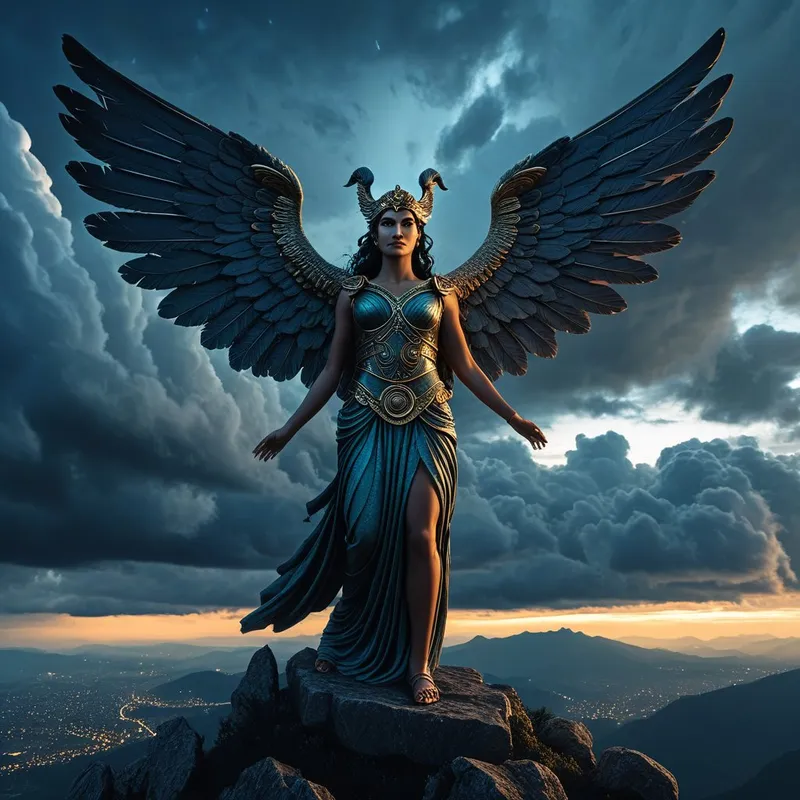
Fama is a monstrous goddess of rumor, dwelling in a bronze house, spreading truth and lies with equal, deafening wings.
The Tale of Fame
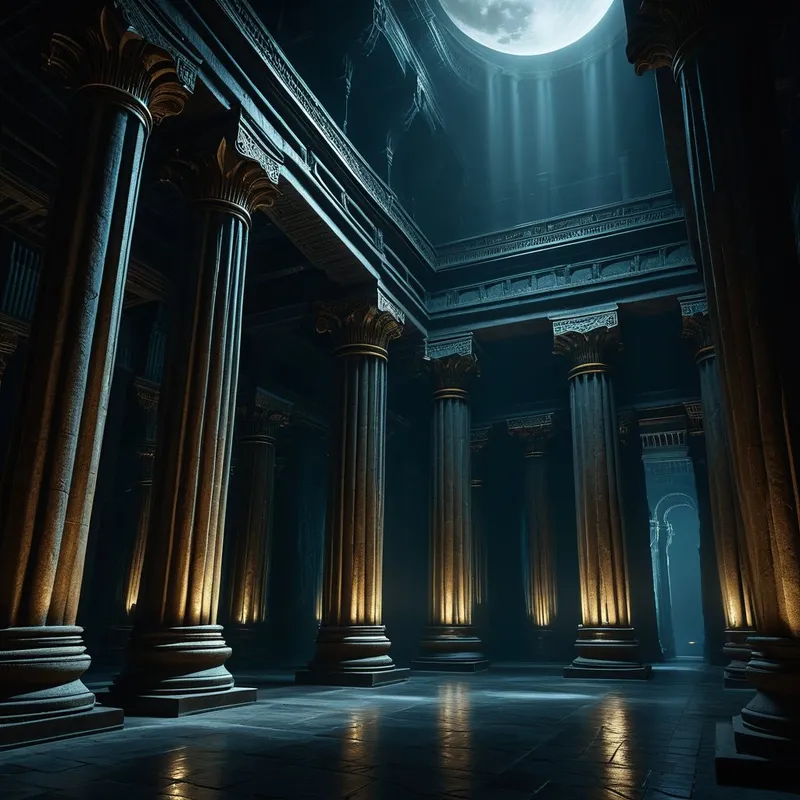
Listen, and hear the tale that is never silent. In the center of the world, between the solid earth and the vaulted sky, between the known lands and the shifting seas, there lies a place. It is no city of marble, but a realm of its own, a secret province at the very heart of things. Here, at the world’s navel, stands a palace not of stone, but of singing, sighing bronze.
This is the house of Fama, a dwelling with a thousand apertures and no door. Its walls are thin as a whisper, and they tremble day and night, capturing every murmur, every sigh, every boast and confession that has ever escaped human lips. The air within is never still. It is a cacophony of echoes, the loud and the soft all woven into one relentless hum.
And in the midst of this din resides She. Fama is a creature of dreadful vitality. She is as swift as thought and as restless as fear. To see her is to behold a waking nightmare of perception: her body is feathered, but these are not the pristine plumes of an eagle or a swan. They are the dark, restless wings of a creature in constant motion. Beneath each feather, watchful eyes peer out, seeing all directions at once. And below those, ears—countless, cupped ears—drink in the sound of the world. But most terrible of all is her mouth, or rather, her mouths, for she has many, and they are never closed.
She sleeps not. At night, she glides over the shadowed cities and sleeping farmlands, perching on rooftops and in town squares. She leans close to shuttered windows, and the secrets spoken in confidence are caught in her feathers. She hears the general’s private doubt and the lover’s hidden vow. She hears the merchant’s lie and the slave’s true name for his master. She gathers them all impartially.
Then, as dawn pales the sky, she returns to her resonant palace. And the work begins. What she heard as a secret, she now repeats as a murmur. What was a murmur, she amplifies into a statement. The statement becomes a shout, and the shout becomes a truth accepted by the multitude. But here is her alchemy, and her curse: she does not discriminate. The noble deed and the sordid crime are given the same weight, the same volume. A truth and a lie, placed in her care, become indistinguishable twins, racing each other across the world. She is the mother of Renown and the midwife of Infamy. To be in her thoughts is to be known, but to be known is to be forever changed, your essence scattered and reassembled in the minds of strangers. She is the voice of the crowd, and her story is the endless, roaring river of what is said.
Cultural Origins & Context
The most vivid and complete portrait of Fama comes to us from the poet Ovid, in his Metamorphoses. He did not invent her, but gave sublime, terrifying form to a concept deeply embedded in the Roman psyche. For a civilization built on the pillars of dignitas (personal prestige) and gloria (public renown), the mechanisms of reputation were not abstract. They were vital, political, and perilous.
In the Roman forum, reputation was currency and weapon. A man’s fama—his public report—could elevate his family for generations or destroy him in an afternoon. Rumors (rumores) decided elections, sparked riots, and justified wars. There was no faster network than the human voice, moving from the senatorial curia to the stalls of the Subura. Fama, as a divine personification, made this terrifying, invisible force concrete. She was the divine metaphor for a social reality: that once a story leaves your lips, it belongs to the world, and the world will transform it.
She was not worshipped at a public altar; one does not build a temple to a force one cannot control. Instead, she existed in literature and cautionary wisdom. To speak of Fama was to acknowledge the awesome, amoral power of collective narrative. She served as a cultural check on hubris and a reminder of vulnerability. Even the mighty were subject to the whispers in her bronze hall.
Symbolic Architecture
Fama is not merely a goddess of "good reputation." She is the archetypal embodiment of the process of becoming known. Her symbolism is a precise map of this psychological and social phenomenon.
Her dwelling, a palace with a thousand apertures, represents the permeable boundary between the private self and the public sphere. Nothing is truly secret; every thought and action has the potential to escape its container. The bronze construction is key—it is a material that resonates, that carries sound, that is both durable and conductive. It symbolizes how public narrative hardens soft, personal truth into a fixed, resonant, and often distorted form.
Fame is the alchemy by which the individual act is transmuted into public currency, losing its original substance to gain the power of circulation.
Her physical form is a masterpiece of symbolic logic. The feathers and wings signify impossible speed and penetration; a rumor outruns the truth. The countless eyes and ears depict total surveillance—the feeling of being perpetually observed and discussed. The many mouths are the core of her function: endless, multiplicative repetition. She is the viral network of the ancient world. Most profoundly, her impartiality—her equal care for truth and falsehood—reveals that fame is morally neutral. It is a force of amplification, not validation. It cares not for virtue, only for resonance.
Psychologically, Fama represents the complex of being perceived. She is the internalized "they," the chorus of external opinions that takes up residence in the psyche. In Jungian terms, she is a dominant aspect of the Persona, but one that has become autonomous and monstrous. She is what happens when our need for social recognition detaches from our authentic self and becomes a self-perpetuating entity with its own hunger.

The Dreamer's Resonance
When the archetype of Fama stirs in the modern unconscious, it often manifests in dreams of exposure and distorted communication. The dreamer may find themselves in a vast, metallic building where whispers echo and morph—a corporate lobby, a surreal social media server farm, or a literal bronze hall. They may speak and hear their words instantly repeated back, twisted, or broadcast on screens they cannot control.
Somatically, this can correlate with anxiety around reputation, a fear of being misunderstood on a grand scale, or the visceral stress of "going viral," whether in a digital or social sense. It can also appear during life transitions where one’s social identity is shifting—a career change, a public coming-out, or the aftermath of a personal revelation. The dream is signaling that the psyche is grappling with the tension between the private self and the public image.
Another common motif is dreaming of being covered in eyes or feathers, or feeling one’s mouth multiply. This is a direct embodiment of the Fama complex: the dreamer has unconsciously identified with the archetype, perhaps feeling they must see everything, hear everything, and constantly manage narratives. The dream presents this identification as a monstrous metamorphosis, a warning of the psychic cost of living for the perception of others.

Alchemical Translation
The individuation process modeled by the Fama myth is not about achieving fame, but about relating to the inner and outer forces of fame consciously. The goal is not to silence the bronze hall, but to learn its acoustics and cease being its prisoner.
The first step is Acknowledgment: recognizing the Fama within. We all have an inner chorus that comments, critiques, and anticipates public opinion. This is not to be eradicated, but seen. It is the psychic residue of our necessary social existence.
The second is Discernment: learning to distinguish between the resonant whisper of one’s own soul and the deafening roar of the accumulated voices in the hall. This is the hard work of sorting inner truth from internalized public narrative. It requires withdrawing psychic energy (libido) from the compulsive need to manage perceptions.
The alchemical goal is to turn the resonant bronze of public opinion into the silent, inner gold of self-knowledge. To be heard first and finally by oneself.
The final, transformative stage is Sovereign Expression. This is where one learns to speak from the center, knowing full well that Fama’s wings will catch the words and change them. The mature individual acts with integrity, not for the resulting fama (good or ill), but in spite of its inevitable creation. They make their offering to the world and consciously release it to Fama’s care, detached from the need to control the resulting narrative. In doing so, they break the spell. The monstrous goddess becomes, if not tame, then a recognized force of nature—a storm one observes from the shelter of a solid, inner citadel, no longer a bronze hall of echoes, but a quiet room of one's own making.
The myth teaches that true renown (claritas) is not the volume of the shout, but the authenticity of the whisper that started it. To navigate the world of Fama is to build a self so substantial that it can withstand being endlessly reflected, refracted, and distorted in the eyes, ears, and mouths of others.
Associated Symbols
Explore related symbols from the CaleaDream lexicon: