
Fairy Bells Myth Meaning & Symbolism
A mortal musician must journey into the Sídhe to reclaim stolen music, facing the perilous beauty of the fairy realm.
The Tale of Fairy Bells
Listen now, and let the fire’s glow dim. Let the wind in the oak still. I will tell you of a time when the veil was thin as a spider’s silk, and the music of the world was not yet divided.
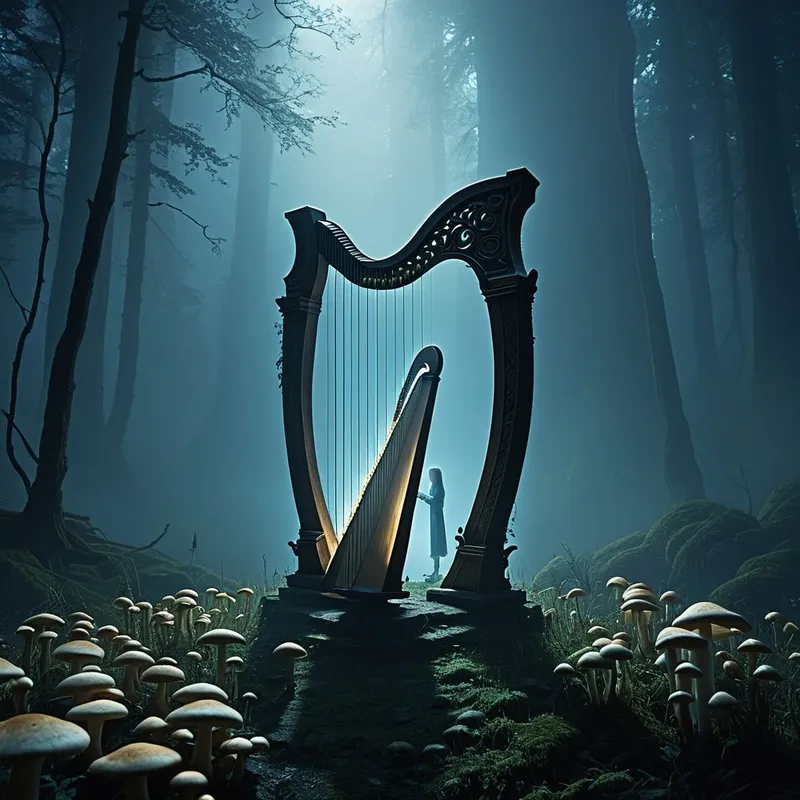
There was a harper, Caoimhín, whose fingers could draw weeping from stone and laughter from the rain. His tunes were not his own, he said, but borrowed from the wind in the reeds and the sigh of the turning stars. His greatest melody was a lament for the setting sun, a song of such piercing beauty that even the Aos Sí on their hidden hills would pause their revels to hear its echo.
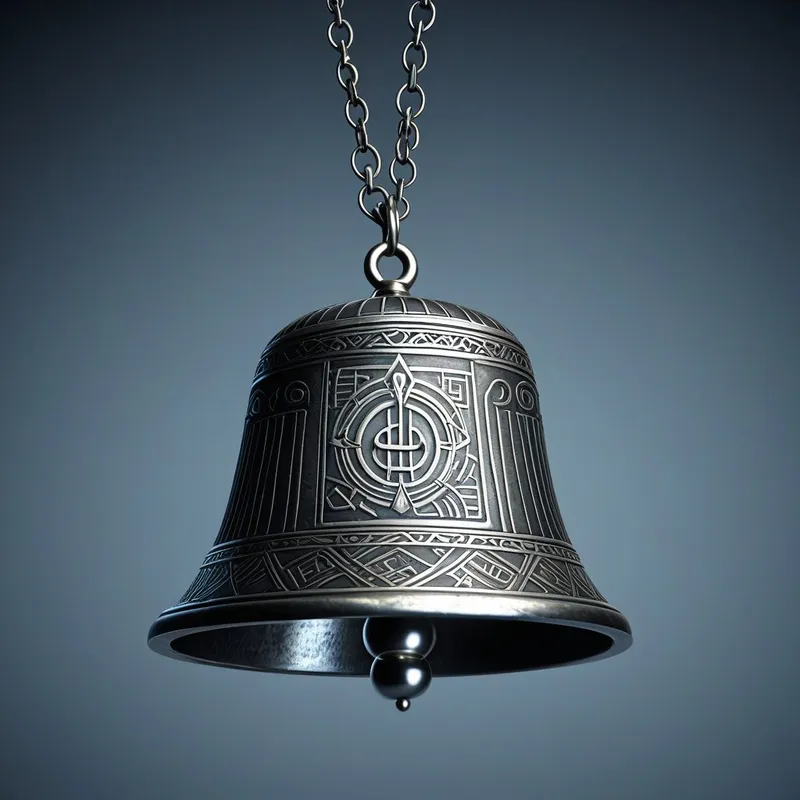
One Samhain eve, as the boundary between worlds dissolved into twilight mist, Caoimhín played that lament by a lone hawthorn, a tree sacred and feared. As the last note trembled in the air, a cold, perfumed breeze snatched it whole from the strings. His harp fell silent, not a string broken, but utterly mute, as if its very soul had been stolen. From the roots of the hawthorn, a light emerged. It was the Bean Sídhe, clad in gowns of woven moonlight and sorrow. In her hand, she held a tiny, perfect bell of silver, within which Caoimhín’s stolen note danced and shimmered, trapped.
“Your music touched my throne of sorrow,” she said, her voice the sound of ice melting. “Its beauty is now a jewel in my crown. To reclaim it, you must come to my hall and play a tune that will make this bell ring of its own accord. Fail, and you will remain, a silent ornament for eternity.”
Thus began his journey into the Sídhe. He crossed rivers of memory and forests of whispering shadows, guided only by the faint, captive shimmer in the bell he now carried. The fairy realm was a place of terrifying beauty—feasts that offered eternal hunger, laughter that echoed with loneliness, and time that flowed like honey and venom. He was tempted with a new, flawless harp, its promise of easy song. He was threatened with the horror of the Each-Uisge. Yet, he clutched his silent, mortal harp, its wood familiar against his chest.
In the vast, crystalline hall of the Fairy Queen, he was commanded to play. The assembled Aos Sí watched with alien eyes. He plucked the strings, but no sound came. He played the notes of his stolen lament, but the bell remained still. Despair wrapped around his heart. Then, looking not at the queen but at his own worn hands, he did not play the stolen song. Instead, he played the truth of his journey—the fear, the longing, the silence, the raw and imperfect ache of a mortal soul in an immortal land. It was a tune of vulnerability, not of stolen perfection.
And as that honest, broken melody filled the hall, the silver bell on the queen’s palm began to tremble. It did not ring with the pristine note it held, but with a new, harmonious tone that resonated with Caoimhín’s humble song. The two sounds intertwined, the lost and the found, the perfect and the flawed, creating a third music more profound than either alone. The bell shattered into a shower of light, and his harp’s voice returned, richer and deeper than before. The queen, with a nod that held both defeat and respect, granted him passage home. He returned at dawn, his music no longer borrowed, but earned, forever holding within it the memory of the silent dark and the perilous, clarifying light of the Otherworld.
Cultural Origins & Context
The motif of stolen music or skill is a deep vein in Celtic lore, with tales like that of the Dagda’s harp or the children of Dian Cécht speaking to a profound cultural understanding. The “Fairy Bells” story, as a cohesive narrative, is not found in a single ancient manuscript but is a folkloric crystallization of these themes, passed down through the seanchaí (storytellers) of Ireland, Scotland, and Wales. Its function was multifaceted: it was a cautionary tale about the dangers of attracting fairy attention, especially at liminal times like Samhain. More importantly, it served as an allegory for the source of artistic inspiration. Creativity was not seen as a purely human invention but as a gift—or a loan—from the Otherworld, requiring respect, sacrifice, and often a harrowing journey to be integrated fully. The story affirmed that true artistry involves a dialogue with the unseen, a theft from the divine that must be reconciled through personal ordeal.
Symbolic Architecture
At its heart, the myth is a map of the psyche. The stolen melody represents a core element of the Self—an innate talent, a deep feeling, a moment of authentic inspiration—that becomes “complexed.” It is captured by the Anima (the Fairy Queen), the inner representative of the unconscious, which is both alluring and dangerous. The mute harp symbolizes the resulting creative or spiritual impotence, a life lived on the surface after a profound inner value has been lost to the depths.
The journey into the Sídhe is the necessary descent into the unconscious. One does not negotiate with a complex from a distance; one must enter its domain.
The fairy realm’s deceptive beauty mirrors the seductive power of neurosis and inflation—the promise of eternal, easy perfection that ultimately hollows the soul. The final, successful song is the critical symbolic turn: redemption comes not through replicating the lost perfection, but through integrating the experience of the loss itself. The hero must offer his shadow—his fear, his vulnerability, his mortal imperfection—as the true price of redemption. The shattering of the bell signifies the dissolution of the complex; the trapped, idealized element is freed and merges with the conscious personality, creating a new, more whole capacity.
The Dreamer's Resonance
When this myth stirs in modern dreams, it often manifests as sequences of profound loss—losing one’s voice, an instrument failing, a cherished song forgotten. The dreamer may find themselves in eerily beautiful yet unsettling landscapes (liminal spaces, glittering caves, silent parties) searching for a small, vital object. Somatic sensations accompany this: a tightness in the throat, a hollow feeling in the chest, or the frustrating inability to make a sound when trying to call out.
Psychologically, this signals that a vital aspect of the dreamer’s authentic self-expression has been dissociated, often in service of an “ideal” or to appease an internalized critical authority (the Fairy Queen). The dream is not merely about artistic block, but about a deeper soul-loss—the sacrifice of one’s unique emotional truth for a semblance of safety, approval, or perfection. The dream invites a recognition of this internal theft and the beginning of the uncomfortable, necessary journey to recover what is genuinely one’s own.

Alchemical Translation
The alchemical process mirrored here is the Nigredo, the descent into darkness, followed by the Albedo. The theft of the melody is the initial separation, the creation of the prima materia of suffering. The journey into the Sídhe is the dissolution in the alchemical vessel—the conscious ego is stripped of its certainty and forced to confront the contents of the unconscious.
The triumph is not in recovering the stolen gold, but in discovering that the lead of one’s own humble, flawed experience is the true philosopher’s stone.
The final act—playing the song of the journey instead of the stolen ideal—is the Coniunctio. It is the marriage of the conscious and unconscious, the perfect ideal with the imperfect reality. The new, third music that results is the Rubedo, the embodied, living spirit of individuation. For the modern individual, the myth teaches that healing and wholeness are not found in returning to a state before the wound (recovering the pristine bell), but in weaving the raw material of the wounding experience—the silence, the fear, the longing—into the fabric of the Self. Our most authentic power is not what was taken from us, but what we become in the courageous, faithful act of seeking it.
Associated Symbols
Explore related symbols from the CaleaDream lexicon: