Ezekiel's Vision Myth Meaning & Symbolism
A prophet in exile beholds a terrifying, glorious vision of the divine throne-chariot, a revelation of order amidst chaos and a call to speak truth.
The Tale of Ezekiel's Vision
The air by the Chebar canal was thick with the dust of forgetting and the salt of wept tears. Here, among the willows, the people hung their harps, for how could they sing the songs of Zion in a strange land? And among them was the priest, Ezekiel, son of Buzi, whose soul was a dry riverbed in the Babylonian sun.
Then came the day the sky broke open.
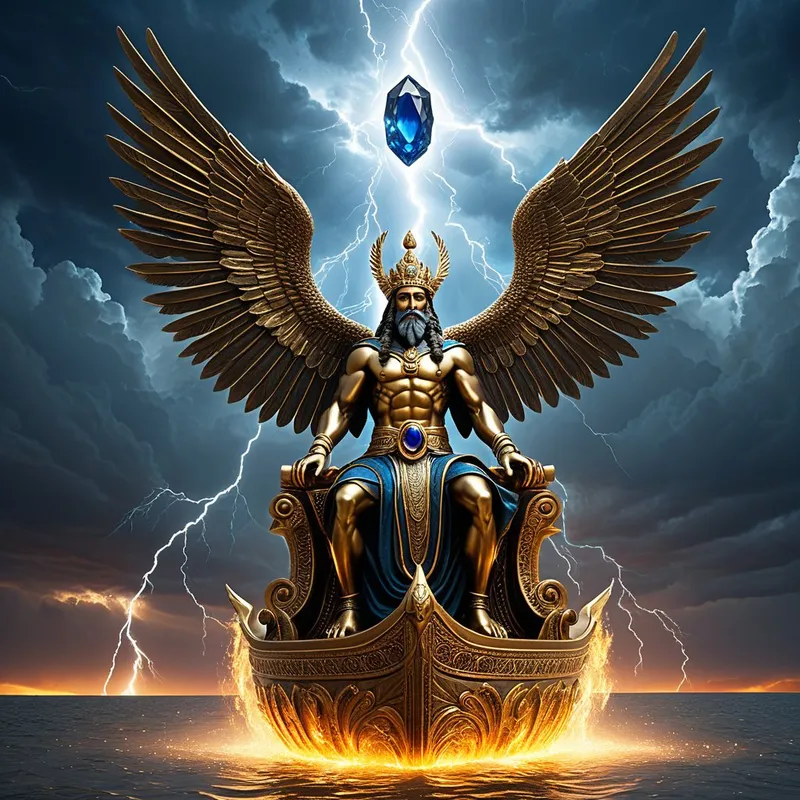
It began not with a sound, but with a pressure, a gathering weight in the atmosphere. A wind, a great rushing wind, swept in from the north—but this was no desert storm. It was a whirlwind, and at its heart, a fire that took hold of itself, glowing with the heat of molten metal. From within this tempest of flame, forms coalesced. Four living creatures, each a masterpiece of terrifying synthesis. They had the form of a man, yet each bore four faces: the face of a man in front, a lion on the right, an ox on the left, and an eagle behind. Their wings touched one another, two stretching upward to veil their bodies, two stretching downward to cover their feet. And they moved as one, straight forward, wherever the spirit would go, without turning.
Their appearance was like burning coals of fire, like torches moving between the creatures, and the fire was bright, and from the fire went forth lightning. And beside each creature was a wheel, a wheel within a wheel, their rims full of eyes all around. When the living creatures moved, the wheels moved beside them; when the creatures rose from the earth, the wheels rose, for the spirit of the living creatures was in the wheels.
Above the heads of the creatures was an expanse, shining like awesome crystal. And above the expanse, a voice. Then, a throne. Of sapphire, or the likeness of it. And seated upon the throne was a form with the appearance of a man, yet from his loins upward it was like gleaming amber, full of fire, and from his loins downward it was like fire with a brightness all around. Like the bow in a cloud on a rainy day, so was the appearance of the surrounding radiance.
This was the appearance of the likeness of the glory of the Lord.
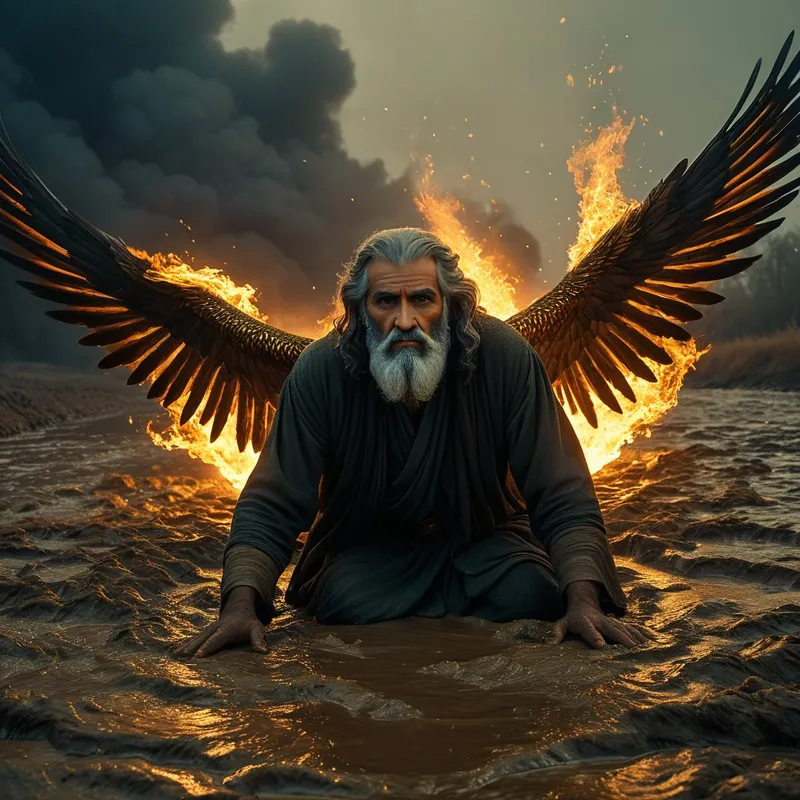
And Ezekiel fell on his face. And he heard a voice speaking. And the voice said, “Son of man, stand on your feet, and I will speak with you.” And a spirit entered into him and set him upon his feet, trembling, yet upright. The voice commissioned him, a voice that was the sound of many waters, the sound of a great army, yet utterly singular. He was to be a watchman, to speak the words given to him, whether the exiles would hear or refuse to hear. The vision of the chariot-throne, the Merkabah, was not merely a spectacle. It was a mandate, etched in fire upon the soul of a broken man by the banks of a foreign river.
Cultural Origins & Context
This vision is recorded in the opening chapters of the Book of Ezekiel, a text born in the crucible of the Babylonian Exile (c. 597–587 BCE). Ezekiel was both a priest and a prophet, a man whose identity was rooted in the Temple liturgy of Jerusalem, now utterly destroyed. The myth emerged not in the center of power and religious certainty, but in the liminal space of displacement, where all familiar structures of meaning had collapsed.
Its primary function was one of radical theological and psychological reassurance. The dominant theology of the time suggested the God of Israel was territorially bound to the land and the Temple. The Exile implied God’s defeat or abandonment. Ezekiel’s vision shatters this notion. It declares that the divine presence, the Kavod (Glory), is not confined. It is mobile, sovereign, and terrifyingly present even in the heart of the empire that conquered Judah. The myth was a survival mechanism for a culture in trauma, asserting that their God was not dead, but transcendent and unbound, and that He was with them in their exile. It was passed down as sacred scripture, a cornerstone of Merkabah mysticism, where the vision became a map for ascending to the divine throne through intense meditation and purity.
Symbolic Architecture
The vision is a dense, overwhelming symbolic system depicting the architecture of a conscious universe.
The throne does not rest on the earth, but is borne by composite creatures and wheels full of eyes. This is the psyche’s intuition of a cosmic order that is dynamic, intelligent, and all-seeing, yet fundamentally alien to human-scale logic.
The four living creatures—human, lion, ox, eagle—represent the totality of the living creation, the archetypal pillars of the terrestrial world: nobility (lion), strength (ox), freedom (eagle), and intellect (human). Their unified movement signifies the harmonious, if incomprehensible, coordination of all cosmic forces under a single divine will. The “wheel within a wheel” covered in eyes symbolizes omniscient perception and the complex, interlocking mechanisms of fate, causality, and natural law. The eyes see in all directions; nothing is hidden.
The central, overwhelming symbol is the mobile throne. It is the ultimate paradox: absolute sovereignty that is not static, but in motion. It represents the dynamic core of the Self, the central organizing principle of the psyche (what Jung termed the Self archetype), which can manifest not in peaceful integration, but in cataclysmic, rearranging power. The vision comes to Ezekiel not when he is seeking it, but when he is utterly defeated. It symbolizes the eruption of the numinous into a state of psychic collapse, not to comfort, but to reconstitute from the ground up.
The Dreamer's Resonance
When this mythic pattern stirs in the modern dreamer, it signals a profound confrontation with the archetype of order. One does not dream of the Merkabah during times of quiet contentment, but in periods of extreme disorientation, exile from one’s own life, or the collapse of a long-held worldview.
The somatic experience might be one of overwhelming pressure, a sense of being pinned by a gaze from all directions (the wheels with eyes), or of hearing a complex, mechanical hum that feels both intelligent and indifferent. Psychologically, the dreamer is undergoing a forced expansion of consciousness. The familiar “faces” of their personality (their human identity) are being confronted with their other latent archetypal energies: the raw courage of the lion, the stubborn endurance of the ox, the visionary perspective of the eagle. The dream is an imperative from the deep psyche to acknowledge these other parts and to understand that they are all driven by a single, central “spirit” (the spirit in the wheels). It is a call to witness the terrifying machinery of one’s own soul and the larger patterns of one’s fate.

Alchemical Translation
The process Ezekiel undergoes is a perfect model for psychic alchemy, or individuation. He begins as “orphan” (the exiled priest), stripped of his container (Temple, homeland). The vision is the nigredo, the blackening—an overwhelming, disintegrating encounter with the raw, unfiltered Self that shatters the ego’s pretensions.
The command, “Son of man, stand on your feet,” is the first act of transmutation. The spirit enters him and forces uprightness. This is the transition from passive victimhood to conscious, if trembling, witness.
His commission as watchman is the albedo, the whitening. He is given a new, conscious purpose born from the dissolution. He must integrate the vision by giving it voice, by translating the ineffable symbolic language of the unconscious (the wheels, the creatures, the throne) into the directed speech of consciousness (prophecy, warning, truth-telling). This is the sacred task of making the unconscious conscious.
Finally, the mobile throne itself symbolizes the rubedo, the reddening, and the attainment of the Philosopher’s Stone. The achieved Self is not a fixed state of perfection, but a dynamic, moving center of gravity. It is the realization that one’s core identity and purpose are not dependent on external temples, lands, or roles (which can be lost), but are borne along by an inner, sovereign intelligence that moves with the spirit through all exiles and all landscapes. The modern individual’s “Merkabah work” is to construct, through introspection and integration, this inner throne-chariot—a psyche capable of bearing the weight of the numinous and moving with purpose through the whirlwinds of life.
Associated Symbols
Explore related symbols from the CaleaDream lexicon: