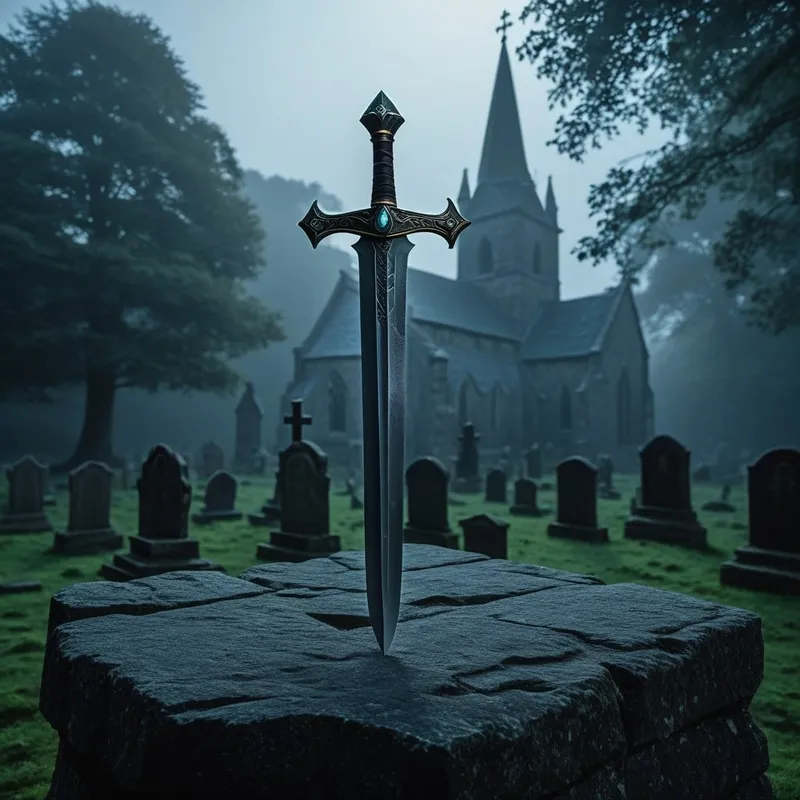
Excalibur in the Stone Myth Meaning & Symbolism
A sword, embedded in an anvil upon a stone, awaits the one true king, proving that rightful power is not taken, but recognized and received.
The Tale of Excalibur in the Stone
Listen, and hear a tale from the age of mists, when Britain was a land of warring lords and deep, forgotten magic. The great king, Uther Pendragon, was dead, and the realm plunged into a winter of despair. The lords quarreled like jackals over a carcass, and the people wept for a leader who could unite the shattered land.
In this darkest hour, on a Christmas morn when hope itself seemed frozen, a miracle bloomed in the churchyard of the greatest church in London. The people, gathered for mass, emerged to find a sight that stole their breath. In the center of the yard stood a great square stone, like an altar from a time before churches. Upon it rested a heavy anvil of iron, and plunged deep through the anvil and into the heart of the stone itself was a splendid sword. Its blade caught the weak winter sun, and its pommel glittered with gems. And around it, written in letters of gold, was a proclamation: “Whoso pulleth out this sword of this stone and anvil, is rightwise king born of all England.”
A murmur like the sea swept through the crowd. Kings and dukes, barons and champions—all who fancied their strength and their right—stepped forward. They wrapped hands hardened by war around the jewelled hilt. They planted their feet and heaved until their faces purpled and their muscles screamed. But the sword slept on, unmoved, as if it were a mountain root. It rejected them all. The stone was not merely heavy; it was choosing. Season after season, through tournaments and feasts, the sword remained, a silent judge in the churchyard, a promise and a taunt.
Years passed. The land’s winter persisted. Then came a tournament, a grand contest of arms. A young boy, a ward named Arthur, served as squire to his foster brother, Sir Kay. In the frantic bustle, Kay discovered he had left his own sword at his lodgings. He commanded Arthur, “Fetch me a sword, boy!”
Arthur, eager to please, dashed away. But the lodgings were locked and empty. Desperate, his eyes fell upon the churchyard, and the sword in the stone. Knowing nothing of its decree, seeing only a fine blade ready to hand, he approached. There were no straining nobles now, only the quiet and the cold. He took the hilt. It fit his grip not as a tool fits a hand, but as a key fits a lock destined for it. He did not strain; he drew. With a sound like a sigh of releasing earth, the blade slid free from the anvil and the stone.
He presented the sword to Sir Kay. And so the truth began, like a crack in ice, to spread. The lords, furious and disbelieving, demanded proof. They forced the stone back into the churchyard, commanded Arthur to replace the sword. And before the assembled might of a skeptical realm—before bishops, knights, and scowling kings—the boy, this unknown fosterling, placed the blade back into its resting place. And then, while strong men again failed, he drew it out. Once, twice, and once more for all to see. The sword yielded to him alone. Not to the strongest arm, but to the rightful heart. The winter broke. The people shouted, though some lords grumbled still. For the stone had spoken. The king, rightwise born, had been found not by conquest, but by recognition.
Cultural Origins & Context
The tale of the sword in the stone is a cornerstone of the Arthurian cycle, but its roots are curiously shallow in the oldest strata of the myth. It does not appear in the earliest Welsh texts. Its first known telling is in Robert de Boron’s Merlin (c. 1200), and it was popularized for the English-speaking world by Sir Thomas Malory’s Le Morte d’Arthur (1485).
This narrative emerged in the high medieval period, a time obsessed with questions of legitimacy, divine right, and the nature of true nobility. It functioned as a powerful political and social metaphor. In a feudal society where power was often seized by the most brutal or the most cunning, the myth presented an idealized alternative: sovereignty as a sacred trust, conferred by a mechanism beyond human manipulation. It answered a deep cultural longing for a leader whose authority was incontestable because it was ordained—by God, by destiny, or by the ancient magic of the land itself. The story was told in courts and sung in halls, a reminder to both ruler and ruled that true kingship is a service, a burden only the destined can bear, proven not in the coronation ceremony, but in the silent churchyard test.
Symbolic Architecture
At its core, the myth is a profound allegory for the discovery of authentic selfhood and legitimate authority. The components are not mere plot devices but deep symbols of the psyche.
The Stone represents the hardened, collective world—tradition, law, the established order, and the unconscious foundation of society and self. It is inert, heavy, and seemingly immutable. The Anvil upon it signifies the forge of destiny and trial; it is the point of impact where will meets fate. Together, they form the seemingly insurmountable problem of the age: how can new life, new order, emerge from this frozen state?
The sword in the stone is the ultimate paradox: the instrument of division and clarity, sheathed in the heart of unity and obscurity.
The Sword, Excalibur in its first form, is not just a weapon. It is discernment, sovereign will, and divine mandate. It is the power to cut through illusion, to make decisive judgments, and to defend a sacred boundary. Embedded in the stone, it symbolizes the latent potential for true authority that exists within the very fabric of the world and the self, waiting to be activated.
Arthur’s act is not one of conquest, but of recognition and reception. He does not break the stone; he liberates the sword from it. This is the critical psychological turn: the ego does not create its own authority through force of will alone. Instead, it must align itself with a deeper, pre-existing pattern of wholeness—the Self—and become its instrument. The myth teaches that rightful power is not grabbed; it is accepted as a duty when one’s personal nature aligns with a transpersonal destiny.
The Dreamer’s Resonance
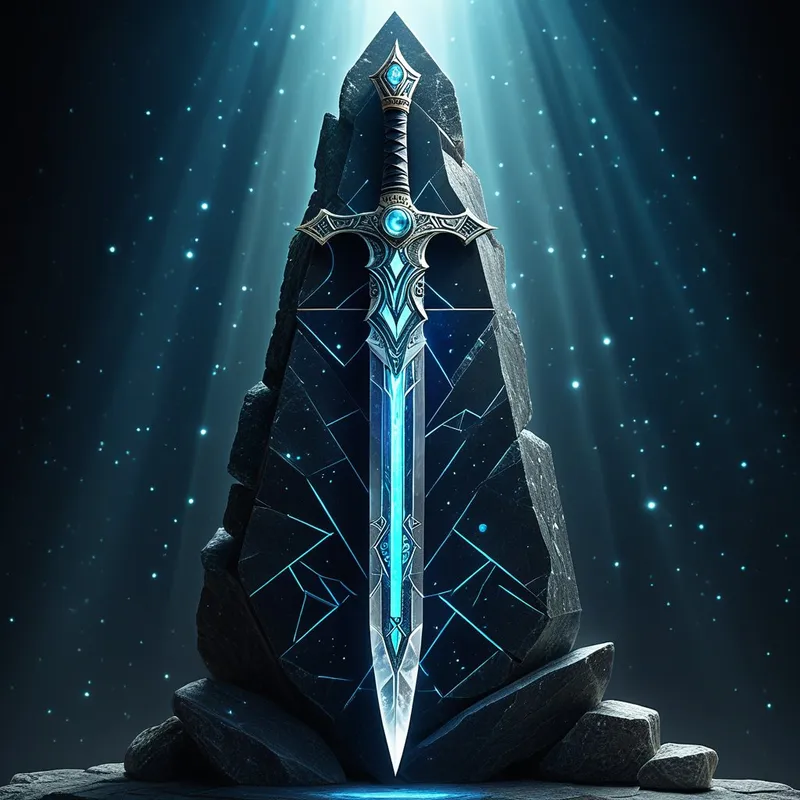
When this mythic pattern stirs in the modern dreamscape, it often signals a profound crisis or opportunity around vocation and authentic power. To dream of a sword stuck fast in a stone, a tree, or any immovable object is to confront the dreamer’s own sense of latent, unrealized potential. The dreamer may feel they possess a gift, a clarity of purpose, or a capacity for leadership (the sword), but it is trapped within the confines of their current life structure, familial expectations, or internalized limitations (the stone).
The somatic experience in such dreams is key. Dreaming of failing to pull the sword often accompanies feelings of fraudulence, imposter syndrome, or a life lived according to others’ scripts. There is a straining, a frustration, a fundamental disconnect. Conversely, dreaming of successfully drawing the sword can be accompanied by a surge of effortless power, a sense of “fit,” or a profound quiet certainty. This is the psyche signaling the alignment of the conscious personality with its deeper archetypal blueprint. The dream is an invitation to ask: Where in my life am I straining for a power that is not truly mine? And where, if I were to act with authentic integrity, might my actions feel “fated” and effortless?
Alchemical Translation
The journey of the sword from the stone is a perfect map for the individuation process. The initial state is nigredo—the blackening, the winter of the realm, the fragmented self ruled by competing inner “barons” (complexes). The stone is the hardened, unconscious state of the personality.
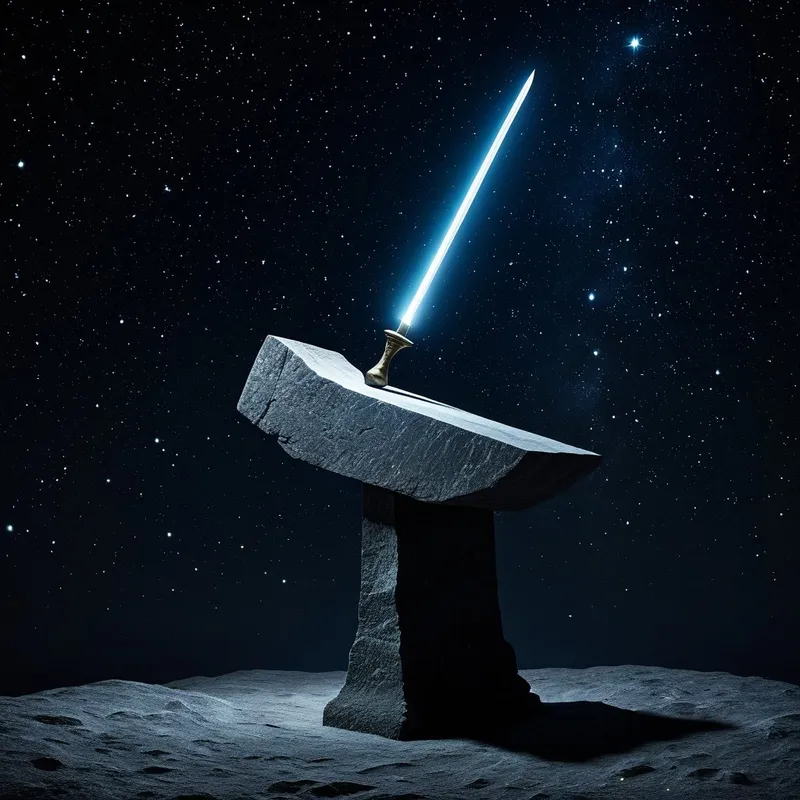
The act of drawing the sword is the coniunctio, the sacred marriage. It is the moment when the conscious ego (Arthur) successfully connects with and extracts the power of the Self (the sword) from the depths of the unconscious (the stone). This is not an act of violence, but of precise, destined union.
To pull the sword is to perform an alchemy of the soul: transforming the leaden weight of fate into the golden agency of destiny.
The resulting kingship represents the integrated personality. The sword, now wielded, is the differentiated consciousness that can cut through neurosis, make clear boundaries, and act with authority born of inner unity. The stone is not destroyed; it remains as the foundation, the grounding reality of one’s history and being. But it is no longer a prison. It is the throne upon which the liberated Self now rightly sits.
For the modern individual, the myth instructs us that our true “power” and “calling” are not invented, but discovered. They are embedded in the very core of our being—our talents, our deepest wounds, our innate character. The labor is not to manufacture a false self impressive enough to seize the sword, but to strip away all that is not the rightful king—the illusions, the borrowed identities—until we are simple and authentic enough for the stone to release its treasure to us. We become sovereign not by ruling over others, but by first claiming the kingdom of our own integrated soul.
Associated Symbols
Explore related symbols from the CaleaDream lexicon: