Euclid's Elements Myth Meaning & Symbolism
A myth of the divine geometer who descends to impose perfect, eternal order upon the chaotic, formless world of becoming.
The Tale of Euclid's Elements
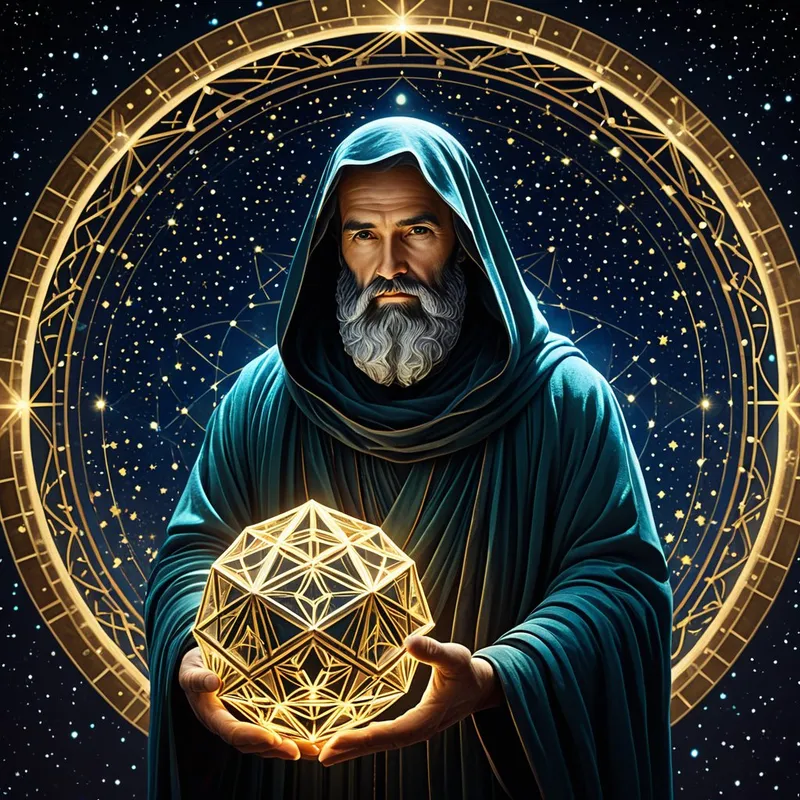
Listen, and hear the tale not of a man, but of an ordering. In the time when the world was still soft, a formless clay awaiting a seal, there was only the churning of potential—the Chaos. It was a realm of shadows without objects to cast them, of relationships without terms. Then, from the silent, starless deep, a presence descended. Not with thunder, but with a thought. Not with a sword, but with a compass.
They called him the Geometer. His brow was not crowned with gold, but with the invisible angles of perfect contemplation. In his hand, he carried no scepter, but the unbreakable law of necessity. He stood upon the featureless plain of becoming and planted his staff. Where it touched, a point was born—the first and most profound of all mysteries. A location without dimension, a "here" that defined a "there."
From this singularity, he spoke a word that was a line. "Let there be a shortest path between two points." And there was. A ray of pure direction, infinite and unbending, cutting the formless mist. With this line, he drew a circle, sweeping his arm in an arc of perfect closure, creating the first bounded space, the womb of all figures. The conflict was not against a monster of flesh, but against the very nature of indeterminacy. The rising action was the relentless, patient application of axiom upon axiom, postulate upon postulate. Each statement was a stone, perfectly hewn, laid upon the last with a logic so pure it chimed like crystal.
He wrestled the wild, irrational shapes of the world into obedience, proving that within the seeming chaos of a triangle’s sides lay a secret, immutable harmony. He built, from these first principles, a cathedral of thought: the five perfect solids, the Platonic Solids, which became the very atoms of creation—fire, earth, air, water, and the cosmos itself. The resolution was not a battle won, but a world rendered intelligible. The final proposition was not a conclusion, but a door swinging open onto a landscape of eternal truth, where the light of reason cast no shadows. He did not conquer; he revealed. And in that revelation, the universe found its skeleton.
Cultural Origins & Context
This mythos crystallized not around campfires, but in the shaded colonnades of the Academy and the great Library of Alexandria. Euclid, the historical figure, is a shadow behind a radiant idea. His Elements was more than a textbook; it was a cultural artifact of supreme ambition, a systematic attempt to map the very architecture of divine reason. In a culture that venerated logos—word, reason, proportionate relationship—as a fundamental cosmic principle, this work was sacred scripture.
It was passed down not by bards, but by scholars and scribes, its transmission a sacred duty. Its societal function was profound: it was the ultimate paideia, the educational formation of the Greek mind. To work through its proofs was not merely to learn geometry; it was to undergo a spiritual exercise, to train the soul to perceive eternal truths beyond the deceptive flux of the senses. It served as the bedrock of philosophy, the practical tool for the astronomer, and the moral metaphor for the statesman seeking order in the polity. It asserted a breathtaking claim: that the human mind, through rigorous deduction, could partake in the mind of the divine.
Symbolic Architecture
At its heart, the myth of the Elements is a myth of the Logos imposing itself upon the Chaos. It represents the foundational human urge to find pattern, certainty, and necessity in a world of accident and change.
The point is the monad, the indivisible seed of consciousness from which all understanding grows. The line is the vector of intention, the will to connect and define. The circle is the symbol of wholeness, the self-contained psyche.
Euclid, as the Geometer, is the archetypal Sage, but also the inner Psychopomp who guides the soul through the labyrinth of confusion toward the center of clarity. The geometric proofs are not cold calculations; they are ritual steps in a dance of revelation. The struggle to prove a theorem mirrors the internal struggle to reconcile contradiction and achieve a moment of seamless understanding—a tiny, personal experience of cosmic order. The entire edifice symbolizes the psyche’s own structure: built from simple, self-evident truths (axioms of the self) into a complex, stable, and beautiful identity.
The Dreamer's Resonance
When this myth stirs in the modern unconscious, it often manifests in dreams of architecture, impossible geometry, or foundational repair. To dream of measuring vast, empty spaces, of drawing perfect lines that glow with intrinsic light, or of discovering that the walls of one’s home are built upon flawless geometric principles indicates a profound psychological process.
Somatically, this may be felt as a craving for structure, a deep need to "get to the point" or "draw a line" in a chaotic life situation. It is the psyche, in its self-organizing wisdom, attempting to perform its own Elements: to return to first principles. It is a process of re-founding. The dreamer may be overwhelmed by emotional complexity (the chaotic plane) and the unconscious is responding by activating the inner geometer—the part that seeks clarity, definition, and unshakable truth. The anxiety in such dreams often lies in the fear that the lines won't be straight, the proof won't close, revealing a flaw in one's foundational logic of self.
Alchemical Translation
The alchemical journey modeled here is the opus of crystallization. Where base alchemy seeks to turn lead to gold, this geometric alchemy seeks to turn the prima materia of confused experience into the crystalline lattice of conscious understanding.
The nigredo, or blackening, is the formless chaos, the problem without a solution, the life feeling without reason or shape. The albedo, or whitening, is the arrival of the first axiom, the "given," the one irreducible truth upon which one can stand. The citrinitas, or yellowing, is the arduous, step-by-step work of deduction, the linking of one insight to the next in a chain of golden necessity.
The final stage, the rubedo or reddening, is the Q.E.D., "that which was to be demonstrated." It is the moment of triumphant synthesis, where the sought-after conclusion is revealed to have been contained within the premises all along. For the modern individual, this is the process of individuation through intellect and integrity. It is building a life not on the sand of opinion or the swamp of emotion, but on the bedrock of self-evident truths that one has proven to oneself. It is the realization that the soul's freedom is found not in lawlessness, but in willingly embracing the beautiful, necessary laws of one's own deepest nature. The Geometer within does not imprison; he liberates by providing the eternal forms within which creation becomes possible.
Associated Symbols
Explore related symbols from the CaleaDream lexicon: