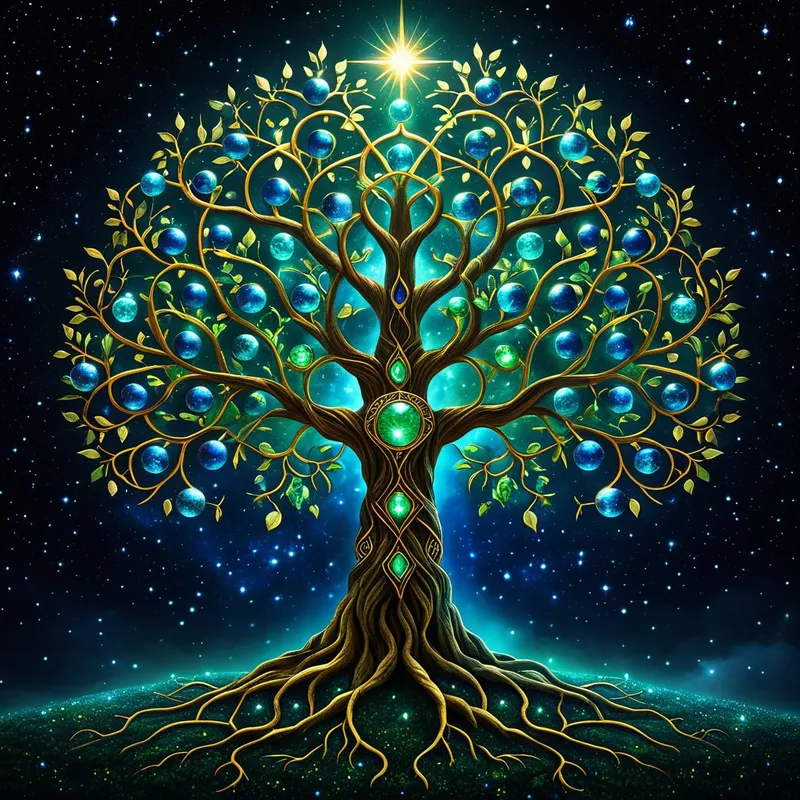
Etz Chaim Myth Meaning & Symbolism
A cosmic tree of ten luminous spheres, mapping the descent of divine light into creation and the soul's perilous ascent back to its source.
The Tale of Etz Chaim
Before the world was world, before time was time, there was only the Infinite—Ein Sof—a boundless ocean of light without vessel, thought without word, presence without form. And within that endless stillness, a contraction occurred, a holy withdrawal: Tzimtzum. From that primordial void, a single point of concentrated will flashed forth.
That flash was not a sound, but the first idea of sound. It was not light, but the desire for light. And from that desire, a vessel began to form—not of clay or stone, but of divine longing itself. It grew, branching and fractaling, into a structure of ten holy vessels, ten spheres of radiant intention. This was the Etz Chaim, the Tree of Life.
Each sphere, a Sephirah, sang its own note in a silent hymn. Keter, the crown of pure white fire, burned at the summit. Below it, Chokhmah and Binah—father and mother—gave birth to the seven lower realms: the stern majesty of Chesed and the severe judgment of Gevurah, balanced in the heart as Tiferet. Then came the sustaining Netzach and the foundational Hod, joined in the body as Yesod, all pouring into the final vessel, Malkhut, the queen who receives all light.
But the light was too pure, too fierce. The early vessels, unable to contain the torrent, shattered—Shevirat HaKelim. Holy sparks of that primal radiance scattered, falling through the branches of the Tree, buried in the shells of brokenness, Kelipot. The Tree groaned, a wounded cosmos. Its pathways, the 22 connecting channels, became fraught with danger and shadow.
Yet the Infinite did not abandon its creation. A new, gentler light flowed down the central pillar, a zigzagging bolt of sustenance—the Lightning Flash. And a call was woven into the roots of the Tree, a call heard not with ears but with the soul: to gather the sparks, to mend the vessels, to make the ascent. The myth is not of a battle won, but of a journey forever beginning, of a light forever descending so that a soul might dare to climb.
Cultural Origins & Context
The myth of the Etz Chaim is not a folktale told around fires, but a secret whispered from master to disciple in the study halls of medieval Provence and Safed. It crystallized in texts like the Zohar (13th century), written in a coded Aramaic that itself mirrored the Tree’s hidden structure. This was esoteric knowledge, Kabbalah, meaning “that which is received.” It was passed hand to hand, mind to mind, under vows of maturity and moral readiness.
Its societal function was dual. For the community, it provided a theodicy—an explanation for a world of exile and suffering rooted in a primordial divine drama (Shevirat HaKelim). More profoundly, for the individual mystic, it was an active, experiential map. The Tree was a diagram of the divine cosmos and the anatomy of the human soul. To study it was to engage in Tikkun Olam—the repair of the world—by first undertaking the repair of one’s own inner universe, aligning one’s attributes with the divine emanations. It transformed prayer from petition into a conscious act of navigating these inner-outer spheres to draw down healing light.
Symbolic Architecture
The Etz Chaim is the ultimate symbolic architecture of the psyche in relation to the cosmos. It is not a static diagram but a dynamic system of relationships.
The Tree grows in two directions at once: its roots drink from the heavens, and its branches bear the fruit of the earth.
Each Sephirah represents a fundamental archetypal energy or stage of consciousness. Keter is the transcendent spark of pure potential, the Self in its most unknown form. Chokhmah is the flash of intuition, the “aha!” moment, while Binah is the womb that gives it form and structure—the dynamic between inspiration and comprehension. The lower Sephirot map the human experience: the grace and overflow of Chesed versus the necessary boundaries and discipline of Gevurah, synthesized in the heart-center of Tiferet, the integrated Self.
The shattering of the vessels symbolizes the inevitable trauma of incarnation—the fragmentation of wholeness into the complexities and contradictions of lived experience. The scattered sparks are the fragments of our own divine potential, lost in our complexes, wounds, and unconscious patterns (Kelipot). The entire system is held in the tension of the three pillars: the right (Mercy/Expansion), the left (Severity/Restriction), and the central pillar of Consciousness, the path of balance and return.
The Dreamer's Resonance
When this myth stirs in the modern dreamer, it often manifests not as a literal tree, but as an architecture of ascent or integration. One may dream of climbing a vast, intricate ladder through different colored levels of light, each with a distinct emotional tone—perhaps anxiety at a red, constricted level (Gevurah), or peace in a green, expansive space (Chesed). One might dream of searching for scattered jewels in a ruined palace, or of trying to repair a complex, broken machine that is somehow also one’s own body.
Somatically, this process can feel like a reorganization of energy in the body—a clearing of blockages, a sense of currents moving up the spine (echoing the central pillar), or a pressure in the crown of the head. Psychologically, it is the process of moving from a state of identification with a single, fragmented part (a trauma, a role, a complex) toward a more conscious relationship with the full spectrum of one’s being. The dream is signaling that the psyche is attempting its own Tikkun Olam, gathering lost parts of the self. The shadowy, dangerous paths (Netivoth) in the dream represent the fraught but necessary transitions between psychological states.

Alchemical Translation
The alchemical work modeled by the Etz Chaim is the opus of psychic transmutation known as individuation. It is the conscious undertaking of the soul’s journey it has always been on unconsciously.
The descent of the divine is the condition for the ascent of the human; the wound is the birthplace of the healer.
The process begins with the Nigredo, the blackening, mirrored in the Shevirat HaKelim—the acknowledgment of one’s fragmentation, one’s broken vessels. The scattered sparks are the gold hidden in the shadow. The work of Tikkun is the Albedo, the whitening: the careful, ethical labor of gathering these sparks by integrating repressed emotions, acknowledging one’s capacity for both mercy and severity, and balancing the inner opposites.
Ascending the central pillar is the Citrinitas, the yellowing, where insight (Chokhmah) is tempered by understanding (Binah), leading to the heart-centered realization of Tiferet—the true, authentic Self that is both individual and connected to the transpersonal. The final stage, the Rubedo or reddening, is not a static arrival at the crown (Keter), but the ability to fully embody this realization in the world (Malkhut). One becomes a stable vessel, not to hoard the light, but to channel it. The seeker becomes a living pillar on the Tree, a conscious participant in the endless, sacred circuit where the divine descends so that the human may ascend, and in ascending, invites the divine ever deeper into the world.
Associated Symbols
Explore related symbols from the CaleaDream lexicon: