Etemenanki Myth Meaning & Symbolism
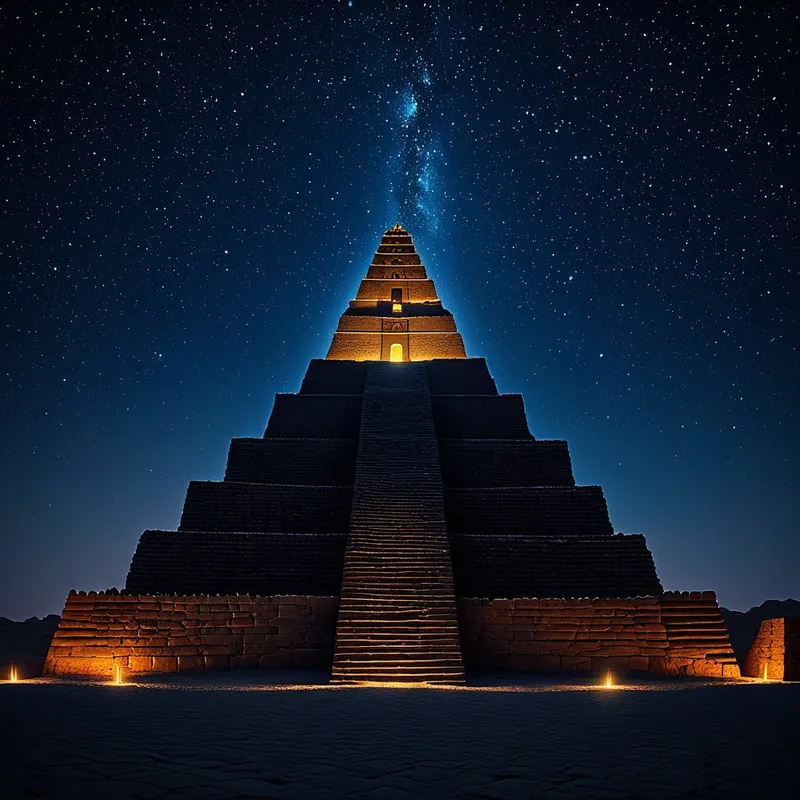
The myth of the great ziggurat, a divine ladder between heaven and earth, built by gods and kings to establish cosmic order and human purpose.
The Tale of Etemenanki
Hear now the tale of the Etemenanki, the axis of the world. In the beginning, after the great deluge had receded and the mud of creation lay fresh, the gods themselves walked upon the earth. They found it formless, a trackless plain between the Apsu below and the Anu above. A silence hung between the waters and the stars, a gap too vast for prayer to cross.
The great god Marduk, slayer of the chaos-dragon Tiamat, surveyed his hard-won order. He decreed: "Let there be a bond. Let there be a navel, a place where the cords of heaven are tied fast to the pegs of the earth. Let it be a mountain of baked earth and fragrant bitumen, a stairway for our descent and a beacon for their ascent." And so the design was etched upon the tablet of destiny.
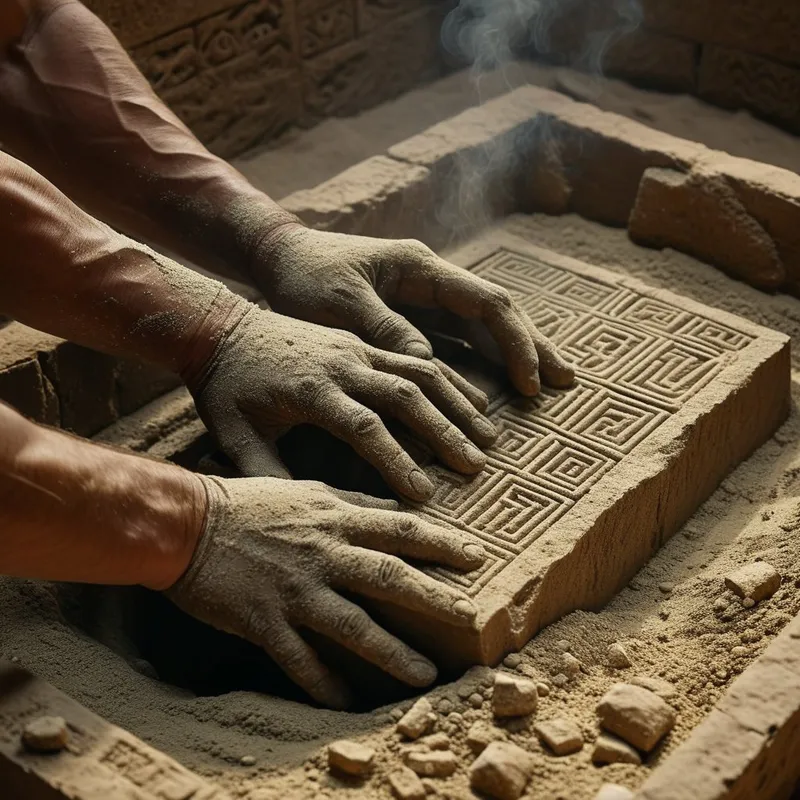
The labor fell to humanity, the sag-gig-ga, fashioned from the blood of a slain rebel god and the clay of the earth. For generations, under the scorching sun and by the light of the moon, they toiled. They molded countless bricks, stamping each with the name of the king, the servant of the gods. They hauled them from the kilns, their backs bent, their songs a rhythmic plea to the divine. The scent of hot bitumen, black and pungent as primordial tar, filled the air, sealing tier upon tier.
Seven levels they raised, each smaller than the last, painted in the colors of the planets. At its base, the roar of the city; at its summit, only the whisper of the wind and the presence of the god. Upon the highest terrace, in a chamber of cedar and gold, the bed of Marduk stood empty, waiting. Here, once a year, in the sacred Akitu festival, the king would climb. He would take the hand of the high priest, who embodied the god, and be stripped of his regalia, slapped, and humbled, to prove he was but a mortal steward. Only then, reaffirmed in his servitude, was order secured. The ladder stood firm. The cosmos breathed in harmony. The me flowed down its sides like honey, and the prayers of the people rose like smoke.
Cultural Origins & Context
The story of Etemenanki is not a single, frozen myth but a living ideology built in brick and ritual. Its historical referent was the great ziggurat of Babylon, dedicated to Marduk, likely constructed and rebuilt over centuries from the Old Babylonian period onward. It reached its legendary height under King Nebuchadnezzar II in the 6th century BCE. The myth was not merely told; it was performed. It was the theological justification for the monarchy and the state. The king’s primary divine duty was to be the temple-builder, the maintainer of this cosmic connection.
The narrative was embedded in ritual texts, foundation cylinder inscriptions buried within the structure itself, and the elaborate ceremonies of the Akitu. To "tell" the myth was to enact it: through the rhythmic labor of brick-making, the procession of priests, the king’s symbolic humiliation and reinstatement. Its societal function was paramount: it visualized and stabilized the entire Mesopotamian worldview. It answered the existential fear of a return to chaos by physically and symbolically anchoring the world to the divine source of order. The ziggurat was the beating heart of the empire, the guarantee that the sun would rise, the rivers would flood, and the kingdom would endure.
Symbolic Architecture
At its core, Etemenanki is the ultimate symbol of the axis mundi—the world center, the link between realms. It is a mountain, a ladder, a bridge, and a navel all in one. Psychologically, it represents the human psyche’s innate structure and its deepest yearning: to connect the foundational, often chaotic waters of the unconscious (the Apsu) with the lofty, ordering principles of consciousness and spirit (the Anu).
The ziggurat is not an escape from the earth, but a transformation of it. Each tier is a stage of consciousness, built from the very mud of our embodied, instinctual nature.
The seven tiers correspond to the known planets and the stages of alchemical and psychological refinement. The arduous, collective labor signifies the slow, often grueling work of building a coherent Self. The king’s annual humiliation at the summit is the critical symbolic act: the ego (the king) must be regularly dissolved and reconsecrated to a higher power (the god) for the structure to hold. The summit is not for permanent residence; it is a place of encounter, where the human touches the divine and returns, renewed, to govern the earthly realm with borrowed authority.
The Dreamer's Resonance
When this myth stirs in the modern unconscious, it often manifests in dreams of immense structures: endless staircases, towering skyscrapers, precarious ladders, or complex, multi-level buildings. The somatic experience can be one of awe mixed with exhaustion—the feeling of a monumental, necessary task. The dreamer may be building, climbing, or watching such a structure decay.
To dream of climbing Etemenanki suggests a conscious engagement in the process of psychological ascent—seeking meaning, perspective, or spiritual connection. The focus is on the effort, the view from each new level. To dream of its foundation, or of laying bricks, points to the essential, often overlooked work of grounding and building a stable psyche from raw, earthy experience. A dream of the structure crumbling or being inaccessible speaks to a felt disconnection from one’s inner center or higher purpose, a "cosmic anxiety" where the link between daily life and deeper meaning has been severed. The dream is the psyche’s blueprint, urging the reconstruction of that inner axis.
Alchemical Translation
For the individual on the path of individuation, the myth of Etemenanki models the alchemical opus: solve et coagula—dissolve and coagulate. The "base matter" is the unrefined self, the chaotic blend of personal history, complexes, and instincts (the post-diluvial mud). The "work" is the deliberate, patient construction of a structured personality (the ziggurat), tier by tier, insight by insight.
The king’s journey to the summit and back is the archetypal pattern of inflation and correction. The ego ascends, claims the throne of consciousness, but must regularly descend to be stripped bare in the service of the greater Self.
The modern "king" is the ruling consciousness of the individual. The annual ritual translates to the necessary psychological practice of humility: periodically surrendering the ego’s rigid control, its titles and achievements, to listen to the voice of the inner Marduk—the inner organizing principle, the Self. This is not self-abnegation, but a sacred recalibration. One does not live at the summit, in a state of spiritual inflation. One builds the structure so that the connection is possible, then returns to live in the city of one’s relationships and responsibilities, now irrigated by the me—the divine laws of one’s own authentic nature. The triumph is not in reaching a static heaven, but in maintaining the living, breathing ladder between the depths and the heights, making the whole of one’s experience a sacred, connected whole.
Associated Symbols
Explore related symbols from the CaleaDream lexicon: