Erinys Myth Meaning & Symbolism
Ancient goddesses of vengeance born from primordial blood, the Erinys pursue the guilty until sacred rites restore cosmic and psychological balance.
The Tale of Erinys
Hear now a tale not of bright Olympus, but of the deep, chthonic earth. It begins with a crime that stains the cosmos—the spilling of a parent’s blood.
When the Titan Ouranos was cast down by his son Kronos, his blood fell upon the ancient body of Gaia. From that dark, fertile ground, they arose. Not one, but three: Eumenides, men called them in fearful hope, but their true name was Erinys. They were born not of love, but of violation; not of order, but of primal disruption. Their very essence was the cry of spilled blood that goes unanswered.
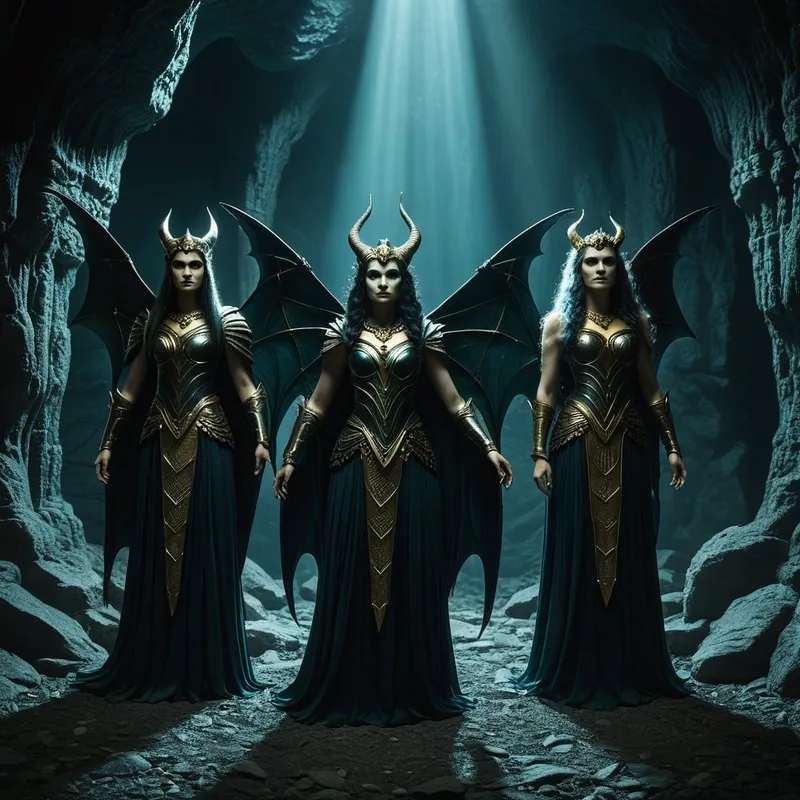
They dwelt in Erebos, in darkness older than the sun. They wore robes the color of dried blood, and serpents coiled in their hair and around their arms. Their wings were not of feather, but of leathery hide, and in their hands they carried whips tipped with brass. They did not sleep. They listened. They waited.
For when kin-blood soaked the earth—when a son raised a hand against his mother, or a host betrayed his guest—the earth itself would whisper to them. The stain would become a scent, and the scent a trail. Then they would rise, a silent storm from the underworld, visible only to the guilty. To the murderer, they appeared as relentless phantoms, their breath hot and foul, their whispers a ceaseless chorus in the mind: Matricide. Betrayer. You are ours.
So it was for Orestes. He had done the unthinkable, driven by the command of Apollo to avenge his father Agamemnon by slaying his mother, Clytemnestra. One sacred duty fulfilled, another, older one shattered. The moment his blade found its mark, the air grew thick. The sweet, metallic scent of her blood called across the unseen world. And they came.
He fled from Mycenae, but he could not outrun them. In every still pool, he saw their reflections behind him. In the rustle of leaves, he heard the drag of their scourges. They hounded him across land and sea, not to kill him swiftly, but to break his mind, to drink the madness of his guilt, to chase him until his soul was as barren as the stones he stumbled over. His flight was his punishment, a living death under their eternal gaze.
His only sanctuary was the temple of Athena in Athens. There, exhausted and haunted, he clasped the ancient wooden idol of the goddess, a supplicant polluted by blood. The Erinys surrounded the temple, their fury a palpable shadow, demanding their rightful prey. The cosmic order itself hung in balance.
Athena, in her wisdom, convened the first court of justice: the Areopagus. Apollo spoke for Orestes, arguing the newer law of the father. The Erinys, the voice of the old, matriarchal earth, spoke for Clytemnestra, arguing the primordial law of the mother. The votes of the mortal jurors were tied. Then Athena, born from the mind of Zeus alone, cast her ballot for Orestes. He was free.
But the goddess did not dismiss the ancient ones. She saw their power, their necessity. With profound respect, she offered them a new home, a new honor. No longer would they be hunters in the dark. They would become guardians within the polis, protectors of justice from their sacred caves beneath the Athenian hill. Their fury was not banished, but transformed. They accepted. The Eumenides were born from the Erinys, and the world took a shuddering breath, moving from blind vengeance to mindful justice.
Cultural Origins & Context
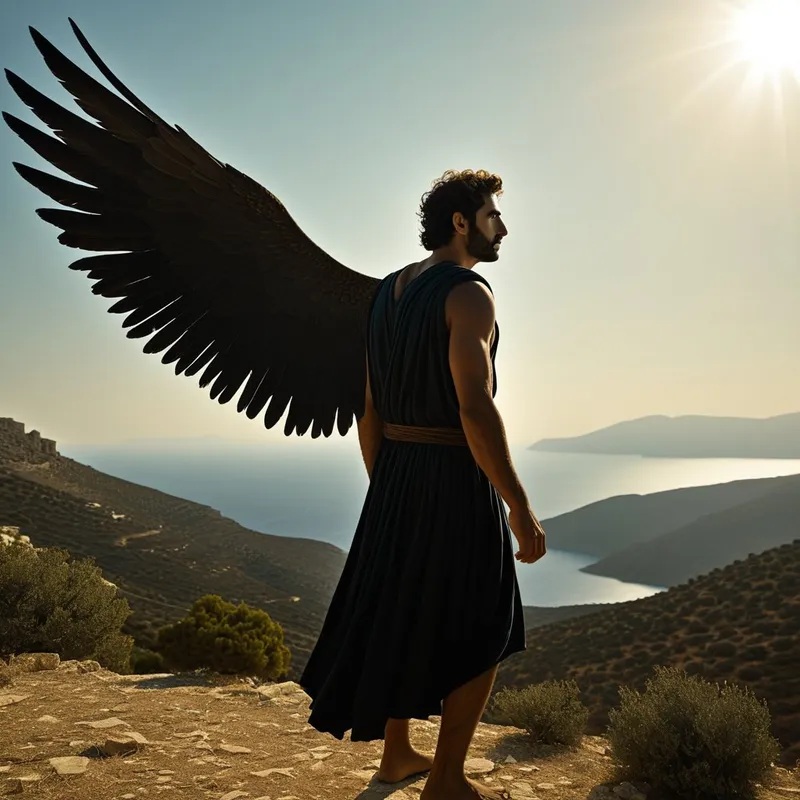
The myth of the Erinys is not a single story but a powerful, evolving cultural force rooted in the deepest strata of pre-Olympian Greek religion. They belong to the chthonic (earth) deities, far older than the Olympian pantheon. Their origins lie in the fundamental, pre-political human understanding of miasma—ritual pollution caused by acts like murder, particularly kin-slaying. This pollution was not merely a personal stain; it was a contagious blight on the family, the community, and the land itself.
Their stories were passed down through epic poetry, most definitively in Aeschylus’s trilogy, the Oresteia. Here, they are not mere monsters but potent theological and philosophical arguments made flesh. In the oral tradition and later tragic drama, they served a critical societal function: they externalized the terrifying concept of a moral order that exists beyond human law. Before codified courts, the fear of the Erinys was a powerful deterrent against societal chaos. They represented the collective conscience of the clan, the unbearable weight of blood guilt that could only be cleansed through specific, arduous purification rites administered by seers and priests.
Symbolic Architecture
The Erinys are the psyche’s own law, older than reason, older than the conscious ego. They are not evil, but absolute.
They are the embodiment of the psychic fact that a violated fundamental order must exact a price. To ignore them is to invite psychosis; to face them is to begin the work of soul.
They symbolize the autonomous complex of guilt. When we betray a deep, inner truth—when we "murder" a part of our own potential, integrity, or connection—an Erinys is born within. It manifests as chronic anxiety, obsessive thoughts, self-sabotage, or a pervasive sense of being pursued by a nameless dread. Their serpentine hair signifies the tangled, "reptilian" complexity of this guilt, which strikes at the instinctual level. Their whips are the lash of a merciless, inner critic.
Their transformation into the Eumenides is the myth’s crowning psychological insight. It represents the alchemy of conscience. Raw, persecutory guilt (the Erinys) must be acknowledged, heard, and given a sacred place in the structure of the self. It then transforms into a protective, guiding force (the Eumenides)—a healthy superego or moral compass that safeguards our humanity rather than torturing it.
The Dreamer's Resonance
When the pattern of the Erinys stirs in modern dreams, the dreamer is in a state of psychic emergency related to a violated taboo. This is not about social faux pas, but a breach of one’s own deep ethical or soulful code.
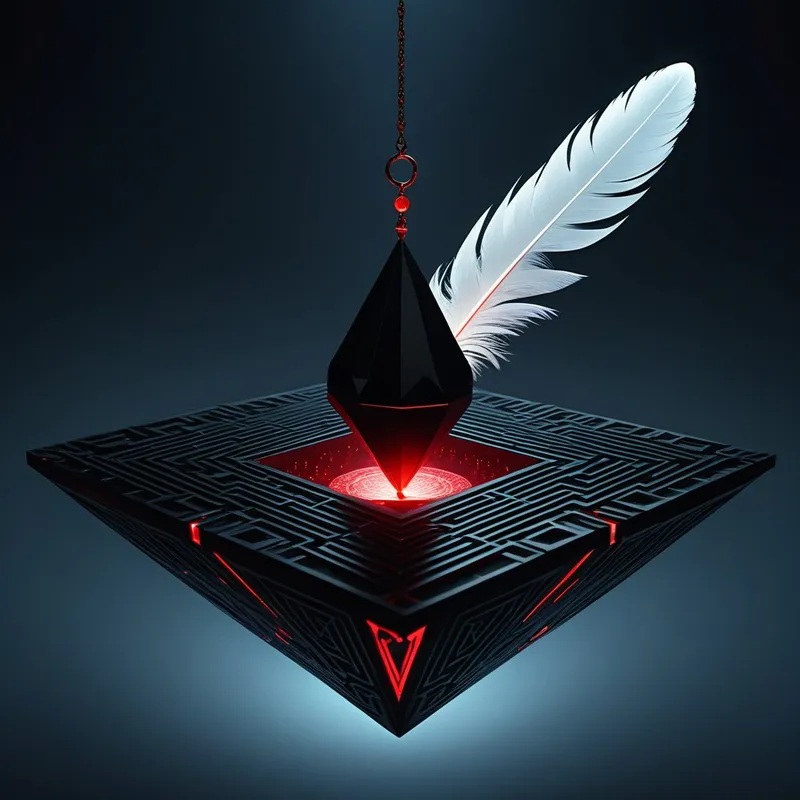
The dream imagery is one of pursuit. You are fleeing through labyrinthine streets, a decaying house, or a barren landscape. The pursuers are rarely seen clearly—they are shadows, ominous figures, buzzing insects, or most tellingly, a feeling of being watched and condemned. The atmosphere is thick with dread. Somatic sensations upon waking often include a tight chest, a racing heart, or a cold sweat—the body registering the chase.
This dream signals that an aspect of the self, a deed or a neglected truth, has been "split off" and is now demanding recognition. The psyche is forcing a confrontation. The dreamer is not being punished by external gods, but by their own dissociated conscience, which will continue its hounding until the inner Orestes stops running and turns to face what he has done.

Alchemical Translation
The myth of Orestes and the Erinys is a master blueprint for the process of individuation, specifically the integration of the Shadow and the moral complex it carries.
Stage 1: The Crime (Activation). The conscious ego (Orestes), often with good intention or under the influence of a lofty, spiritual ideal (Apollo—pure, cold reason), commits an act that severs a primal connection. In modern terms, this could be sacrificing relationship for ambition, betraying a creative calling for security, or silencing intuition for logic.
Stage 2: The Hounding (Confrontation). The autonomous Shadow complex (the Erinys) is activated. This is the stage of symptom: depression, anxiety, addiction, relationship failures. The ego feels persecuted by life itself. The attempt is to flee, to rationalize, to numb—but the hounding continues.
Stage 3: The Supplication (Surrender). Exhaustion leads to a crisis. The ego must finally fall at the feet of a higher, reconciling function. In the myth, this is the altar of Athena, symbolizing the transcendent function—the capacity to hold opposites. Psychologically, this is the moment of true humility, of seeking therapy, meditation, or any practice that allows the conscious mind to listen.
Stage 4: The Trial (Integration). The inner court is convened. The voice of the old, instinctual, matriarchal self (the Erinys) and the voice of the new, patriarchal, rational order (Apollo) are both given a hearing. This is the hard inner work of acknowledging the validity of both perspectives without identification.
Stage 5: The Transformation (Individuation). The tied vote and Athena’s deciding role signify that no old rule fully applies; a new, individual synthesis must be born. The guilt is not absolved but transmuted. The persecutory Furies are invited in and given a new, honored role as protective Eumenides. In the individual, this is the transformation of crippling guilt or shame into a grounded, compassionate wisdom. The energy that once chased us now guards our integrity. The cycle of blood is ended, not by denial, but by sacred inclusion.
Associated Symbols
Explore related symbols from the CaleaDream lexicon: