Erinyes Myth Meaning & Symbolism
Ancient goddesses of vengeance born from spilled blood, the Erinyes relentlessly pursue those who violate sacred kinship bonds, embodying the psyche's primal cry for justice.
The Tale of Erinyes
Hear now a tale not of Olympus’s bright peaks, but of the world’s dark, foundational groan. Before the reign of Zeus, in the time of primal becoming, the sky-god Ouranos lay upon the earth-goddess Gaia, a suffocating embrace. From their union sprang the Titans, but Ouranos, in fear and loathing, thrust each newborn back into Gaia’s womb. The earth groaned in agony, her depths a prison.
She fashioned a sickle of adamant and called upon her children. Only the youngest, Kronos, dared answer. He lay in wait. When Ouranos next descended to cover Gaia, Kronos struck. With a terrible, sweeping arc, he severed the sky from the earth. Ouranos roared in anguish, his blood and seed spraying across the cosmos. Where the dark, fertile drops fell upon Gaia, life sprang anew. But where the blood, the hot, vital ichor of a wounded god, splashed upon the earth… there, from the soaked soil, three figures arose.
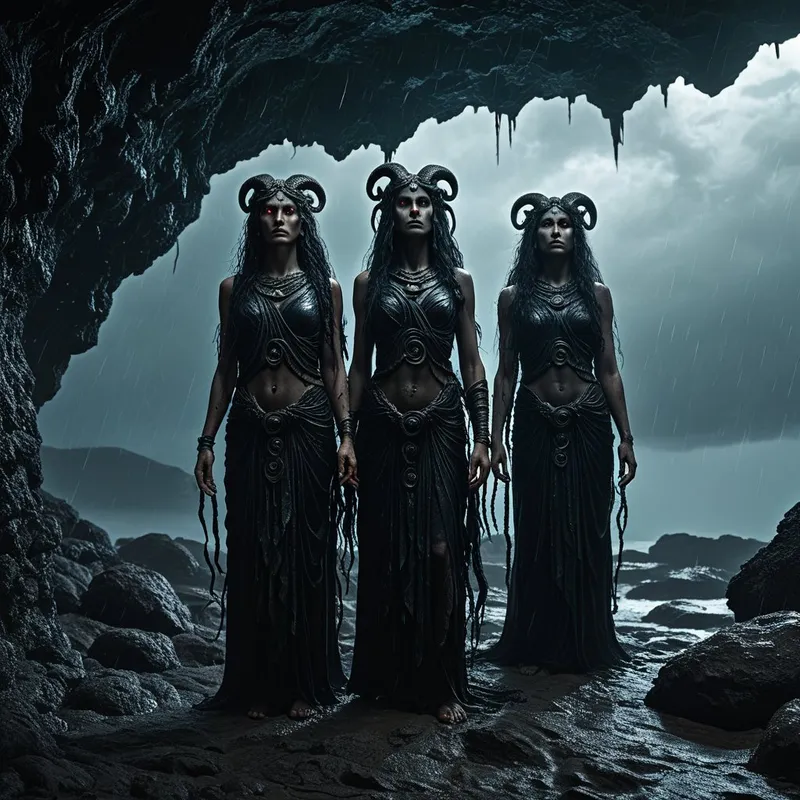
They were not born, but manifested. Their forms were of women, yet ancient beyond time. Their hair was a living nest of black serpents, hissing with a sound like dry leaves on stone. Their eyes wept tears of hot blood, seeing not the world, but the stain upon it. In their hands, they carried brass-studded whips and burning torches that cast no comforting light, only a stark illumination of truth. They were the Erinyes, and their first breath was a curse. They had no names, only a purpose: to pursue.
Their quarry was the one who spilled the kin-blood. Kronos, who had maimed his own father, felt their gaze turn upon him. A chill entered his golden age, a whispering at the edge of his throne. He fled, but they are the hounds of conscience, tireless and unswerving. They track not by footprint, but by the psychic scent of guilt. They find him in his dreams, their whispers becoming the grinding of the stone that will one day hold his own children. The cycle was set.
Generations later, the stain spread. Agamemnon sacrificed his daughter for a fair wind. His wife, Klytaimnestra</abbr, avenged the child, bathing her husband in his own blood. Then her son, Orestes, stood, dagger in hand, before his mother. The deed was done—a father avenged, a mother slain. And in the silent, bloody aftermath, as Orestes stared at his crimson hands, the air grew thick and cold.
They came. Not with thunder, but with a silence that swallowed sound. The Erinyes encircled him, their blood-tears tracing paths down cheeks of stone. They did not scream; they chanted, a low, rhythmic drone that vibrated in the marrow. “Matricide. Matricide. The blood of the womb calls for blood.” Their torches cast his shadow, a twisted, cowering thing, upon the palace walls. Orestes ran, and they followed, a relentless procession of nightmare. Across land and sea, through waking and sleeping, they were his constant shadow, the embodied scream of the natural order he had shattered. He was driven to the very edge of sanity, to the temple of Apollo at Delphi, and finally to Athens, to the court of the goddess Athena.
There, on the Areopagus, the first trial was held. The Erinyes stood, ancient and terrible, their case simple: the old law of blood for blood must be upheld. Apollo defended Orestes, arguing for the new law of the father, of civic order. The votes were tied. Athena, born from the mind of Zeus alone, cast the deciding vote. She acquitted Orestes. But she did not banish the Erinyes. Instead, she offered them a home, a sacred cave beneath Athens, and a new name: the Eumenides. She honored them. She transformed their endless, destructive pursuit into a guardianship of justice from below, the necessary shadow to the city’s bright laws. The primal scream was heard, respected, and integrated. The Furies, at last, found rest.
Cultural Origins & Context
The myth of the Erinyes is not a singular story with one author, but a deep, cultural stratum that permeates the earliest layers of Greek thought. They appear in the epic cycles of Homer and the profound tragedies of Aeschylus, particularly in his Oresteia, which provides the most complete narrative of their confrontation and transformation. These stories were not mere entertainment; they were the sacred texts of a culture grappling with its most fundamental anxieties.
Passed down through oral tradition and later formalized in theater, the myth served a critical societal function. In a world before codified law courts and police forces, the fear of the Erinyes was a powerful deterrent against intra-familial violence, the most destabilizing crime imaginable. They represented the collective, unconscious conscience of the community, the automatic and terrible consequence of violating philia—the sacred bonds of kinship. Their persistence in art and ritual, from curses inscribed on lead tablets to chthonic offerings, shows a culture deeply aware of a moral order that existed beyond the whims of gods or men, an order written in the very blood of the world.
Symbolic Architecture
The Erinyes are the psyche’s embodiment of inescapable consequence. They are not evil, but absolute. They represent the autonomous complex of guilt that activates when a fundamental taboo—often against one’s own blood or deepest self—is broken.
They are the voice of the wounded parent, the betrayed child, the forsaken instinct, rising from the unconscious to demand acknowledgment.
Psychologically, they symbolize the shadow in its most relentless and personified form. When an individual commits a profound self-betrayal, murders a part of their own soul (their creativity, their compassion, their truth) for ambition or convenience, the Erinyes are born within. They are the depression that follows burnout, the anxiety that haunts a lie, the physical symptom that manifests from repressed trauma. They do not seek punishment for its own sake, but for restoration. Their pursuit is the psyche’s brutal, non-negotiable method of forcing the ego to confront what it has tried to bury. The blood they weep is both the crime and the undeniable reality of connection that the crime severed.
The Dreamer's Resonance
To dream of being pursued by the Erinyes is to experience the somatic reality of a guilty conscience or a profound moral injury. The dreamer may not be fleeing a literal crime, but rather the consequences of a broken promise to the self, a betrayal of one’s own values, or the suppression of a painful truth.
The atmosphere is key: a feeling of inescapability, a landscape that offers no refuge, and pursuers who are implacable and just. There is no reasoning with them. This dream pattern signals that a psychological process of confrontation can no longer be avoided. The ego is being hunted by contents of the unconscious that have been activated by an action or inaction. The dreamer is in the "Orestes phase"—fleeing, tormented, and on the brink of psychic collapse. The body may respond with night sweats, a racing heart upon waking, or a lingering sense of dread, as the dream-work translates unprocessed guilt into a primal chase narrative. It is the self’s emergency alarm.
Alchemical Translation
The myth of the Erinyes models the alchemical process of nigredo—the blackening, the confrontation with the shadow—and its ultimate transmutation. The journey is not one of defeating the Furies, but of enduring their pursuit until one arrives at the court of a higher consciousness (Athena).
The individuation process requires that we do not silence the inner Fury, but stand trial before it, allowing its ancient, bloody testimony to be heard.
For the modern individual, the "matricide" or "patricide" may be the necessary killing of an internalized, oppressive parental complex, or the breaking of a toxic familial pattern. The crime creates the Furies (guilt, anxiety, depression). The long flight is the painful period of integration, where one must live with the consequences of one’s necessary act of self-liberation. The trial represents the moment of conscious reflection, where the old, automatic law of guilt (the Erinyes) is confronted by the new, discerning voice of the differentiated Self (Athena). Acquittal is not exoneration from consequence, but the recognition that the act, though painful, served a higher order of psychic truth.
The final transformation into the Eumenides—the Kindly Ones—is the alchemical gold. It is the point where raw, persecutory guilt is transmuted into a vigilant conscience. The energy that once tormented you now guards your boundaries, enforces your integrity, and becomes a sacred, protective force rooted in the depths of your being. The integrated Fury is no longer a hunter from the dark, but a revered guardian of your inner citadel.
Associated Symbols
Explore related symbols from the CaleaDream lexicon: