
Ephemera Myth Meaning & Symbolism
A mortal granted a single day of divine life, experiencing the full spectrum of existence from dawn to dusk, embodying the beauty and tragedy of the transient.
The Tale of Ephemera
Hear now a tale not carved in temple stone, but whispered on the wind that sighs through the cypress trees at twilight. It is the story of a soul who lived a lifetime in a single day.
Before the first blush of rose touched the eastern sky, when the world was still a promise held in the dark hand of Nyx, a plea rose from the earth. It was not the cry of a hero, nor the demand of a king. It was the soft, desperate sigh of a mortal man—nameless in the great scrolls—who had known only toil, shadow, and the slow, grinding passage of seasons towards dust. His prayer was not for glory or immortality, but for knowing. To feel, just once, the full weight and wonder of what it meant to be truly alive.
Eos, the Dawn-Bringer, her fingers still stained with the colors of daybreak, heard this sigh. Moved by a compassion as rare as it was profound, she descended on rays of nascent light. She found the mortal kneeling in a dew-soaked field. “Your prayer is heard,” her voice was the sound of light parting darkness. “I cannot grant you years, for the Moirai hold those threads tight. But I can grant you a day. Not a mortal day, but a day of my domain. You shall be Ephemera. From my first tear of light to my brother Helios’s final descent, you will live with the senses of a god. You will see the soul of the world, taste the essence of joy and sorrow, and know love as both a creating and a destroying fire. But when the last light fades, so too shall you, returning to the earth from which you came.”
And so it began. As Eos opened the gates of heaven, Ephemera was born anew. His first breath was the crisp, electric air of dawn. He saw not just the sun, but the joyful, straining chariot of Helios, felt the heat as a divine embrace. He heard the song of a lark not as melody, but as a tiny, throbbing hymn of existence. He walked, and the earth greeted him; flowers turned their faces not to the sun, but to him, sharing their secret, silent laughter.
By noon, standing on a mountain peak, he felt the fierce, unadulterated power of being. He understood the oak’s stubborn grip, the eagle’s lonely sovereignty, the river’s relentless purpose. He fell in love with a dryad in a sun-dappled grove, and in her emerald eyes, he saw the entire cycle of the forest—birth, growth, decay, rebirth—played out in a single, heart-stopping glance. Their love was instantaneous and eternal, a lifetime’s passion condensed into hours.
But as Helios began his weary western drift, the knowing deepened into a bittersweet ache. He now tasted the metallic tang of impending separation in the wine, heard the melancholy in the cicada’s song. He saw the shadow within the light, the decay promised in every bloom. He held his lover, and in her touch, he felt the future memory of her grief. This was the full price of the gift: to experience the piercing beauty of connection precisely because it was doomed.
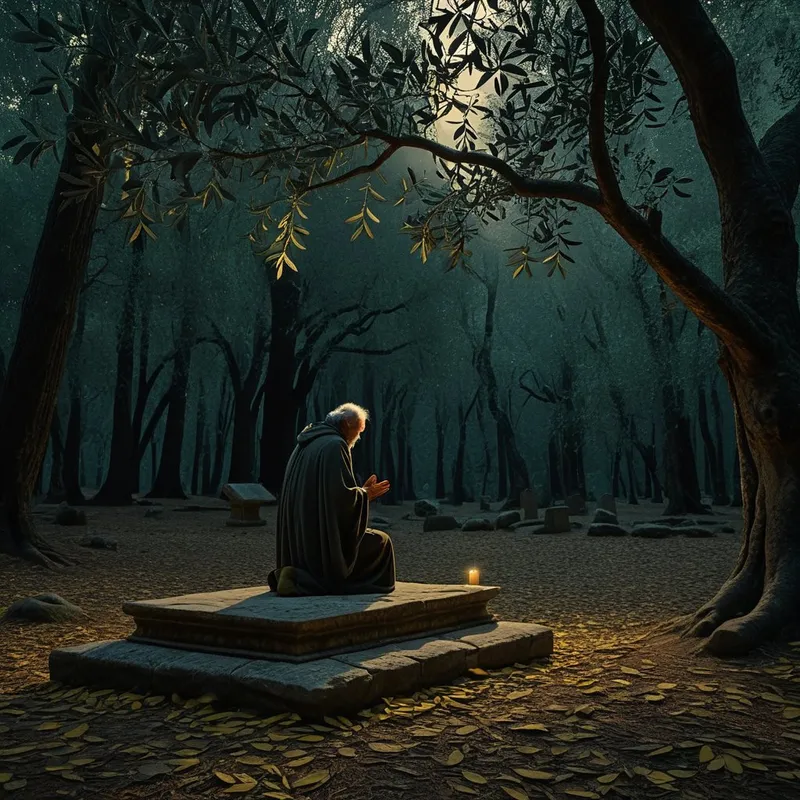
As the sky bled purple and gold, Ephemera felt no terror, only a deepening, resonant peace. He returned to his starting place, the field now gilded in twilight. He did not rage. He did not plead. He offered a final, silent prayer of thanks to Eos, to the world, to the day itself. Then, as the first star—Hesperos—pierced the violet veil, he lay down. His form, once radiant, began to gently dissolve, not into nothing, but into the components of the evening: his breath became the cool breeze, his sight the lingering afterglow on the clouds, his love the scent of night-blooming jasmine on the air. He was gone, having lived more wholly in one day than most do in a lifetime.
Cultural Origins & Context
The tale of Ephemera exists in the liminal spaces of Greek mythology. It is not part of the grand epic cycles of Homer or Hesiod’s structured theogonies. Instead, it finds its home in local folklore, philosophical parable, and the tradition of the ainos—a fable-like story told to convey an ethical or existential truth. It was likely a story shared by poets and philosophers, particularly those of the Hellenistic period who were preoccupied with the nature of happiness (eudaimonia) and the acceptance of human limits (moira).
Its societal function was not to explain natural phenomena or validate political structures, but to offer solace and perspective. In a culture that celebrated kleos (glory) and yearned for divine favor and immortality, the story of Ephemera served as a profound corrective. It whispered that a life’s value is not measured by its length, but by its depth and quality of perception. It was a narrative tool for grappling with the central human tragedy: the consciousness of our own finitude. By personifying this condition in a figure who chooses and embraces his condensed fate, it provided a model for finding meaning within mortality’s strict bounds.
Symbolic Architecture
Ephemera is the archetype of the fully realized moment. He is not a hero who conquers external monsters, but one who integrates the ultimate internal adversary: the fear of death through the conscious acceptance of life’s transience.
The most profound wholeness is not found in duration, but in depth. To live an entire spectrum of being—from the naive joy of dawn to the wise sorrow of dusk—is to complete a cosmic circuit within the human soul.
The single day symbolizes a complete psychological cycle. Dawn represents the ego’s birth and inflation (the god-like senses), noon is the confrontation with the Self and its powers (love, sovereignty, connection), and dusk is the necessary integration of the shadow—the acceptance of limits, loss, and dissolution. Ephemera’s journey is the journey of consciousness itself: from unconscious unity with the world, to conscious separation and experience, to a chosen return to unity. His dissolution is not an annihilation, but a redistribution of essence back into the world soul (Anima Mundi), suggesting that our individual consciousness is a temporary gathering of universal elements, meant to be experienced intensely and then released.

The Dreamer's Resonance
When this myth stirs in the modern unconscious, it often manifests in dreams of accelerated time or condensed experience. You may dream of living years in a night, watching a loved one age rapidly before your eyes, or finding a beautiful place you know you must leave at dream’s end. These are not anxiety dreams in the simple sense; they are the psyche’s alchemical crucible.
The somatic feeling upon waking is crucial: a poignant ache in the chest, a sense of breathtaking beauty mixed with loss, a feeling of having been both emptied and fulfilled. Psychologically, this indicates a confrontation with the transience complex—the deep, often repressed grief and awe we hold regarding the temporary nature of all our attachments, achievements, and even our own identity. The dream is forcing a conscious relationship with this reality. It is the psyche’s way of practicing, of running the software of Ephemera, to build the emotional and spiritual muscles needed to hold life’s beauty and its inevitable passing in the same hand without collapsing into despair or denial.

Alchemical Translation
The alchemical process mirrored in Ephemera’s day is the opus contra naturum—the work against nature—which here means against our natural, instinctual fear of death and clinging to form. His journey models the pinnacle of Jungian individuation: the conscious realization and integration of the Self, followed by a graceful return to the collective, not as an undifferentiated mass, but as a conscious contributor.
The alchemical gold is not eternal life, but the perfected moment. It is the transmutation of leaden, protracted duration into the golden, dense now.
For the modern individual, the myth instructs us in psychic transmutation. First, the Nigredo (the blackening): the initial, painful awareness of our limitation, our “single day.” This is the orphan’s cry. Then, the Albedo (the whitening): the acceptance of the gift, the awakening to heightened perception—choosing to see the divine in the ordinary. This is the dawn. The Citrinitas (the yellowing): the full engagement with life—love, work, creation, conflict—experienced with maximum presence and minimal attachment to outcome. This is the blazing noon. Finally, the Rubedo (the reddening): the culmination. This is the peaceful dissolution at dusk, where the ego, having fully served its purpose of experiencing the Self, willingly relinquishes its central claim. It understands that its end is not a failure, but the completion of its contract with existence. The individual is transmuted from one who fears time into one who inhabits it so completely that they become, like Ephemera, a brief, brilliant note in the eternal symphony, essential precisely because it does not last.
Associated Symbols
Explore related symbols from the CaleaDream lexicon: