Enso Circle Myth Meaning & Symbolism
A single, spontaneous brushstroke forming a circle, embodying the Zen principles of perfect imperfection, the void, and the awakened mind.
The Tale of Enso Circle
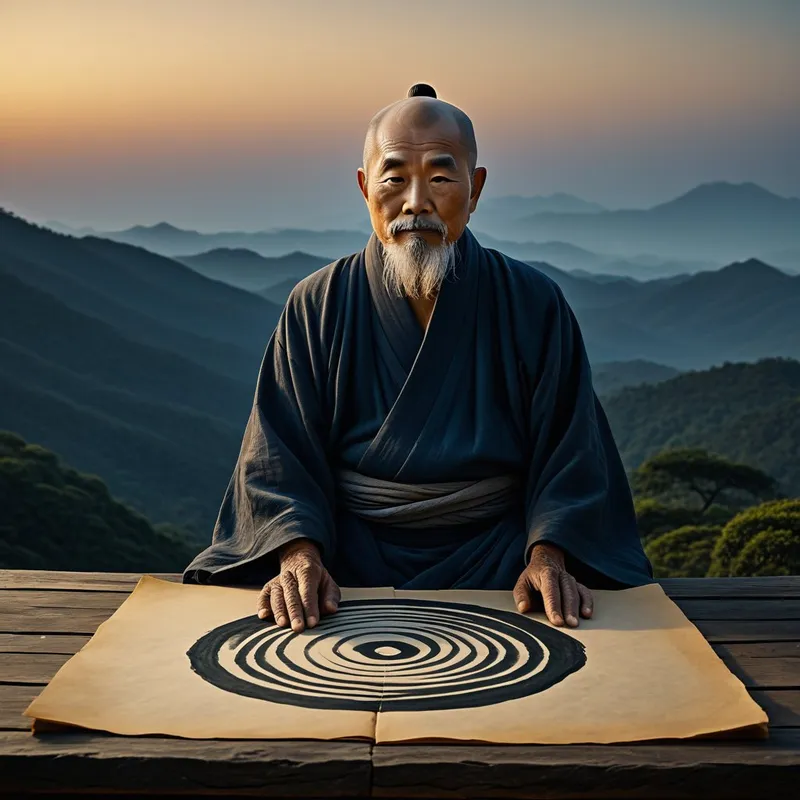
In the hush that exists before thought, in the monastery perched between mist and mountain, there was a master and there was a student. The air was thick with the scent of pine and old paper. The student’s mind was a cage of sparrows, fluttering with questions: “What is the Way? What is enlightenment? How does one grasp the ungraspable?”
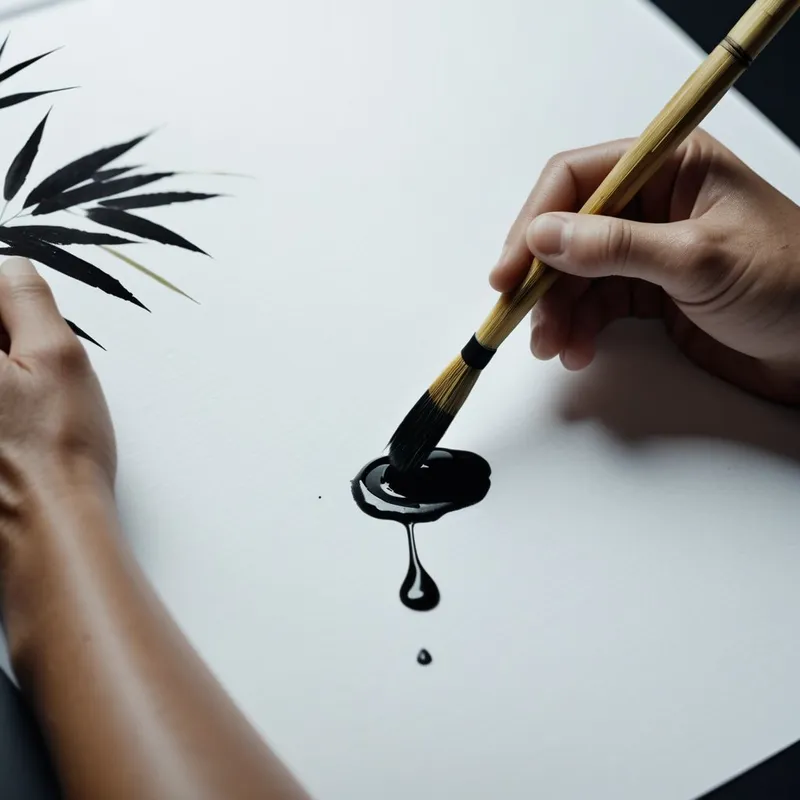
The master said nothing. He moved to the low table where a sheet of washi lay, white as a winter moon. He took up the fude, its bamboo stem worn smooth by ten thousand mornings. He dipped it into the inkstone, the black pool a piece of the night sky captured in stone.
He did not pause to plan. He did not measure. In one breath, one continuous, fearless motion of his entire being, he brought brush to paper. The black line was born—not drawn, but allowed. It arced like a swallow in flight, bold and certain, then thinned, whispering of its own impermanence. It curved, embracing an emptiness, and returned to near its beginning. It did not quite meet. The circle was complete, yet open. The brush lifted.
There was the circle. It was not a geometric ideal. It trembled with the life of the hand that made it. The ink bled slightly into the thirsty paper. The space within was not merely blank; it was potent, a window. The space without fell away. In that single, spontaneous act, the conflict was resolved—not the conflict of student and master, but the deeper conflict of seeking and being, of form and formlessness. The rising action of a lifetime of practice culminated in this falling of the brush. The resolution was the circle itself, hanging in the air between them, saying everything by saying nothing.
The student looked. The sparrows in his mind fell silent. He did not see a symbol. He saw the master’s whole life in that stroke. He saw the mountain, the mist, the unanswerable question, and the vast, accepting silence that held them all. The tale was told.
Cultural Origins & Context
The Enso is not a myth with gods and heroes in the traditional sense, but a performative myth enacted through brush and ink. Its origins are inseparable from the practice of Zen Buddhism, which flowered in China as Chan and was later transmitted to Japan. It emerged from the intersection of Zen’s radical non-dualism and the disciplined, expressive arts of calligraphy and ink painting.
This “myth” was passed down not through epic poetry, but in the zendo and the artist’s studio. It was told by masters to disciples in a language beyond words. Its societal function was pedagogical and transformative. In a culture that valued precision and ritual, the Enso served as a direct counterpoint—a sanctioned eruption of the spontaneous, unconditioned mind. It was a test and a teaching: a visual koan. To create or contemplate an Enso was to engage in an act of spiritual archaeology, digging past the layers of conceptual thought to touch the raw ground of being.
Symbolic Architecture
The Enso is a universe of meaning condensed into a single gesture. Its symbolic architecture is built on paradox, holding opposites in a dynamic, unresolved tension.
The perfect circle is a prison. The broken circle is a gate.
First, it symbolizes the Absolute, Enlightenment, and Wholeness. The circle is a universal symbol of totality, with no beginning and no end. It represents the Dharma, the awakened mind, and the interconnectedness of all things. It is the Tathata of existence.
Simultaneously, it embodies Emptiness (Śūnyatā). The space enclosed by the circle is not an object, but a pregnant void. It is not a “thing” to be filled, but the essential ground from which all form arises and to which it returns. The circle frames this emptiness, making it visible.
Crucially, it represents Imperfection and Impermanence (Anicca). The brushstroke is uneven. The ends may not meet. The ink splatters. This is not a flaw, but the heart of the teaching. It is a record of a unique, unrepeatable moment in a universe of change. It honors the beauty of the asymmetrical, the worn, the authentic—what the Japanese call wabi-sabi.
Psychologically, the Enso represents the Self in the Jungian sense—the archetype of wholeness and the center of the personality. It is the psyche striving toward integration, where conscious and unconscious, light and shadow, are contained within one boundary. The openness of the circle signifies that this wholeness is not a closed system, but one that remains engaged with the infinite.
The Dreamer's Resonance
When the Enso appears in a modern dream, it is rarely as a neat, printed symbol. It manifests as the dreamer’s psyche working toward integration. One might dream of trying to draw a perfect circle but the line wobbles and fractures, mirroring anxiety about one’s own coherence or the fear of not “closing” an important life chapter. Another might dream of a vast, black circle in the sky, both ominous and awe-inspiring, representing an encounter with the numinous, the vast unknown of the unconscious.
Somatically, this dream process can feel like a pulling toward center—a deep, almost gravitational yearning for resolution and peace amidst internal chaos. It can also feel like a release, the moment the brushstroke is committed: a letting go of obsessive control. The dream-Enso is the psyche’s own brushstroke, attempting to circumscribe the contents of the unconscious, to give a shape to the formless pressures of one’s inner life. The dreamwork is in the attempt, not the perfect result. The tension between the dream-circle’s ideal form and its messy reality is where the psychological growth occurs.
Alchemical Translation
The alchemical process modeled by the Enso is the transmutation of the leaden, fragmented ego into the golden, integrated Self. It is a map for individuation.
The first stage is Nigredo, the blackening. This is the blank paper, the void, the confusion and darkness of the unexamined life or the psychic crisis. It is the student’s restless mind. The ink is the concentrated essence of this experience—the shadow material, the pain, the unanswered questions.
The act of painting is Albedo, the whitening, and Citrinitas, the yellowing. It is the moment of conscious engagement, where will and surrender must fuse. The artist must marshal a lifetime of discipline (the conscious ego) and then utterly relinquish control to the deeper, intuitive self (the unconscious). This is the critical conjunction of opposites.
The hand that holds the brush is the ego. The motion that creates the circle is the Self.
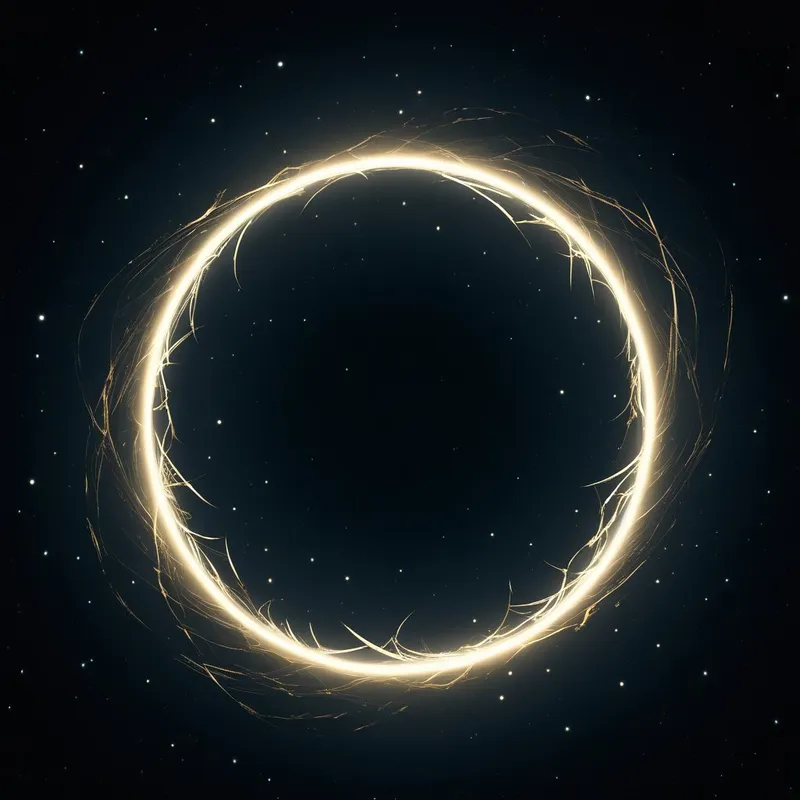
The resulting Enso is Rubedo, the reddening, the culmination. It is the lapis philosophorum, the philosopher’s stone. But this stone is not a static object; it is a dynamic relationship. The circle is the achieved boundary of the individuated personality—a self that knows its own limits and contents. The emptiness within is the connection to the transcendent, the ongoing dialogue with the unconscious. The imperfect, open brushstroke is the acknowledgment that the work is never finished; individuation is a process, not a destination.
For the modern individual, the Enso teaches that wholeness is not found in eliminating flaws or achieving a sterile perfection. It is found in the courageous, spontaneous act of embracing one’s entire story—the bold strokes and the shaky lines, the dense black ink and the empty spaces—and recognizing this unique, imperfect totality as the very expression of one’s authentic being. The circle you draw is your own.
Associated Symbols
Explore related symbols from the CaleaDream lexicon: