Enkidu from the Epic of Gilgam Myth Meaning & Symbolism
A wild man of clay and grass, created by gods to challenge a king, finds his soul in friendship and his death in destiny, forever altering the hero's path.
The Tale of Enkidu from the Epic of Gilgam
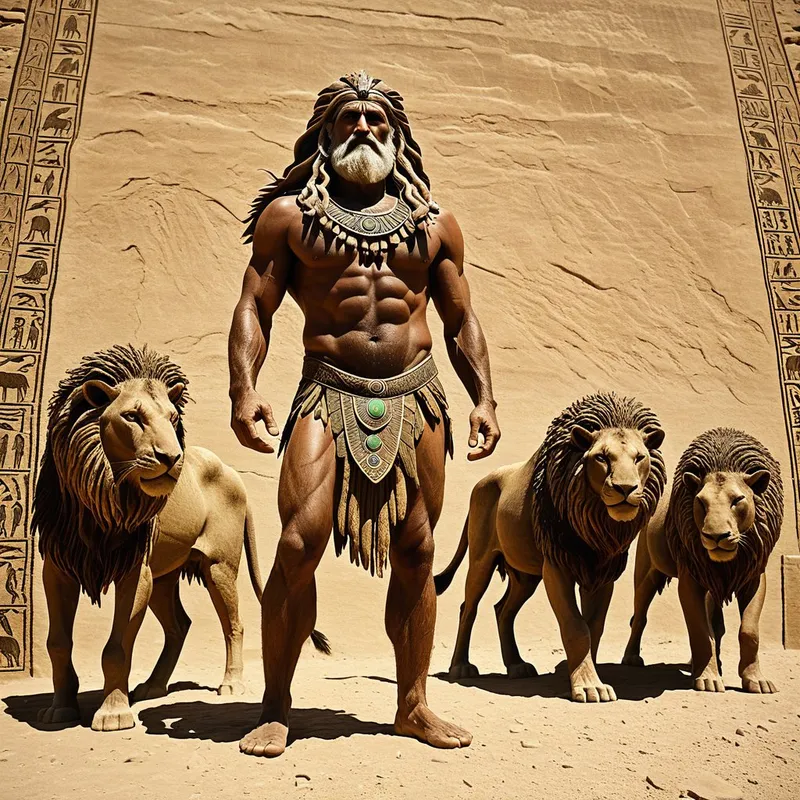
Hear now the tale of the one who was not born, but made. In the great walled city of Uruk, a king named Gilgamesh ruled with a restless, oppressive hand. Two parts god and one part man, his vigor knew no bounds, and the people cried out beneath his unceasing demands. Their lamentations rose like smoke to the heavens, reaching the ears of the gods.
Aruru heard their plea. She took clay from the silent earth, from the abyss where the world was formed, and shaped a counterpart. Not in a womb, but in the wild steppe, she fashioned him. He was Enkidu, a man of shaggy hair, clothed only in his own strength, with the speed of the gazelle and the heart of the untamed plains. He knew no people, only the animals. He drank with them at the watering hole, and they were not afraid.
Word of this wild man reached the hunters, whose traps he destroyed. A plan was woven. A temple priestess, Shamhat, was brought to the wilderness. For six days and seven nights, she lay with Enkidu, teaching him the ways of humanity. When he rose, the animals fled from him; they knew his scent had changed. He had gained knowledge, but lost his first innocence. Shamhat led him to the shepherds, who gave him bread and beer—the food and drink of civilization. His body grew strong, his spirit quickened, and he learned of the king in Uruk who took what he wished.
Driven by a new fire, Enkidu journeyed to the city. He arrived as Gilgamesh, in his divine right, approached the bridal chamber of a new bride. Enkidu blocked the gate, a mountain of fury. They clashed in the street, a tempest of muscle and will, shaking the very foundations of Uruk. Doors splintered, dust clouds rose, and the two titans wrestled, each meeting his equal for the first time. And from that shattering collision, not hatred, but recognition bloomed. Gilgamesh looked into the wild eyes of Enkidu and saw his own soul reflected. They embraced, and a friendship was forged that was stronger than blood.
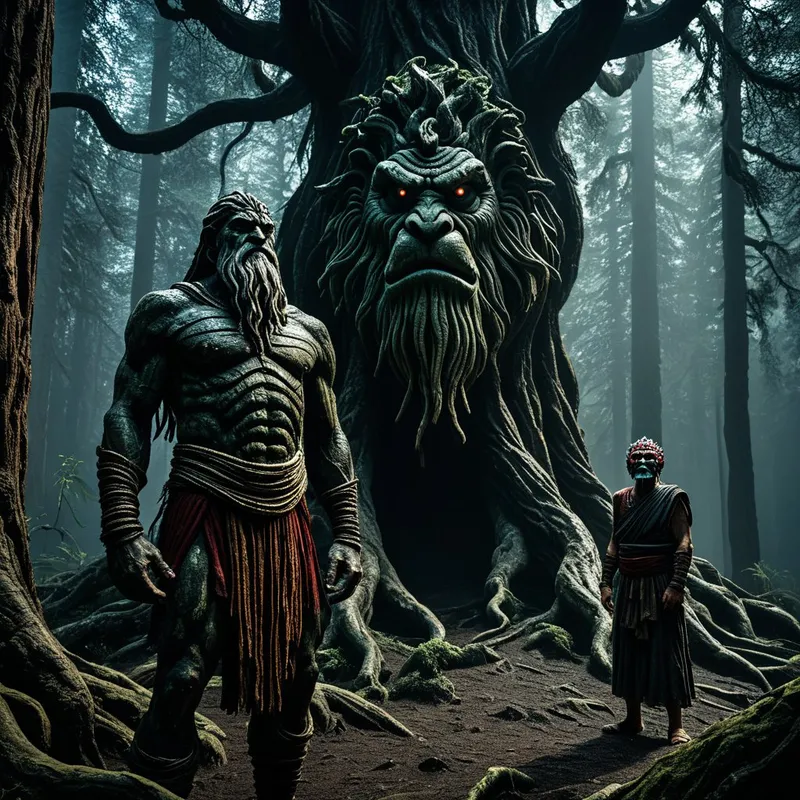
Together, they sought immortal fame. They traveled to the distant Cedar Forest, a place of primordial terror guarded by the monstrous Humbaba, whose face was a whirlwind and whose roar was a flood. With the aid of the sun god Shamash, they triumphed, felling the sacred cedars. But their victory drew the gaze of the gods.
Upon their return, the goddess Ishtar desired Gilgamesh. He spurned her, recounting the fates of her past lovers. In her wrath, she sent the Bull of Heaven to ravage Uruk. Again, the two friends stood together. Enkidu seized the bull by its tail, and Gilgamesh drove his blade home. But as the bull fell, so too did the favor of the gods. In a council, it was decreed: one of the two must die.
It was Enkidu who was chosen. He fell ill, cursed by his own hand for insulting Ishtar. For twelve days, he suffered, raging against the trapper and the priestess who led him from the wild, then lamenting the fate that awaited him in the dark house of dust. Gilgamesh watched, helpless, as the vigor of his friend turned to wax. When Enkidu’s breath finally stilled, Gilgamesh’s howl of grief echoed through the land. He mourned for six days and seven nights, refusing to let the body be buried until a maggot fell from the nostril. The king who knew no equal had learned the price of love: a loss that would send him on a desperate, lonely quest for the secret of life itself.
Cultural Origins & Context
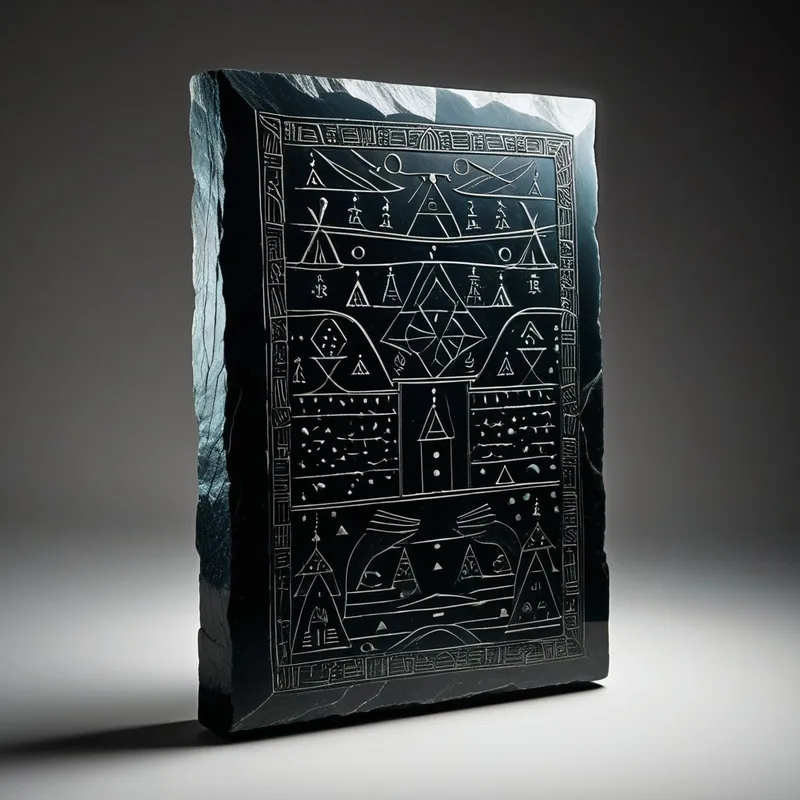
The epic of Gilgamesh is not a single, static text but a living river of story that flowed through Mesopotamian culture for nearly two millennia. Its earliest fragments, in Sumerian, date to the Third Dynasty of Ur (c. 2100 BCE), with the most complete version, recorded on twelve clay tablets in Akkadian, stemming from the library of the Assyrian king Ashurbanipal (7th century BCE). It was recited by court singers and scribes, a foundational narrative exploring the limits of power, the bonds of community, and humanity’s relationship with the divine and the natural world.
Enkidu’s story functioned as a profound cultural mirror. In a society transitioning from nomadic pastoralism to dense urban civilization, Enkidu embodies the tension between the wild, natural state and the cultivated, social order. His creation is a divine response to a king’s excess, positioning him as a necessary corrective—a piece of the natural world sent to temper and humanize the semi-divine ruler. The epic asks its audience: What is lost and what is gained when we leave the wilderness? What does civilization demand of our souls? Enkidu’s journey from animal companion to loyal friend to tragic casualty models the costs of consciousness, community, and ambition.
Symbolic Architecture
Enkidu is the ultimate symbol of the Shadow made flesh. He is Gilgamesh’s uncivilized double, everything the king is not: natural, instinctual, and free from the corruptions and duties of rule. Yet he is not evil; he is whole. His creation represents the psyche’s innate drive toward balance. When the conscious ego (Gilgamesh) becomes tyrannical, the unconscious produces its counterweight (Enkidu).
The meeting of Gilgamesh and Enkidu is not a battle to the death, but a battle for life—the life of the integrated self.
His transformation via Shamhat is one of the most potent symbols of initiation in world mythology. It is not a fall, but an awakening. The sexual act is alchemical, transmuting raw nature into human culture, instinct into relationship. The animals’ rejection signifies the painful but necessary severance from a pre-conscious state. Eating bread and drinking beer complete the rite of passage, incorporating him into the human community. His core symbolic function, however, is that of the catalyst and the sacrifice. He awakens Gilgamesh to friendship and purpose, enabling the king’s heroic deeds, but the integrated self cannot remain in a state of perfect, untouchable union. The death of Enkidu is the death of the idealized, mirrored self. It forces the ego to confront mortality, loss, and the solitary journey of meaning-making that defines true individuation.
The Dreamer's Resonance
To dream of an Enkidu figure—a powerful, wild being emerging from a natural landscape into your urban or domestic space—signals a critical moment of somatic and psychological reckoning. The psyche is presenting your unlived life, your untamed potential, or your repressed instincts demanding recognition.
Somatically, this may manifest as restlessness, a craving for physical exertion, or a sense of being “caged” by routine. Psychologically, you may be facing a situation where your polished, civilized persona (your inner Gilgamesh) is being challenged by a raw, emotional truth or a desire that feels too primal to acknowledge. The dream may depict a fierce struggle with this figure. The resolution—whether it ends in combat, embrace, or the wild figure leading you away—reveals the psyche’s directive. Is it time to integrate this wildness, to learn from it? Or is this energy, having served its purpose, preparing to depart, leaving you to mourn and grow from its absence? Such a dream often precedes a major life transition, asking you to sacrifice an old way of being to make room for a new depth of understanding.
Alchemical Translation
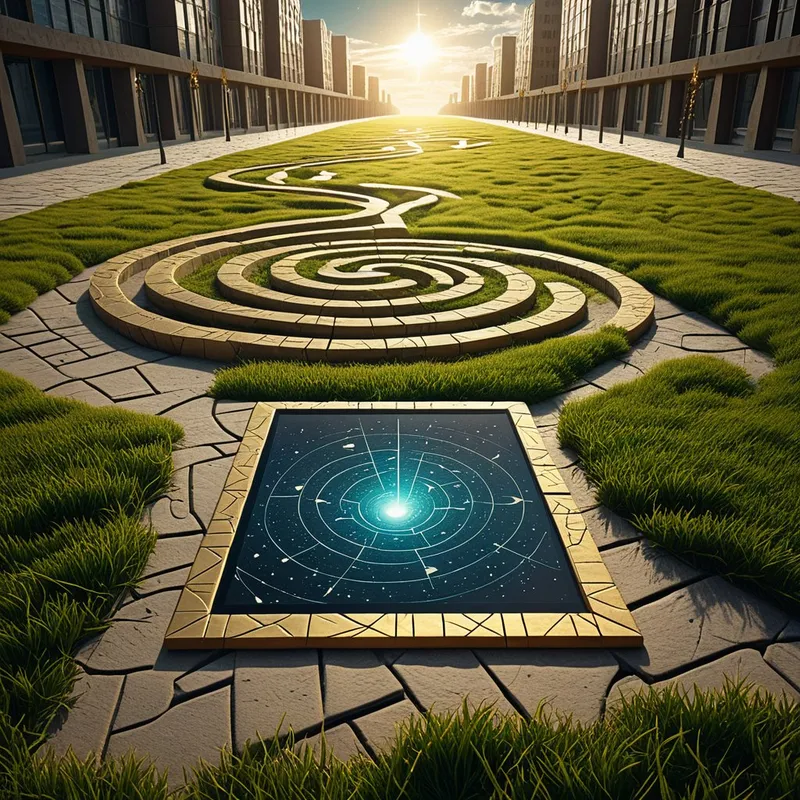
The myth of Enkidu is a precise map of the early stages of individuation. The alchemical process begins with the nigredo, the blackening. Gilgamesh’s tyrannical rule represents the inflated, dysfunctional ego, ruling in isolation. The gods’ creation of Enkidu is the unconscious prima materia, the raw, chaotic substance necessary for transformation.
Their battle in Uruk is the coniunctio oppositorum—the sacred conflict of opposites. This is not a fight for domination, but for conjunction. The embrace that follows signifies the albedo, the whitening, where the ego acknowledges and integrates the shadow. This creates the “hermaphroditic” whole—the inseparable duo capable of heroic action (slaying Humbaba, the Bull of Heaven).
The death of Enkidu is the essential mortificatio and separatio. The integrated content must die as a separate entity to be fully absorbed into the greater psyche.
This is the myth’s most profound alchemical truth: the beloved other, the perfect mirror, must be lost. Gilgamesh cannot cling to Enkidu. He must let the composite being die so that Enkidu’s wild wisdom, loyalty, and love can be internalized. Gilgamesh’s subsequent quest for immortality is initially a failure, but his return to Uruk, having accepted mortality, marks the beginning of the rubedo, the reddening. He returns not as a god-king, but as a wise, human ruler, his kingship now tempered by the memory of his wild-hearted friend. The gold he brings back is not eternal life, but the hard-won knowledge of limits, love, and legacy—the true treasures of a soul that has undergone its own great work.
Associated Symbols
Explore related symbols from the CaleaDream lexicon: