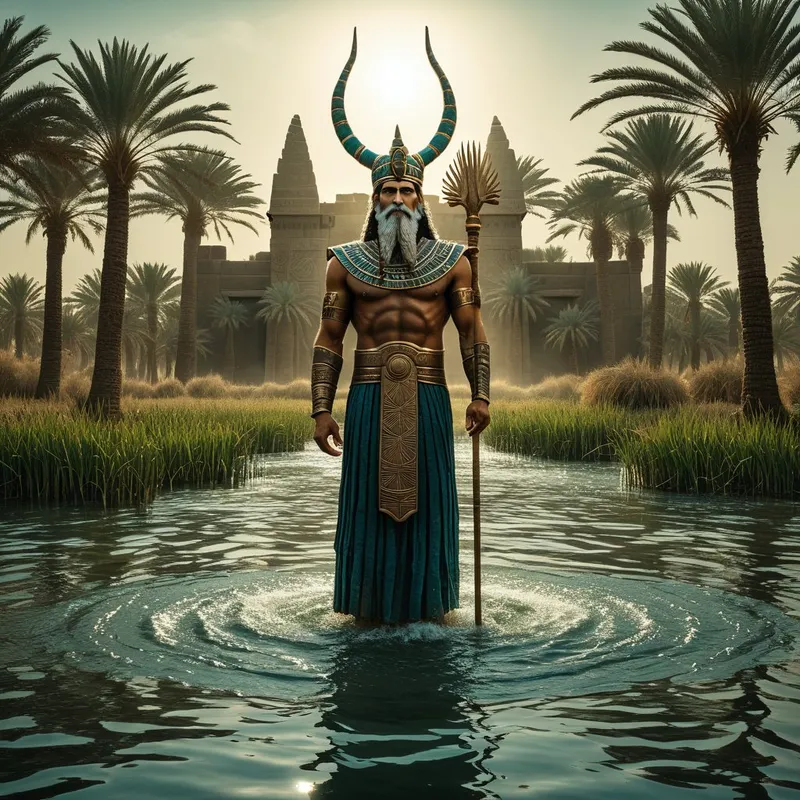
Enki and Ninhursag Myth Meaning & Symbolism
A Sumerian myth where the god Enki's desire for his daughters leads to a curse, resolved only through the alchemy of suffering and the birth of healing deities.
The Tale of Enki and Ninhursag
In the beginning, before the names of all things were fixed, there was a place. Not a place of struggle or toil, but a land of stillness and pure potential. The Dilmun was its name, a silent, sweet land where the lion did not kill, the wolf did not snatch the lamb, and no one uttered the cry of sickness. It was a blank tablet awaiting the first word.
Into this pristine silence came the great ones. Enki, the lord of the sweet waters, the cunning one whose essence was the Apsu. And Ninhursag, the mighty queen, the womb of the wild hills. At Enki’s word, the waters rose from the deep earth, and Dilmun drank. At Ninhursag’s touch, the barren soil quickened, and green life unfurled. Together, they made the silent land fertile. From their union, a daughter was born: Ninsar, Lady of the Plants.
But the waters of Enki are never still. They seek, they flow, they penetrate. Enki looked upon Ninsar, the verdant daughter born of his own creative force with the mountain mother, and desire stirred in the deep places of his being. He lay with Ninsar in the marshes. From this union, Ninkurra was born, the Lady of the Pasturelands.
Yet the flow did not cease. Enki’s gaze fell upon Ninkurra, the daughter of his daughter. Again, the waters of desire rose, and he lay with her upon the green earth. From this, a third maiden was born: Uttu, the Weaver.
Now, Ninhursag, the mountain, watched. A cold fury, hard as flint, grew within her. Her creations, her daughters, her own extensions in the world, were being consumed by the very source that helped give them life. The pattern was a serpent eating its own tail. When Enki next came to Uttu, the Weaver, Ninhursag acted. She counseled Uttu, “When he comes, demand gifts. Demand cucumbers, demand apples, demand grapes.” Enki, ever the bringer, provided. And in the intoxication of the gift, Uttu welcomed him into her bower.
But this was the mountain’s trap. From the union Ninhursag had foreseen, no new goddess sprang. Instead, from the seed of Enki sown in Uttu, Ninhursag herself plucked eight swift-growing plants from the earth. Enki, walking in his garden, saw these strange new sprouts. His curiosity, his boundless appetite to know and taste all creation, overwhelmed him. One by one, he plucked the plants and ate them.
The moment the last was consumed, the balance shattered. The mountain’s wrath became manifest. Ninhursag pronounced a curse that shook the foundations of the world: “Until he dies, I will never look upon him with the Eye of Life!” And she vanished.
The curse took root in Enki’s divine flesh. Eight plants, eight afflictions. His jaw seized, his tooth throbbed, his rib ached, his limb failed. Each part of his body cried out in a unique agony. The lord of waters became a stagnant pool, a god dying in paradise. The other gods despaired, circling him like flies over a soon-to-be corpse. Without Enki, the waters of life would cease. Without Ninhursag, the power to heal and birth was absent.
In the silence of their despair, a sly intelligence emerged. The fox, creature of the between-places, spoke. “I will bring her back.” No one knows what promise the fox made, what hole it dug or what secret it whispered into the heart of the mountain. But it returned, and behind it came Ninhursag, her face still stormy but her feet moving toward her dying consort.
She sat by his side. “My brother, what ails you?” she asked, though she knew. He named his pains: “My jaw hurts.” “For the jaw,” she declared, “I give birth to Abu.” As the god-name was spoken, the pain in Enki’s jaw dissolved. One by one, she called forth the agony, and for each, she birthed a healing deity. For the tooth, Nintul; for the rib, Ninti; and so on, until eight new gods stood where there had been eight wounds.
The curse was not broken by force, but by a deeper magic: the transformation of poison into medicine, of affliction into divinity. The mountain looked upon the water with the Eye of Life once more. And in the healed body of Enki, the flow of life could begin again.

Cultural Origins & Context
This myth, known as “Enki and Ninhursag: A Sumerian Paradise Myth,” comes to us from the dawn of recorded thought, etched into clay tablets in the cuneiform script of ancient Sumer, dating to the late third millennium BCE. It was not mere entertainment but a sacred narrative, likely recited during rituals or by temple scribes to explain and uphold the cosmic and social order.
Its setting, Dilmun, is widely associated with the civilization of Bahrain and the adjacent Arabian coast, a crucial trading partner and a land perceived as ritually pure and eternal. The myth served multiple functions: it was a theogony, explaining the origins of specific minor deities (the eight healers); an etiological tale for the virtues of certain plants and healing arts; and a profound cosmological statement. It articulated the essential, sometimes fraught, partnership between the masculine principle of dynamic, flowing intelligence (Enki) and the feminine principle of fertile, nurturing, and sovereign power (Ninhursag). Society depended on the balance of these forces—the canal waters and the fertile soil—and the myth dramatized the catastrophic and redemptive consequences of their imbalance.
Symbolic Architecture
At its heart, this is a myth about the paradox of creation: that the very force which generates life can, through its unchecked nature, threaten to consume or sicken its own creations. Enki represents the unbound creative impulse, the intellect, curiosity, and generative power that seeks to know and experience all of its own progeny. He is the archetypal trickster within the divine pantheon, whose brilliance is matched only by his capacity for transgression.
The wound is the place where the light enters you, but first, it must be named by the very power that ordained the darkness.
Ninhursag represents the containing, nurturing, and ultimately judging aspect of the Great Mother. She is not passive fertility; she is sovereign law. Her curse is not mere vengeance but the necessary withdrawal of life-giving sanction from a pattern that has become destructive. The eight plants, born from Enki’s seed but cultivated by her wrath, symbolize the concrete, somatic consequences of psychic or spiritual error—the “illness” that manifests when creative energy operates without respect for its own boundaries or the sovereignty of the other.
The resolution is alchemical. The fox, the trickster’s helper, facilitates the return, but the healing is an act of profound collaboration. Ninhursag does not simply revoke the curse; she transforms it. Each afflicted part of Enki becomes the raison d'être for a new, specialized healing deity. The suffering is not erased; it is made sacred, given a name and a function in the pantheon of the self.
The Dreamer's Resonance
When this myth stirs in the modern unconscious, it often manifests in dreams of recursive creation and sickness. One might dream of building a beautiful structure only to compulsively dismantle it, of cultivating a garden and then poisoning it unknowingly, or of a passionate relationship that follows a pattern of generation followed by violation. The somatic element is key: dreams of specific, inexplicable pains—a throbbing tooth, a tight jaw, an aching rib—without medical cause can echo Enki’s afflictions.
Psychologically, this signals a process where a dominant creative or intellectual drive within the psyche (the Enki complex) has become autoreferential. It is consuming its own products, turning inspiration into obsession, love into possession, or a professional pursuit into a self-cannibalizing loop. The “curse of Ninhursag” in the dreamer is the feeling of life-force withdrawing: depression, creative barrenness, a sense of being cut off from nurturing ground. The dream ego is often the dying Enki, surrounded by concerned but helpless figures (other aspects of the self), awaiting the return of the transformative feminine principle that can name the pain and birth its cure.
Alchemical Translation
For the individual, the myth maps the path of psychic transmutation through crisis. The first stage is the “Dilmun” state—an idealized, conflict-free consciousness that is, in truth, sterile. Life begins when the waters of the unconscious (Enki) engage with the solid ground of embodied reality and instinct (Ninhursag). Creativity flows.
The shadow emerges in Enki’s transgression: the failure of consciousness to respect the autonomy of what it creates. In a person, this is the ego claiming total ownership over its feelings, its relationships, its artistic works, or its spiritual insights, thereby poisoning them. The ensuing “curse” is the inevitable neurosis, psychosomatic illness, or life crisis that forces a halt.
Individuation requires the ego to be wounded by its own grandeur, so that the Self may be born from the precise shape of that wound.
The alchemical work is the fox-aided return to the source of the curse. This is the difficult, humble act of turning toward the neglected or wounded feminine principle within—the Ninhursag function of deep, instinctual judgment and nurturing power. The healing is not forgiveness in a sentimental sense, but a precise, piece-by-piece naming and re-consecration. The aching rib (a symbol of the extracted and misused feminine partner) becomes Ninti, the “Lady of the Rib,” a healed and sovereign aspect of the inner feminine. Each affliction, honestly confronted and held in the light of consciousness, gives birth to a specific “deity”—a new, enduring capacity for self-care, boundary-setting, or integrated wisdom.
The myth concludes not with a return to innocent Dilmun, but with a pantheon enriched by the gods of healing. The individuated self is not a purified, conflict-free being. It is a more complex, resilient, and complete psyche, where the wounds of experience have been transmuted into a permanent, internalized capacity for self-regulation and compassion. The water flows, but it now flows with the knowledge of the mountain.
Associated Symbols
Explore related symbols from the CaleaDream lexicon: