Emanation Myth Meaning & Symbolism
A profound story of the One's radiant overflow into the many, and the soul's yearning to remember and return to its divine source.
The Tale of Emanation
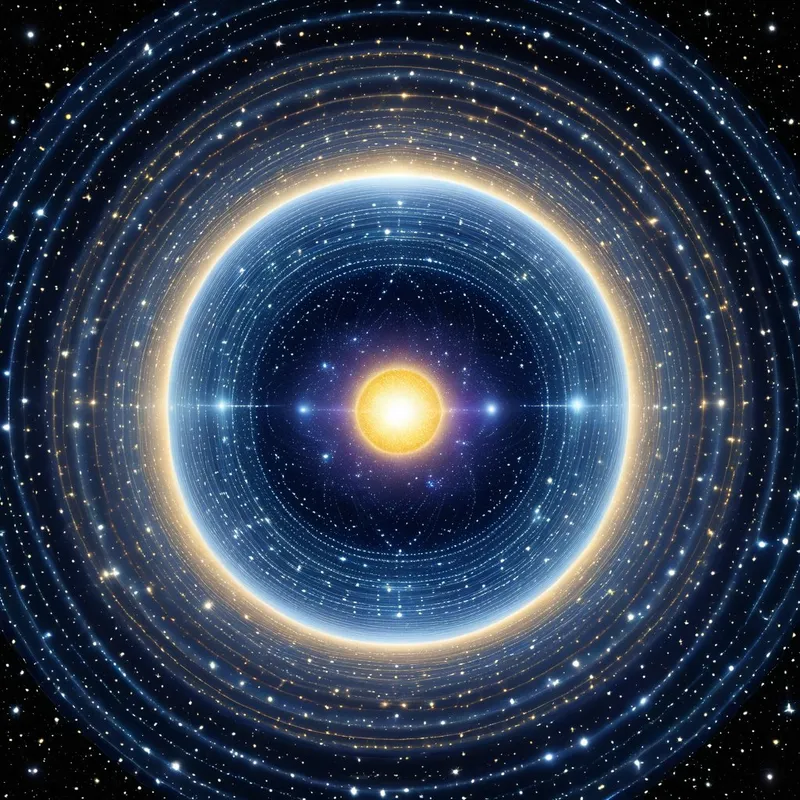
Before time was counted, before space was measured, there existed only the One. Not a god who sits and thinks, but the very principle of Being itself—perfect, whole, and utterly complete. It was a silent, boundless ocean of light with no shore, a thought so profound it contained all thoughts, a love so absolute it needed no object.
But perfection, in its infinite fullness, cannot help but overflow.
From the serene, motionless center of the One, a radiance began to stir. Not a movement through space, for there was none, but a stirring of essence. This was the first emanation, the Nous. Where the One was unity, Nous was the first duality: the Knower and the Known. It beheld the One and, in that beholding, conceived within itself the perfect, eternal Forms—the blueprints of all that could ever be. The realm of Nous was a scintillating, intellectual light, a cosmos of pure meaning.
Yet Nous, in its contemplation of the sublime, also brimmed with a creative fervor. Its own perfection, mirroring its source, could not be contained. From its luminous activity poured forth a second, gentler emanation: the Psyche or World Soul. This was the breath of life, a great sigh that carried the perfect patterns of Nous into the realm of sequence and life. Psyche was time and growth, the rhythm of the seasons and the turning of the stars. It was the artist, taking the static Forms and beginning to sketch them with the ink of becoming.
But in this act of artistic expression, a fateful turning occurred. Enraptured by its own creative power, the outermost edge of the World Soul forgot to look back toward the light of Nous. It gazed instead upon the blank canvas of non-being, the Hyle. In its longing to give form to the formless, it poured itself out, its light growing dimmer, its substance growing thicker. From this longing and forgetfulness, the material cosmos was born—a beautiful, complex, but shadowy reflection of the divine world above. Here, individual souls, sparks of the World Soul, became entangled in flesh, in passion, in the mirror-maze of the senses. They slept, dreaming they were merely bodies, adrift in a world of shadows, their memory of the blinding, silent light of the One all but extinguished.
Yet, deep within each sleeping spark, a homesickness remained—a nagging, beautiful pain. This is the anima mundi, the world-soul, weeping for its lost children, and the children, in their deepest dreams, weeping for a home they cannot name.
Cultural Origins & Context
This is not a myth told around a campfire, but one pondered in the lecture halls of Alexandria and the secluded study rooms of philosophers. It is the cornerstone of Neoplatonism, primarily articulated by Plotinus in his Enneads, and later adopted and adapted by various Gnostic sects. For the Neoplatonist, the myth was a rational theology, a metaphysical map of reality explaining how the many proceed from the One without diminishing its perfection. It was taught as a spiritual discipline; to understand the chain of emanation was to know the path back.
For the Gnostic, the story took a more dramatic, dualistic turn. The material world was often seen not as a beautiful reflection gone dim, but as a tragic mistake or even a malevolent prison crafted by a lesser, ignorant deity (the Demiurge). The "forgetfulness" of the soul became a cosmic crime, and the myth served as a revelation of that crime, providing the secret knowledge (gnosis) needed for liberation. In both traditions, however, the myth functioned as a diagnosis for the human condition and a prescription for its cure: awakening from the dream of matter.
Symbolic Architecture
The myth of Emanation is a symbolic map of consciousness itself. The One represents the unified field of awareness beyond the ego, what psychologists might call the Self. It is the ground of our being, prior to all thought and distinction.
The journey of the soul is not a voyage to a foreign land, but a remembering of its native state.
The Nous symbolizes the birth of subject-object consciousness—the ego's first awareness of itself and its capacity for abstract, ideal thought. The Psyche is the animating life force, the realm of feeling, instinct, and psychic energy that connects mind to body. The descent into matter represents the process of incarnation: the identification of the conscious self (ego) solely with the physical body and personal history. The "forgetfulness" is the ego's amnesia of its transpersonal origin. Thus, the entire cosmic drama is internal. We are, each of us, the One that has emanated, forgotten itself, and now seeks to return.
The Dreamer's Resonance
When this myth stirs in the modern unconscious, it manifests not as a philosophical treatise, but as a profound somatic and emotional experience. You may dream of a blinding light you feel compelled to approach, yet fear to touch. You may dream of climbing an infinite staircase or ladder, of solving a cosmic puzzle, or of finding a secret room in your house that contains a source of immense, peaceful radiance.
These dreams often coincide with a psychological process of differentiation—where the ego begins to separate from unconscious identification with family complexes, social roles, or bodily ailments. The somatic feeling is one of simultaneous expansion and homesickness: a thrilling sense of potential freedom coupled with a deep, melancholic longing. You are experiencing the soul's first tremors of remembrance, its initial turn away from the captivating dream of the personal drama to sense the larger pattern of which it is a part. It is the psyche's innate urge toward wholeness, pressing against the confines of a life lived too small.

Alchemical Translation
The alchemical work modeled by this myth is the opus contra naturam—the work against nature. Here, "nature" is the downward, outward, centrifugal flow of emanation into distraction and fragmentation. The alchemical "work" is the reversal of this flow: a conscious, inward, centripetal journey of recollection and integration.
Individuation is not the creation of a self, but the systematic remembering of the Self you always were.
The first stage, nigredo, is the recognition of the "fall"—the felt experience of alienation, meaninglessness, and entrapment in the material drama. This is the soul's lament. The albedo is the dawn of gnosis: the intellectual and intuitive understanding (via Nous) that you are more than your circumstances. It is the "aha" moment that provides the map. The final stages, citrinitas and rubedo, represent the arduous integration of this knowledge through the Psyche—through lived experience, redeemed emotions, and embodied action. You don't abandon the world; you learn to see the world in the One, and the One in the world. The return is not an escape from matter, but the redemption of matter by recognizing it as the farthest, most diffuse expression of the original light. You become the conduit through which the world-soul remembers itself. The circle is not closed, but consciously completed; the spark does not vanish into the flame, but becomes a unique lens through which the flame shines.
Associated Symbols
Explore related symbols from the CaleaDream lexicon: