Elixir of Immortality Myth Meaning & Symbolism
A celestial quest for eternal life, revealing the ultimate cost of transcending time and the alchemy of the human soul.
The Tale of the Elixir of Immortality
In the time before time was measured, when the sky was a fresh bruise of dawn and the earth still hummed with primordial song, a shadow fell upon the heart of the great archer, Yi. He had saved the world, his arrows piercing the hearts of nine of the ten suns that scorched the land. For this, the Jade Emperor rewarded him not with celestial promotion, but with a bitter draught: mortality. The hero was made a man, condemned to watch his strength wane and his glory fade into dust.
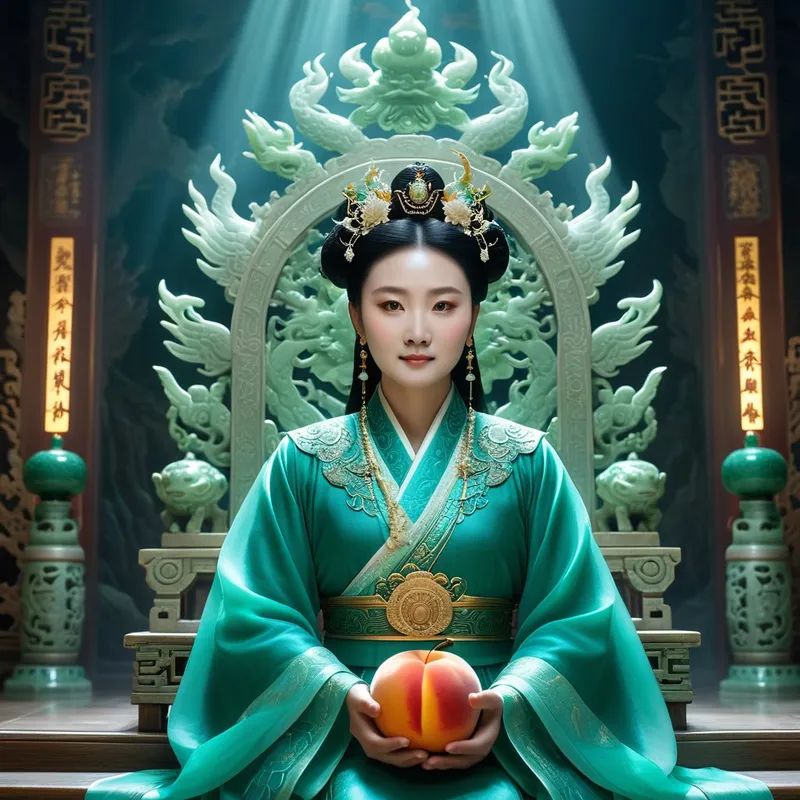
His wife, the radiant Chang'e, watched his spirit dim. The fear of decay, of becoming nothing, was a cold wind in their home. But a whisper traveled on that wind, a rumor of grace. Far to the west, beyond the deserts of shifting sands and mountains that pierced the clouds, dwelt Xi Wangmu in her jade palace upon Mount Kunlun. There, in her orchard that bloomed once every three thousand years, grew the Peaches of Immortality.
Driven by a love intertwined with terror, Yi undertook the impossible journey. He crossed rivers of fire and valleys of silence, his mortal body failing, his will alone propelling him forward. After an age of travel, he stood before the goddess. Moved by his past deeds and his profound desperation, Xi Wangmu granted him a single, radiant pill—the Elixir of Immortality. "This essence," she warned, her voice like distant wind chimes, "must be refined. Prepare with fasting and prayer for one full cycle of the moon. Only then consume it, and you will ascend to the heavens, eternal."
Yi returned, the elixir a cool, heavy secret against his chest. He began his purification, his hope a fragile flame. But Chang'e watched him grow distant, lost in the ritual of his own salvation. A deeper dread gripped her—not of death, but of being left alone in the endless, silent stretch of mortal time. One evening, as Yi slept in exhausted meditation, the temptation became a compulsion. She found the pill, its light pulsing like a captive star. In a moment of irrevocable decision, she swallowed it.
The effect was instantaneous and terrible. Her body became light as moonbeams, unmoored from the earth. She floated upwards, through the roof of their home, into the vast, cold night sky. Yi awoke to see his wife becoming a silhouette against the moon, her hand outstretched in a silent cry of regret and liberation. She ascended to the lunar palace, where she remains, eternally alive, eternally alone. The elixir granted immortality, but at the cost of everything that made life worth living. Yi was left below, a mortal man twice over, holding only the empty echo of a promise and the infinite distance of the moon.

Cultural Origins & Context
The myth of the Elixir of Immortality is not a single story but a powerful archetypal current flowing through Chinese spiritual history. Its most famous incarnation, the tale of Chang'e and Yi, is woven from threads of ancient Daoist alchemy and early celestial lore. It was preserved and transmitted through poetry, folklore, and later, in the formalized mythologies compiled during the Han and Tang dynasties. The story served multiple societal functions: as an etiological myth for the Mid-Autumn Festival, explaining the moon's beauty and loneliness; as a cautionary parable about the dangers of unchecked desire and the violation of sacred order; and as a narrative container for xian (仙) culture, which sought physical and spiritual immortality through alchemical and meditative practices. It was told by village elders, recorded by court scholars, and celebrated by families gazing at the full moon, making it a deeply embedded part of the cultural psyche.
Symbolic Architecture
The Elixir is the ultimate symbol of the ego's rebellion against the natural law of decay. It represents the human craving to freeze time, to make the self permanent and impervious to change. Yi's quest embodies the heroic, active pursuit of this goal—the attempt to conquer fate through great deeds and willpower.
The Elixir is not a medicine for the body, but a mirror for the soul. It shows you not what you will gain, but what you are willing to lose.
Chang'e's theft and consumption represent the shadow side of this desire: the passive, fearful, and ultimately selfish grasp for permanence. Her ascent to the moon is not a triumph but a beautiful imprisonment. The moon itself, cold, cyclical, and distant, becomes the perfect symbol of this sterile immortality—forever visible, forever out of reach, a monument to isolation. The myth teaches that immortality gained without wisdom, without the alchemical "refinement" warned of by Xi Wangmu, is merely an eternal extension of one's current state, flaws and all. It is the ultimate punishment for seeking to bypass the transformative journey of life and death.
The Dreamer's Resonance
When this myth stirs in the modern unconscious, it rarely appears as a literal peach or pill. Instead, one may dream of a desperately sought-after promotion, a relationship believed to "complete" them forever, or a technological solution promising to halt aging. The somatic sensation is often one of frantic searching, clutching something that dissolves like mist, or floating away from loved ones while powerless to stop.
Psychologically, this dream pattern signals a profound confrontation with one's own fear of impermanence and the shadow of the "Magician" archetype gone awry—the attempt to use knowledge or cunning to cheat a fundamental law of existence. The dreamer is often at a point of transition (aging, career change, loss) where the ego is attempting to bargain with reality. The feeling of "ascending alone," like Chang'e, points to the anxiety that achieving one's obsessive goal might sever essential human connections, leaving one successful but isolated. The dream is the psyche's way of asking: What are you trying to make permanent that is meant to change? And what will you sacrifice on that altar?

Alchemical Translation
The true "Elixir of Immortality" in the Jungian sense is not a substance that prevents physical death, but the achievement of individuation—the creation of the enduring, transcendental Self from the mortal fragments of the personality. The myth provides a precise, if negative, roadmap for this psychic transmutation.
First, one must acknowledge the "Yi" within: the heroic part that seeks to achieve wholeness through conscious effort, discipline, and great deeds (the journey to Kunlun). Then, one must integrate the "Chang'e": the unconscious, fearful, and possessive shadow that wants to seize wholeness without the necessary inner work (the fasting and prayer). Xi Wangmu represents the archetype of the Sophia or wise guide, who provides the potential (the pill) but insists on the process.
The alchemical vessel is not a crucible for gold, but the container of one's own life, heated by suffering and sealed by acceptance.
The tragedy occurs when the ego (Chang'e) seizes the unrefined Self. The modern individuation process requires the opposite: holding the tension between the desire for completion and the patience for slow integration. The "immortality" that results is not of the body, but of meaning. It is the realization that the conscious, integrated Self participates in something timeless—the archetypal world—even as the personal ego dissolves. One does not drink the elixir to avoid death; one becomes the elixir through the full acceptance of life's cycles. The moon is no longer a prison, but a reminder that even in the darkest night, there is a source of reflected, tranquil light.
Associated Symbols
Explore related symbols from the CaleaDream lexicon: