Ehecatl Myth Meaning & Symbolism
The story of the wind god who sacrificed his body to create the path for the sun, teaching that true movement requires dissolution and sacred breath.
The Tale of Ehecatl
Listen. Before the world you know, there was a stillness so profound it was a kind of death. The Fourth Sun had fallen, and darkness, thick and cold, lay upon the face of the primordial waters. The gods gathered in the sacred city of Teotihuacan, their divine hearts heavy. A new sun was needed to move, to bring life, to banish the eternal night. But who would bear its terrible, burning burden?
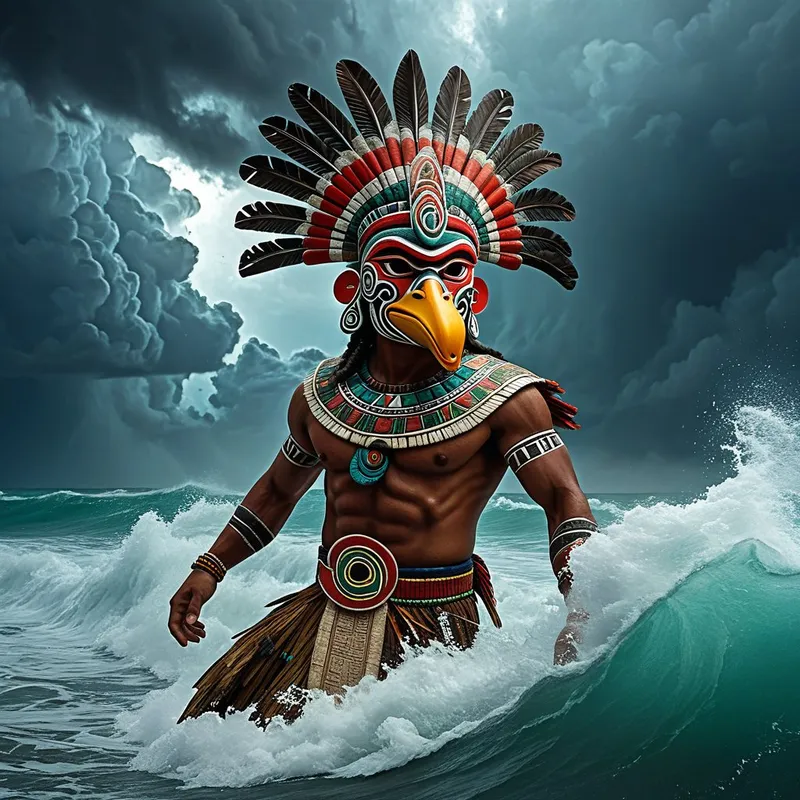
From among them stepped Quetzalcoatl. Yet, to undertake this labor, he had to become something else. He had to become movement itself. He donned the mask of the wind, the red, beak-like visage of Ehecatl. His body grew lean, his form blurred at the edges, becoming not flesh but force. He was no longer just the plumed serpent; he was the breath that precedes the word, the path-clearing gale.
His first task was to summon the sun. But the sun, Tonatiuh, lay dormant, requiring a sacred fuel: the life-essence of the gods themselves. A great fire was built. Two gods, proud and wealthy, offered rich gifts, but their sacrifices were hollow, born of arrogance. The fire sputtered. Then, two humble gods—Nanahuatzin, covered in sores, and Tecuciztecatl, who hesitated—prepared to leap. Tecuciztecatl’s courage failed four times. Nanahuatzin, without hesitation, threw himself into the blaze, followed by his shamed companion. The divine furnace roared.
For four days, the gods waited in the tense silence, staring east. Then, a glow. A searing, impossible light began to crest the horizon. But it did not move. It sat, blazing and terrible, scorching the earth where it stood. The new sun was born, but it was stuck. The world would burn to ash before it completed a single journey across the sky.
The gods turned as one. Their eyes fell upon Ehecatl. He understood. His purpose was not merely to summon, but to enable. The sun needed a road. It needed a current to carry it. Without a word, Ehecatl began to blow. He blew with the force of creation, a hurricane contained within divine will. He blew not at the sun, but beneath it, carving a channel in the fabric of the sky itself. He blew until his essence was spent, until his form, the form of the wind, was stretched thin across the heavens, becoming the very path—the sacred road—upon which the sun now, gloriously, began to move. Dawn broke. The Fifth World had its breath, and its heartbeat.
Cultural Origins & Context
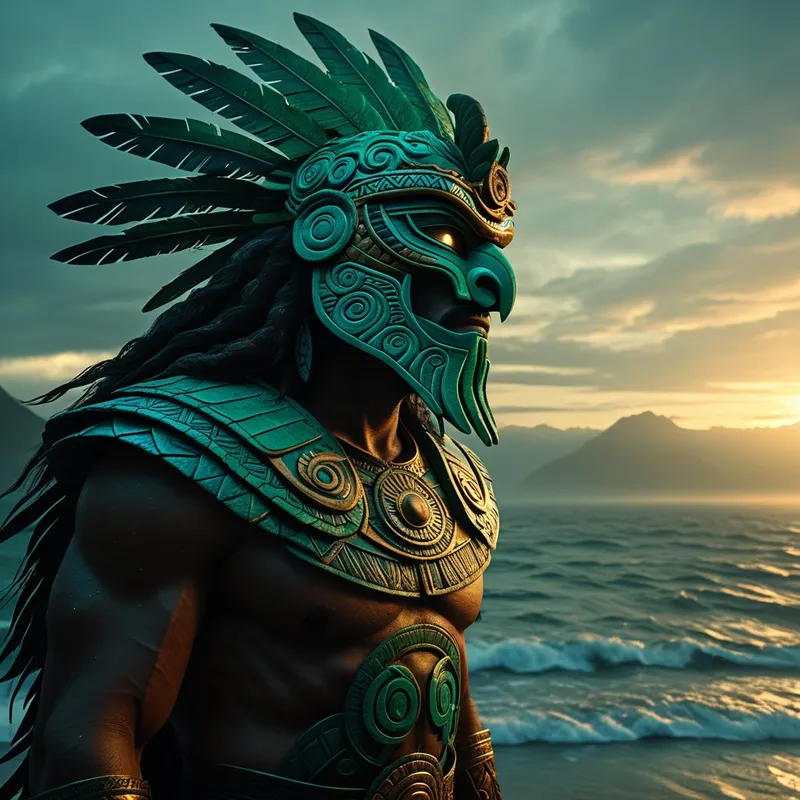
The myth of Ehecatl is woven into the foundational narratives of Postclassic Central Mexico, primarily among the Nahua peoples, including the Aztecs (Mexica). It is a critical chapter in the Legend of the Five Suns, the cosmological story that explained the creation and precarious nature of their world, the Fifth Sun. This myth was not mere entertainment; it was sacred history, recited by priests (tlamatinime) and depicted in codices like the Historia de los Mexicanos por sus pinturas and the Codex Chimalpopoca.
Its societal function was multifaceted. It explained the natural phenomenon of wind as a divine, structuring force—not random weather, but the breath of a god making the solar journey possible. It reinforced the core Mesoamerican principle that cosmic order required sacrifice (nextlahualli), often from the most humble or willing, not the most powerful. Ehecatl’s action modeled the ultimate service: self-dissolution for the functioning of the whole. Temples dedicated to Ehecatl, uniquely circular to minimize wind resistance, were places where this vital, animating force was honored as the prerequisite for all life and time.
Symbolic Architecture
Ehecatl is the archetype of the Enabler, the necessary precursor. He is not the luminary hero, but the force that makes the hero’s journey possible. His symbolism is profound and multi-layered.
The wind does not proclaim itself; it is known only by what it moves. The greatest service is to become the invisible path for another’s light.
Psychologically, Ehecatl represents the animating spirit—the breath (ehecatl means "wind" in Nahuatl) that fills an idea with life-force, turning potential into kinetic energy. He is the inspiration that must blow through the psyche to dislodge a stagnant, "stuck" consciousness (the unmoving sun). His action is one of radical self-effacement; he sacrifices his distinct form to become function, a road. This symbolizes the ego’s necessary surrender to a larger process. The ego may want to be the brilliant sun, but the soul’s evolution often requires becoming the wind that serves a greater motion.
His iconic duck-billed or beak-like mask is also significant. It is a wind instrument, a nozzle that concentrates and directs chaotic air into a purposeful stream. It represents focused intention—the channeling of diffuse psychic energy into a single, world-shaping force.
The Dreamer's Resonance
When the pattern of Ehecatl stirs in the modern dreamer, it often manifests as dreams of powerful, invisible forces, of being compelled to move or of clearing a path. You may dream of standing before a brilliant but static light—a career opportunity, a creative project, a relationship—that feels dazzling yet inert, offering no momentum. The atmosphere is one of immense potential trapped in frustrating stasis.
Somatically, this can correlate with feelings of constriction in the chest or diaphragm, with shallow breath. Psychologically, it is the process of confronting what Carl Jung called a "psychic inertia." The dream is signaling that a heroic effort (the sun) has been made, but the internal architecture for its sustained movement is absent. The Ehecatl process asks: What rigid structures in your life or psyche must be blown apart to create flow? What aspect of your ego-identity are you being asked to dissolve to serve a deeper, more authentic journey? The dream invites you to become the wind, not the destination.

Alchemical Translation
The alchemical journey modeled by Ehecatl is the stage of Solutio (dissolution) in service of Coagulatio (coagulation, or new form). In the individuation process, we often must sacrifice a familiar, solid identity (Ehecatl’s distinct god-form) to become a fluid, functional force that enables a higher synthesis (the sun’s journey).
The alchemy of the soul requires that we be both the sacrifice and the sacred space that holds it. We dissolve to become the vessel for a greater becoming.
For the modern individual, this translates to a profound inner shift. First, one must don the mask of the wind—adopt the perspective of pure process over fixed identity. Ask: "What needs to move, and how can I become the movement?" This often means letting go of credit, recognition, or a cherished self-image as "the one who shines."
Second, one must blow the stuck sun loose. This is the active, often exhausting work of applying sustained pressure—through discipline, therapy, creative practice, or vulnerability—to a core, stagnant complex. It is the breath-work that follows the insight, the consistent effort that turns revelation into revolution.
Finally, one becomes the road. This is the stage of integration where the sacrificed ego is not lost but transmuted. Your lived experience, your scars and wisdom, become the very path upon which your essential self (your inner sun) now travels with purpose. You are no longer just the content of your life; you are the context, the breathing space in which your destiny unfolds. In this, Ehecatl teaches that our highest power lies not in being the unmovable monument, but in becoming the sacred, enabling breath.
Associated Symbols
Explore related symbols from the CaleaDream lexicon: