
Eagle Feather Headdress Myth Meaning & Symbolism
A sacred narrative of a seeker's arduous journey to earn the eagle's perspective, transforming into a vessel of wisdom, responsibility, and connection to the sky.
The Tale of Eagle Feather Headdress
Listen. The story does not begin with a person, but with a longing. It begins in the dust, where a human looks up and sees a speck against the sun, a creature that lives where the air grows thin and the world becomes a map. This human’s name is forgotten, for the story is not about a name, but about the ache in the chest, the pull in the eyes toward that impossible freedom.
This one, let us call them the Seeker, lived with their head bowed to the earth, to the tasks of survival. But their spirit was restless, a bird trapped in a cage of bone and routine. They watched the eagle ride the thermals, a master of two worlds—the solid earth from which it launched, and the boundless sky it claimed. The Seeker did not want to be the eagle. They wanted to understand its silent conversation with the wind, to see what it saw when it gazed upon the winding rivers and the crawling herds from its throne of air.
So the Seeker left the circle of the village fire and walked toward the highest place, the place where the earth reaches for the sky. The journey was the first test: a stripping away. The plains gave way to foothills, the foothills to sharp stones and thinning air. Hunger became a companion; solitude, a teacher. They arrived at the summit, a bare rock spine under a crushing expanse of blue, and they waited. They fasted. They prayed not with words, but with the whole of their hunger and their hope.
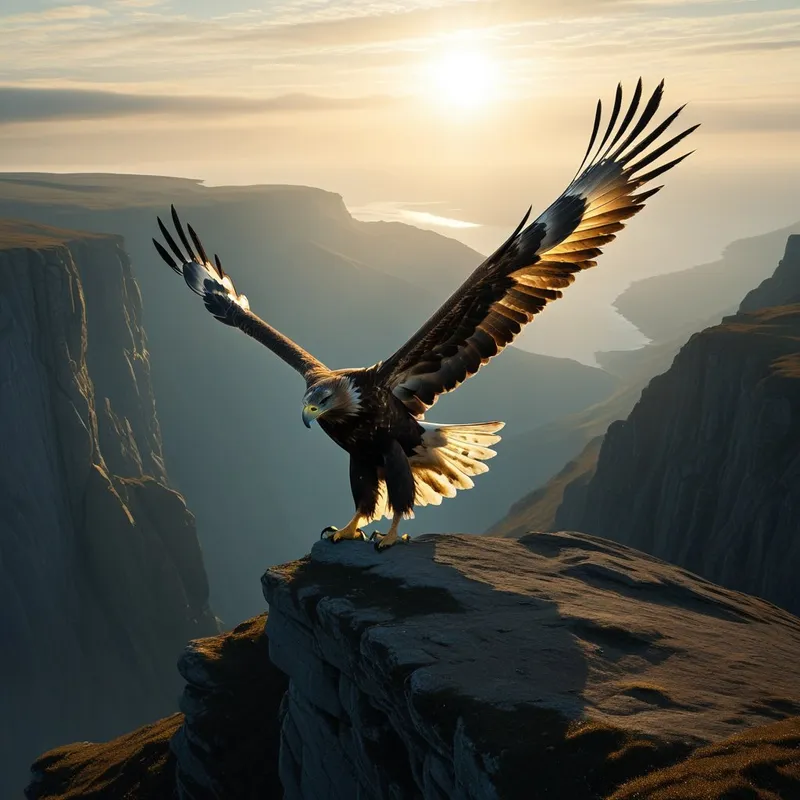
For days, nothing but the mocking wind. Then, on a morning when the dawn bled scarlet across the clouds, the Eagle came. It was not just a bird, but the essence of the sky given form—its eyes were chips of obsidian holding the light of stars, its feathers the color of storm clouds and aged bronze. It did not land, but hovered, the downdraft of its wings a holy wind that battered the Seeker.
“You wish to see?” the Eagle’s voice was the sound of the wind through canyon walls. “The vision is not a gift. It is a weight. To see far is to carry the sorrows of distance. To see clearly is to be responsible for what is revealed. Will you bear this?”
The Seeker, frail and fierce, nodded, their voice raw. “I will bear it.”
The Eagle did not grant a vision then. Instead, it began a dance—a relentless teaching. It would swoop, and the Seeker had to learn to dodge not with fear, but with the fluidity of air. It would ascend, and the Seeker had to learn to follow its path not with their feet, but with their mind’s eye, tracing the invisible currents. The Seeker learned the patience of the perch, the explosive decision of the strike, the boundless joy of the glide. They learned that the eagle’s freedom was not lawless, but a perfect obedience to the laws of the sky.
The final test was one of sacrifice and trust. The Eagle landed, folding its great wings. “A feather,” it said. “One of my primary feathers, which cuts the wind and steers my soul. To take it is to cause me pain. To receive it is to hold a piece of my relationship with the Great Spirit. You must take it, and I must give it.”
With trembling hands, the Seeker approached. This was not conquest, but a sacred exchange. As their fingers closed gently around the base of a long, perfect feather, a shock passed through them—not of pain, but of merging. They saw through the Eagle’s eyes: the village far below as a pattern of life, the river as a vein of the earth, the interconnectedness of all things in a single, silent, soaring glance. In that moment, they felt the Eagle’s pain as their own, and the Eagle felt their yearning fulfilled.
The Eagle released the feather and let out a cry that split the sky. “It is done. You do not wear this feather. You are becoming this feather. Return. Gather others who have passed this test. Let each feather you earn be a story, a prayer, a layer of vision. Together, they will be a headdress—not a crown of rule, but a mantle of responsibility. You will see for the people. You will carry their prayers upward. Your head will be heavy with the sky.”
The Seeker returned, changed. They were not just a person who had met an eagle; they were a person in whom a part of the eagle now lived. And they began the long, lifelong work of gathering the other feathers, of building the headdress, one sacred relationship at a time.
Cultural Origins & Context
This narrative pattern is not a single, fixed myth from one nation, but a profound cultural motif woven through the ceremonial and spiritual life of many Plains, Plateau, and some Woodlands Indigenous cultures. The story is the living doctrine behind the most recognizable symbol of Indigenous North America: the eagle feather headdress.
It was not a story told lightly or to children as a simple fable. It was embedded in the very process of earning the right to wear each feather. Elders and spiritual leaders would impart its lessons to those on vision quests or who had demonstrated exceptional courage, wisdom, or service to the community. Each feather in a bonnet represented a coups—an act of valor, generosity, or leadership—making the full headdress a biographical map of a life lived in accordance with sacred principles. The story functioned as a societal compass, encoding values of humility (the arduous quest), earned authority (not given, but tested), ecological kinship (the dialogue with Eagle), and the ultimate purpose of power: service to the people (the burden of vision).
Symbolic Architecture
At its core, the myth is an allegory for the acquisition of consciousness itself. The Eagle is the symbol of the transcendent function, the ability to rise above the petty, ground-level conflicts of the ego and gain a unifying perspective.
The feather is not a trophy of the kill, but a relic of the encounter—a physical synapse connecting the human mind to the mind of the sky.
The Seeker’s initial longing represents the first stirring of the spiritual or psychological quest, the feeling that there is more to see than one’s immediate circumstances. The arduous journey to the high place is the necessary ascent from the unconscious (the common life) toward a point of observation and confrontation with the archetypal Other. The Eagle’s tests—patience, agility, mental tracing—are the disciplines required to hold higher consciousness: mindfulness, adaptability, and foresight.
The plucking of the feather is the critical alchemical moment. It symbolizes the integration of a piece of that transcendent perspective into the very fabric of the self. It is painful because expansion of consciousness always involves the death of a narrower, simpler self. The resulting headdress, built feather by feather, represents the gradual, lifelong construction of a wise personality—a psyche that can hold multiple perspectives, bear the weight of complex truths, and act as a conduit between the mundane and the numinous.
The Dreamer's Resonance
When this myth pattern activates in the modern dreamer, it often manifests as dreams of flight, of being given a special object of immense weight and value, or of undergoing a silent, demanding test from a powerful animal spirit. Somatic sensations might include feeling a profound pressure on the crown of the head, or a strange, exhilarating lightness in the chest.
Psychologically, this signals a process of earning insight. The dreamer is not being handed wisdom; they are in the arduous, lonely phase of the quest. They may be struggling with a need for a broader perspective on a life problem (a relationship, a career, a personal flaw) but feel stuck in the “dust.” The appearance of the Eagle archetype in dreams calls the dreamer to ascend—to seek solitude, to engage in disciplined reflection, to fast from the distractions that cloud inner vision. The dream is an affirmation from the unconscious: the capacity for a higher view exists, but it must be paid for with focused effort and the courage to leave familiar ground.
Alchemical Translation
The myth of the Eagle Feather Headdress is a precise map of the individuation process, the Jungian journey toward psychic wholeness. It models the transformation of the ego from a ground-bound, fragmented state into a vessel capable of containing the Self.
The first alchemical stage, nigredo (the blackening), is the Seeker’s longing and arduous journey—the confrontation with lack, with hunger, with the blackness of ignorance and solitude. The albedo (whitening) is the encounter with the Eagle, the illuminating confrontation with the archetypal spirit of height and clarity. The dialogue and tests represent the beginning of purification.
The plucking of the feather is the rubedo (reddening), the sacred marriage (coniunctio) of the human and the divine, the ego and the archetype. It is a moment of supreme integration, producing the “philosopher’s stone” of this myth: the single, integrated feather of earned perspective.
Individuation is not the creation of a king, but the crafting of a headdress—a structured, earned assembly of transcendent insights that one must learn to wear with grace and humility.
Finally, the return and the slow gathering of the full headdress represents the ultimate stage: the embodiment of this wisdom in the community of the psyche and the world. The modern individual undergoing this process learns that each hard-won insight (each “feather”) must be integrated into a larger structure of character. The goal is not to become an isolated, soaring eagle, but to become the human who carries the eagle’s perspective back to the human circle, using that vision to guide, to heal, and to connect the earthly to the eternal. The head becomes heavy not with pride, but with the sober, beautiful responsibility of clear sight.
Associated Symbols
Explore related symbols from the CaleaDream lexicon: