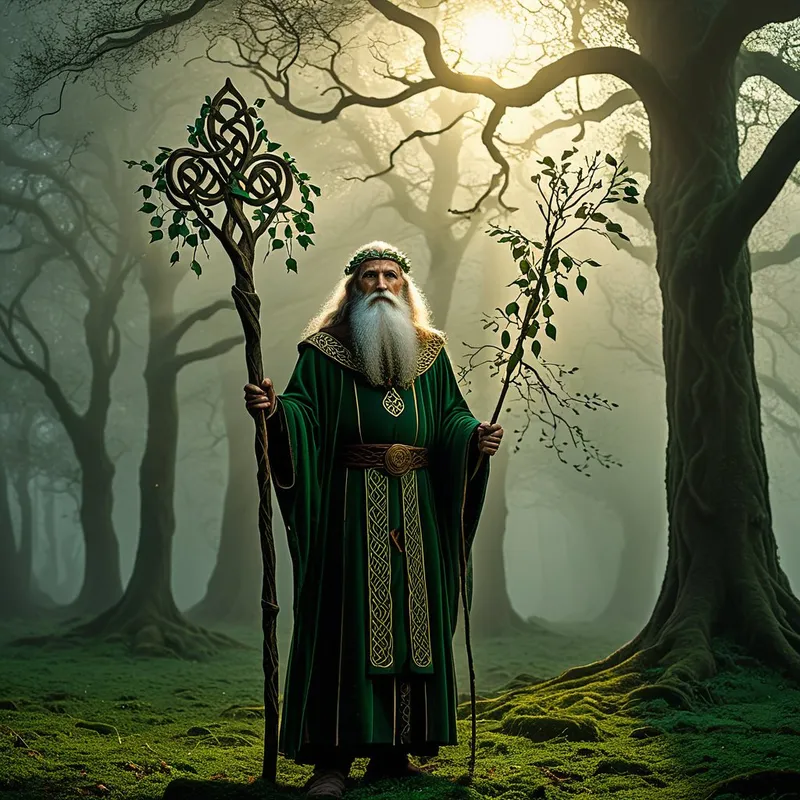
Druid's Rod Myth Meaning & Symbolism
A myth of a sacred staff, a king's sacrifice, and the druid's wisdom forging a bond between mortal sovereignty and the eternal, dreaming earth.
The Tale of Druid's Rod
Listen. The wind in the nemeton does not whisper; it remembers. And it remembers a time when the king was not a man upon a throne, but a pulse within the land’s own breast.
There was a king, Ard Rí, whose name is lost to the mist, for his story is not about a name, but a wound. His reign began in summer’s fullness, but a blight came. Not of pestilence, but of spirit. The rivers ran thin and silver, like old scars. The cattle gave sour milk. The people’s songs turned to whispers, and the whispers to a silence that hung heavier than winter fog. The king, in his hall of oak and bronze, felt the disconnect in his very bones—a hollow ache where the land’s vitality should have sung.
He summoned Druí, the one who walks between the worlds. The druid’s eyes were the grey of a midwinter sea, and in his hand he bore not a weapon, but a staff. It was no mere branch; it was the Slat na Draoi, a length of ancient oak, from which a helix of pale, sacred mistletoe grew, bound by strips of leather from a white bull. It hummed with a silent frequency.
“The covenant is broken,” the druid said, his voice the sound of roots shifting deep in earth. “You rule over the land, Ard Rí, but you are not of it. Sovereignty is not taken. It is given. And it must be renewed.”
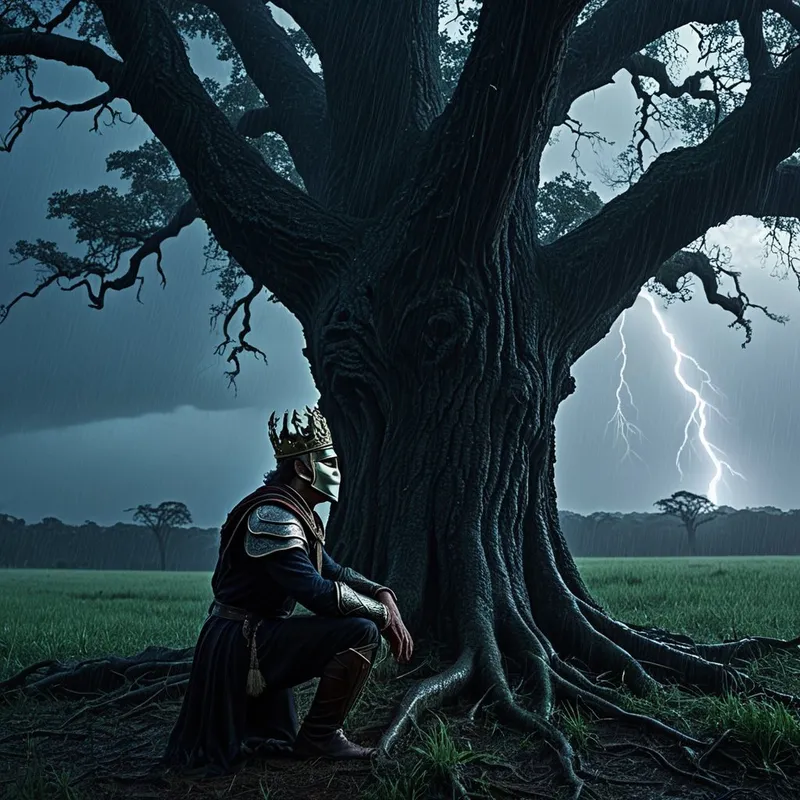
The king, desperate, asked for the ritual. The druid led him, not to a temple, but to the heart of the oldest forest, to a clearing where a single, colossal oak stood, its bark seamed like an elder’s face. “Here,” the druid intoned, planting his Rod into the soft earth at the tree’s base. “The tree is the pillar of the world. Your blood is the sap of your line. They must become one stream again.”
There was no enemy to fight, no beast to slay. The only sacrifice required was the king’s own illusion of separateness. As the sun bled on the horizon, the druid, using a blade of black flint, made a cut in the king’s palm and a corresponding cut in the root of the great oak. He then guided the king’s bleeding hand to press against the tree’s wounded flesh.
The king cried out—not in pain, but in revelation. It was an agony of connection. He felt the deep, slow thirst of the roots, the memory of glaciers in the stone below, the panic of the deer in the distant thicket, and the patient, immense dreaming of the earth itself. He felt his own small life, his fears and his pride, dissolving into that vast network. He did not give his blood; he remembered it was never his alone.
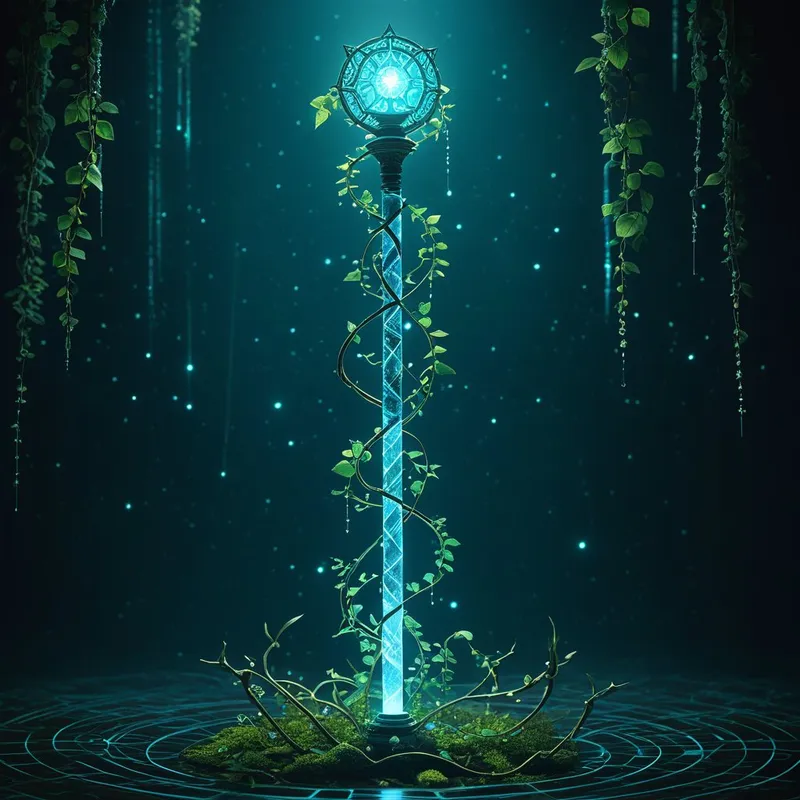
As his life force ebbed into the roots, the Slat na Draoi, standing between them, began to glow. The oak and mistletoe writhed as if alive, and a light, gold and green, pulsed from the staff up into the tree’s branches and down into the king’s failing form. In that moment of near-death, the boundary dissolved. King and tree, mortal and land, were one circuit.
The king awoke at dawn, cold dew on his skin. The wound on his hand was closed, a silvery scar in the shape of an oak leaf. The druid helped him rise. The Rod was now plain wood once more. But when the king placed his scarred hand upon the earth, he knew, without knowing how, that the streams would run full, that the calves would be strong. The covenant was written anew, not on parchment, but in the shared memory of blood and sap.
Cultural Origins & Context
The myth of the Druid’s Rod is not a single, standardized tale from a specific manuscript, but a thematic pattern woven through the fragmentary tapestry of Celtic lore, reconstructed from later Irish and Welsh texts, classical commentaries, and the enduring motifs of folklore. It belongs to the oral tradition, the province of the fili and the druid, not the scribe. Its function was foundational, not merely entertaining.
It served as the sacred blueprint for kingship. In Celtic societies, a king’s legitimacy was not derived solely from lineage or conquest, but from his symbolic marriage to the goddess of the land, often called Sovereignty (Flaitheas). The myth dramatizes this abstract concept. The druid, as mediator between the human and the otherworld, facilitates this union through the Rod, the instrument of correct ritual (fír). The king’s “sacrifice” is the surrender of his isolated ego to this greater order. The story was likely recited or enacted during the feis, the king’s ritual feast, to embed this psychic truth into the collective consciousness, ensuring the prosperity (bua) of the tribe.
Symbolic Architecture
At its core, the myth is a map of psychic wholeness. The King represents the conscious ego—the ruling principle of the psyche that has become alienated from its source. The Blight is the symptom of this disconnection: depression, creative sterility, a life lived mechanically, without meaning or vitality.
The Druid symbolizes the transcendent function, the inner guide (the Self, in Jungian terms) that knows the ritual to restore balance. He is not the king, but serves the king’s—and the kingdom’s—higher purpose.
The Rod is the axis of transformation. It is not a magic wand that imposes will, but a conductor that facilitates necessary connection.
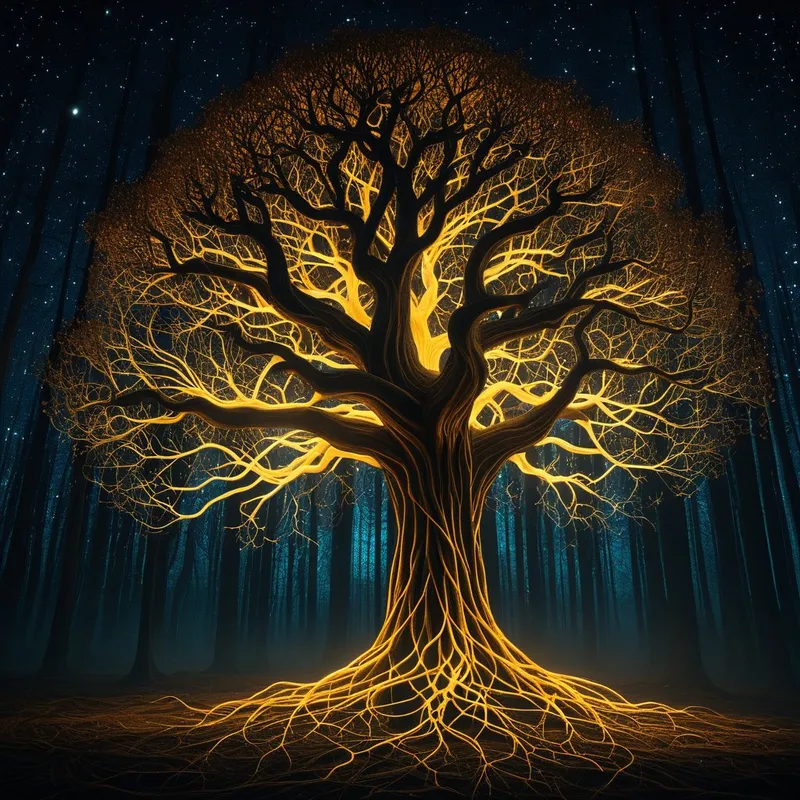
The Oak is the archetype of the World Tree, the immutable, deep structure of the psyche and the cosmos—the collective unconscious itself. The Mistletoe is the paradoxical element: it does not root in earth, yet is essential for the ritual. It represents the transcendent insight, the “lightning-strike” of consciousness that can only connect to the deep self (dur) through a mediator (the druid and his Rod).
The Blood is libido, life force, and the essence of individual identity. The ritual demands that this identity be offered up, not to be destroyed, but to be transmuted. The scar that remains is the seal of this transformation—no longer a wound of separation, but a sigil of integration.
The Dreamer's Resonance
When this myth stirs in the modern soul, it often manifests in dreams of profound disconnection and sought-after healing. One might dream of a dead or withering tree in the center of a personal landscape. Of trying to speak but finding one’s voice is silent, or that no one listens—a king whose word has no power. There may be dreams of a guiding, anonymous figure (the druid) offering a simple, enigmatic object—a key, a cord, a cup—that promises connection.
Somatically, the dreamer may be experiencing what psychologists call alexithymia—an inability to identify feelings—which is the blight upon the inner kingdom. There is a thirst that cannot be quenched by external achievement. The psyche is initiating a crisis of sovereignty: the ego is being confronted with its insufficiency and is being led, often through a period of depression or illness (the king’s wounding), toward a deeper source of authority. The dream is the Slat na Draoi itself, pointing toward the necessary, terrifying, and ultimately healing act of surrender.
Alchemical Translation
The myth’s process is a perfect allegory for Jung’s process of individuation. The conscious ego (the king) has built a kingdom (a persona, a career, an identity) that initially seems successful but is ultimately sterile because it is founded on a split from the unconscious (the land).
The first step is the recognition of the blight—the neurosis, the midlife crisis, the feeling of meaninglessness. This suffering forces the ego to consult the Self (the druid). The directive is always the same: you must go down, into the darkness of what you have ignored, and offer your most prized possession—your conscious control, your self-image.
The alchemical mortificatio is not death, but the death of the illusion that the ego rules alone. The king does not perish; he is un-knitted and re-woven into a larger tapestry.
The pressing of the wound against the tree root is the coniunctio, the sacred marriage. It is the moment where conscious insight willingly engages with the raw, primal power of the unconscious. This is not a peaceful merger, but a shocking, painful exchange of energy that feels like annihilation to the ego.
The glowing Rod is the transcendent function in action—the new, third thing that emerges from this confrontation, which is the integrated personality. The resulting “scar” of integration is the permanent change in consciousness. One does not “solve” the problem and return to normal. One is fundamentally altered. The renewed covenant means the individual’s life energy is now in dialogue with the deeper Self. Creativity, purpose, and a sense of authentic belonging (the land’s bounty) flow not from forced effort, but from this realigned connection. The Rod, once a tool for a ritual, becomes the living spine of a newly sovereign soul.
Associated Symbols
Explore related symbols from the CaleaDream lexicon: