Dronacharya Myth Meaning & Symbolism
The story of a master archer whose sacred duty as a teacher is shattered by a greater loyalty, leading to a devastating betrayal of his most gifted student.
The Tale of Dronacharya
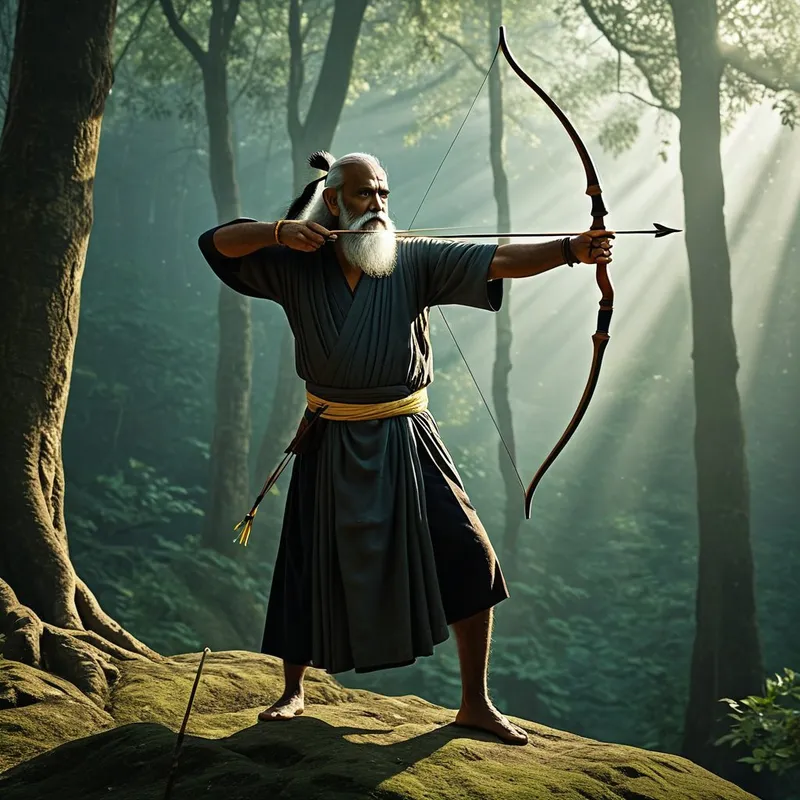
Hear now the tale of the master of masters, the one who held the bow of destiny and strung it with the sinews of sacred duty. His name was Dronacharya, born from a vessel of water, a sage’s seed fallen into a drona, a vessel. From his first breath, he was destined to contain, to hold, to pour forth knowledge.
In the deep, whispering forests of his youth, he learned the art of the bow from the great Parashurama</ab title>. His fingers became one with the bowstring; his eye saw not the target, but the very thread of fate it hung upon. Yet, destiny is a fickle archer. Poverty, that cruel hunter, stalked him. He went to the court of his childhood friend, King Drupada, seeking succor. But Drupada, seated on a throne of pride, laughed. He saw not the sage, but the pauper. “A friend?” he sneered. “Friendship exists only between equals.” The words were arrows that pierced deeper than any blade, embedding a vow of vengeance in Dronacharya’s soul that would fester for a lifetime.
He wandered, a vessel of divine skill now filled with the bitter wine of humiliation, until he came to Hastinapura. There, in the royal court, he performed a miracle. He fired an arrow to retrieve a ring from a well, not by looking at the water, but by hearing the ring’s echo in a droplet of oil. The Kuru princes knelt. He was appointed Kulapati, the supreme preceptor.
His gurukula was not a school, but a crucible. He taught the hundred Kauravas and the five Pandavas the arts of war. But his eye was caught by one: Arjuna. His focus was a flame in the dark. Drona saw in him the perfect vessel for his knowledge. He poured everything into Arjuna, forging him into the world’s greatest archer. He loved him as a son, as his own legacy made flesh and will.
Yet, a shadow student also emerged: Ekalavya. Denied formal teaching by Drona, who was bound by his duty to the royal princes, the tribal boy crafted a clay effigy of the guru and taught himself. Through sheer devotion and genius, he surpassed all but Arjuna. When Drona discovered this, a cold dread seized him. His vow to make Arjuna peerless was threatened. He demanded his guru dakshina. “Give me the thumb of your right hand.” Without hesitation, Ekalavya severed it and offered it, his devotion absolute, his genius forever crippled. The forest fell silent, bearing witness to a sacrifice that was also a murder.
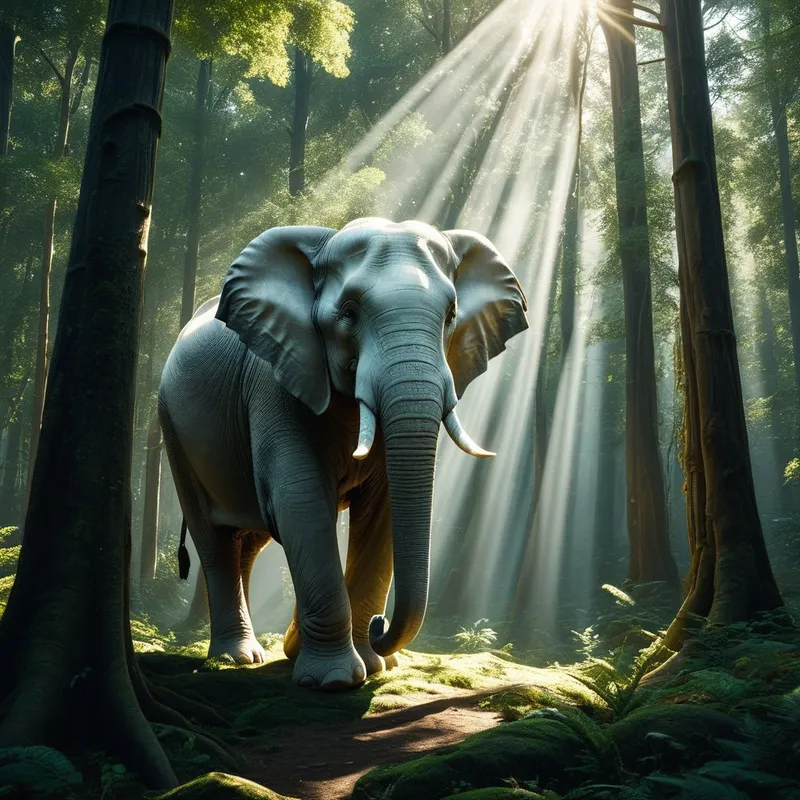
The final act was written on the great battlefield of Kurukshetra. Drona, bound by his debt to the throne that fed him, fought for the Kauravas against his beloved Pandavas. He was invincible, a whirlwind of destruction. The Pandavas knew only one thing could stop him: the shattering of his will. They contrived a lie. They killed an elephant named Ashwatthama—which was also the name of Drona’s beloved son—and shouted, “Ashwatthama is dead!” Drona, disbelieving, sought truth from Yudhishthira, who was oath-bound to never speak falsehood. Yudhishthira spoke, “Ashwatthama, the elephant, is dead.” The last word was drowned by the blare of conchs. Hearing only the first part from the lips of Truth itself, Drona’s spirit broke. He laid down his weapons, entered a meditative trance, and left his body. His son, the real Ashwatthama, lived, but the guru was gone, felled not by an arrow, but by a half-truth wielded by his own disciples.
Cultural Origins & Context
The myth of Dronacharya is a central pillar in the architectural epic of the Mahabharata, a text that functions as the cultural, ethical, and spiritual bedrock of Hindu civilization. It was not merely a story told for entertainment, but a shastra—a treatise—embedded in an itihasa, a history. Passed down orally for centuries by bardic lineages like the Sutas before being codified by sage Vyasa, its recitation was and remains a sacred act.
Dronacharya’s tale served a critical societal function in a culture built upon the dharma of the varna system. He embodies the Brahmin who takes up the role of the Kshatriya, a complex and potentially fraught transition. His story interrogates the very pillars of that society: What is the limit of a guru’s duty? What happens when sacred vows conflict? Can knowledge be owned, or is it a river that flows where it will? He is the ultimate teacher, yet his pedagogy is marred by favoritism and a devastating, pragmatic cruelty. The myth provided a narrative container for discussing the immense power and potential peril inherent in the guru-shishya (teacher-disciple) relationship, the cornerstone of traditional knowledge transmission.
Symbolic Architecture
Dronacharya is the archetype of the ekagrata—the focused will—turned to both creation and destruction. He is not a simple sage, but the Complex Guru.
The guru is the bridge between the human and the divine, but what if the bridge itself is built on the fault line of a personal wound?
His entire life is a reaction to the primal wound of rejection and humiliation by Drupada. This wound becomes the hidden compass of his dharma. His vow to make Arjuna peerless is not pure pedagogy; it is alchemy, an attempt to transmute his own humiliation into another’s invincibility. His knowledge is absolute, but his motivations are tragically human.
The demand for Ekalavya’s thumb is the myth’s most chilling symbolic moment. It represents the tyranny of the formal lineage over innate genius (pratibha). The thumb is the seat of a archer’s skill; its sacrifice is the ritual murder of potential that exists outside sanctioned structures. Drona does not kill the boy; he cripples the divine gift within him, privileging institutional loyalty over the raw voice of talent. It is dharma perverted by attachment.
His death by the “half-truth” is profoundly symbolic. He, the master of perfect aim, is felled by imperfect knowledge. He who demanded absolute clarity from his students is destroyed by ambiguity. It signifies that absolute expertise in an art is no shield against the chaos of human relationships and moral ambiguity. His meditative departure shows his ultimate mastery was over his own life-force, but not over the karmic web his actions helped weave.
The Dreamer's Resonance
To dream of the Dronacharya pattern is to be immersed in the psychology of the Mentor-Shadow. The dreamer may find themselves in the role of the devoted yet exploited student (Ekalavya), sacrificing their innate gifts to appease an internalized, demanding authority figure. The somatic sensation is often one of constriction—a literal or felt sense of a missing thumb, a hampered ability to “grasp” one’s own power.
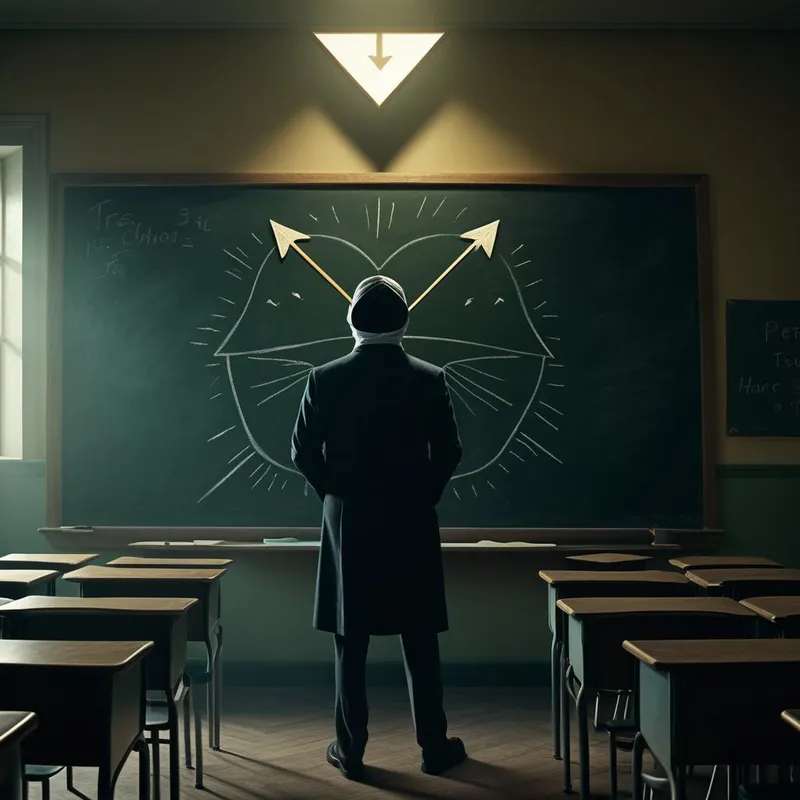
Conversely, the dreamer may be Dronacharya: the accomplished expert bound by a compulsive loyalty to a system, institution, or family that conflicts with a deeper, more personal truth or affection. The dream landscape may feature impossible choices, classrooms that are also battlefields, and a profound sense of being trapped by one’s own excellence and the debts it has incurred. The emotional tone is one of profound isolation amidst duty, a silent scream behind the mask of the competent master. It is the psyche working through the conflict between what you are obligated to do and what you know, in your heart, to be right.
Alchemical Translation
The alchemical journey modeled by Dronacharya is the transmutation of the Wound into Wisdom, and the subsequent shattering of that very wisdom by a greater truth. It is a higher-order individuation process.
The first stage is Calcinatio: the burning humiliation by Drupada reduces Drona’s naive identity to ash. From this ash, in the Solutio of his training with Parashurama, he dissolves his old self and crystallizes a new identity around a single, formidable skill—the bow. This is the creation of the Persona of the Master, brilliant and formidable.
Individuation is not merely becoming whole; it is the terrifying responsibility of holding the contradictions of your own wholeness.
The crisis is the Coagulatio: his identity coagulates, hardens, around the vow born from his wound. His loyalty to Arjuna and his vengeance against Drupada become the fixed, rigid center of his being. He becomes a perfect, but brittle, instrument. The Ekalavya episode is the shadow of this coagulation—the ruthless elimination of anything that threatens this fixed structure.
The final, brutal alchemy is the Mortificatio and Separatio on the battlefield. The half-truth is the aqua permanens, the dissolving water that attacks this fixed structure. It does not kill his body first; it kills his reason for being. His loyalty is rendered absurd, his expertise meaningless. In laying down his weapons and leaving his body, he performs the ultimate Separatio. He separates his pure consciousness from the tangled, duty-bound, vengeance-driven identity he had constructed. His death is, paradoxically, his final and most profound teaching: even the most perfected earthly dharma is provisional. The ultimate loyalty is not to a king, a student, or a vow, but to the truth that shatters all lesser truths. The vessel named Drona is finally emptied, and the water within returns to the boundless ocean from which it came.
Associated Symbols
Explore related symbols from the CaleaDream lexicon: