
Dream Interpretation Tablets Myth Meaning & Symbolism
A divine scribe descends to humanity, gifting the perilous art of dream interpretation, forging a bridge between the sleeping soul and the waking world.
The Tale of Dream Interpretation Tablets
Beneath the vault of heaven, where the Apsu mingles with the Tiamat, the gods dwell in a light too fierce for mortal eyes. They speak in the language of stars and storms, and their thoughts are tablets of destiny, inscribed upon the fabric of the world. But there is another language, a whispering, shadow-tongue spoken in the realm of sleep—the language of dreams. For ages, this language was a sealed book to humanity. Dreams were portents that fell upon the sleeping like stones from a dark sky, leaving behind only dread and confusion upon waking.
In the Ekur of Nippur, the priests would listen to the troubled accounts of kings and shepherds alike. "I saw a mountain that walked," one would say, trembling. "I saw the river run with blood," another would whisper. The priests would consult the entrails of sheep, the flight of birds, but the heart of the dream remained a locked chamber.
Then, from the assembly of the great gods, a decision was made. The divine scribe, the keeper of all formulas and the measurer of the heavens, was summoned. This was Ningishzida, he whose essence is the true timber of the cosmic tree, the serpent-dragon of the subterranean depths who also knows the pathways to the stars. To him was given a sacred task: to descend the Ziggurat of the gods and deliver the key to the shadow-tongue.
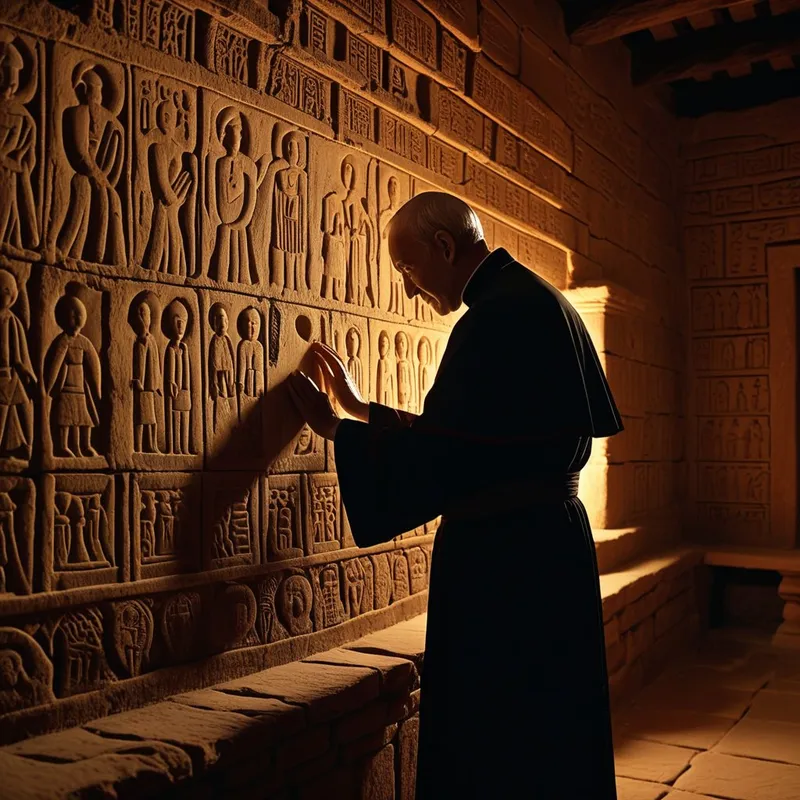
Ningishzida did not come as a thunderclap, but as a figure of deep stillness at the threshold of the temple at dusk. In his hands, which were neither fully man nor beast, he carried not one, but a series of sun-baked clay tablets. They were heavy with the weight of knowledge, their surfaces incised with the precise, wedge-shaped speech of the divine—cuneiform. These were not mere lists. They were maps. A map of a dream of a falling star, which led to the entry: "If a man dreams a star falls from heaven into his lap: the loss of a son." A map of a dream of eating hot embers: "the gaining of unexpected wealth." A map of a dream of a lost sandal: "a journey will be delayed, but fate will be kind."
He presented them to the wisest of the human scribes, a man whose eyes had grown dim from staring at the mundane accounts of grain and livestock. "These," spoke Ningishzida, his voice like the rustle of dry reeds and the flow of deep springs, "are the Duppu Shimati for the night-self. Guard them. For to read a dream is to hold a fragment of destiny itself, still warm from the forge of the soul. It is a power that borders on the divine, and to misuse it is to call the Utukku to your threshold."
With that, the god withdrew, melting back into the liminal space between the torchlight and the advancing night. The scribe was left alone with the tablets. That night, he did not sleep. By the flickering light of a sesame oil lamp, he traced the signs with a trembling finger. He heard the first confession of a dream at dawn, and for the first time, instead of fear, he offered a meaning. The relief on the dreamer's face was like the breaking of a fever. The bridge was built. The whispers of the night could now find their echo in the understanding of the day.
Cultural Origins & Context
This mythic narrative is not a single, codified story like the Enuma Elish, but is woven from the fabric of Mesopotamian cosmological thought and praxis. It crystallizes the function of actual dream interpretation manuals, the oldest of which date back to the Assyrian period, found in the library of Ashurbanipal. These tablets were pragmatic, scholarly tools, used by a specialized class of priests and diviners known as āšipu (exorcist-sages) and bārû (seers).
The societal function was profound. In a worldview where every event was a sign from the gods, dreams were considered direct, if cryptic, messages concerning health, state affairs, family, and fortune. The interpretation tablet was a technological and spiritual instrument for maintaining cosmic order (Ma'at in Egypt, paralleled by Kittum and Mešaru in Mesopotamia). It was a dam against the chaos of unknowing. By systematizing the dream, the priest-scribe enacted a ritual of order, translating divine caprice into actionable advice for the king or commoner, thereby stabilizing the psychological and social realm.
Symbolic Architecture
At its core, the myth symbolizes the human intellect's courageous—and perilous—venture into the irrational depths of the unconscious. The Tablets themselves are the ultimate symbol of logos attempting to structure mythos. They represent consciousness imposing syntax on the raw, imagistic language of the soul.
The tablet is the shore where the chaotic sea of the unconscious finally meets the ordered land of understanding.
Ningishzida, as the psychopomp-god, embodies the mediating function itself. He is a boundary deity, associated with the roots of the world tree and the healing arts—a figure who can traverse the chasm between the deep, instinctual underworld (the source of dreams) and the celestial realm of ordered principle. His gift is not a gift of absolute truth, but of a method. He gives a grammar, not a dictionary. This highlights a profound psychological truth: the meaning of a dream is not fixed by an external authority, but is discovered through the application of a conscious framework to unconscious material.
The Dreamer's Resonance
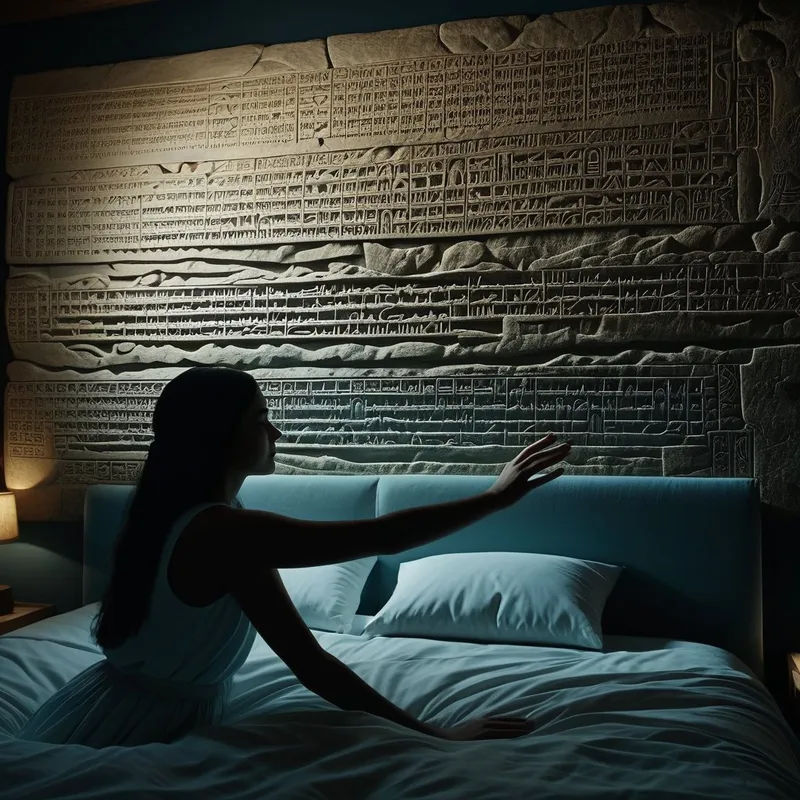
When a modern individual dreams of ancient tablets, encoded texts, or unreadable manuals, they are encountering this archetypal pattern. The somatic sensation is often one of frustrating fascination—a heavy, tactile weight combined with the anxiety of illiteracy. Psychologically, this signals a moment where content from the personal or collective unconscious is pressing for recognition and interpretation. The dream ego stands as the ancient priest before the divine gift: aware that a great truth is present, but lacking the innate skill to decipher it.
This dream motif asks the dreamer: What message from your deeper self are you currently unable to "read"? What inner knowledge feels inscribed in a foreign language? The tablet in the dream is the dream itself, and the dreamer's longing to understand it re-enacts the mythic moment of receiving the interpretive key. It is a call to engage in the inner work of translation, to become one's own āšipu.
Alchemical Translation
The myth models the individuation process as the gradual, disciplined acquisition of a symbolic literacy. The initial state is one of being passively afflicted by unconscious content (the terrifying, unexplained dream). The call to adventure is the arrival of the mediating function (Ningishzida), which in modern terms is the emerging capacity for self-reflection and symbolic thinking.
The alchemy occurs not in the gold of a final answer, but in the very act of holding the lamp of consciousness over the clay of the unknown.
The "tablets" one must learn to read are one's own complexes, recurring dream symbols, and affective patterns. The laborious, often frustrating work of therapy, journaling, or active imagination is the modern equivalent of the scribe's nightly vigil. The goal is not to possess a rigid, one-to-one dictionary ("this always means that"), but to develop a living, personal hermeneutics. The triumph is the integration signified by the relieved dreamer at dawn: when a previously disturbing or chaotic inner experience is named and understood, it loses its autonomous, haunting power and becomes a source of insight. One builds, brick by brick, one's own personal Ziggurat—a stable structure connecting the earthly reality of the ego with the divine whispers of the Self.
Associated Symbols
Explore related symbols from the CaleaDream lexicon: