Dragonfly Myth Meaning & Symbolism
A Zuni myth where a young boy's sacrifice transforms him into Dragonfly, a messenger who bridges worlds and brings the gift of rain.
The Tale of Dragonfly
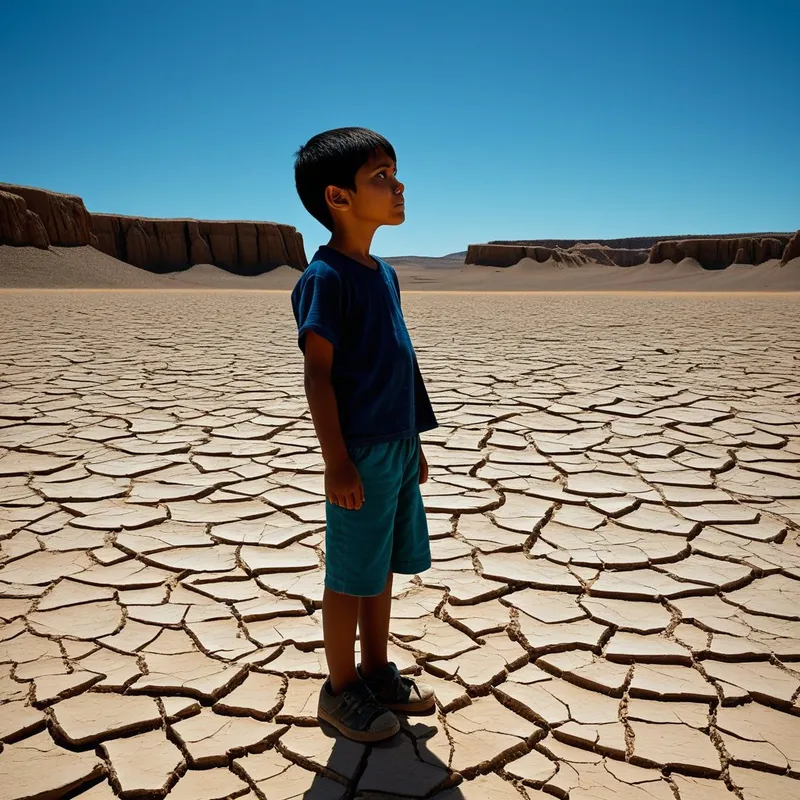
In the time when the world was younger, and the sun pressed its hot hand upon the land, a great thirst lay upon the A:shiwi. The rivers were whispers in the sand, the corn stalks bowed like grieving elders, and the dust hung in the air, a bitter veil. The people prayed, their voices cracking like the earth itself, but the Koko seemed distant, their cloud blankets rolled up and stored away.
Among the people was a boy, not the strongest hunter nor the most skilled potter, but one whose heart was a deep well of feeling. He felt the land’s thirst in his own dry throat, saw the despair in his mother’s eyes, heard the weak cries of the infants. The suffering of his people became a stone in his own belly. He walked away from the pueblo, out onto the vast, shimmering plain where the heat made mirages of lakes that were not there.
He climbed a low mesa, the rock burning beneath his bare feet. Raising his arms to the relentless sky, he did not ask for rain. Instead, he offered a trade. His voice, thin but clear, cut through the stillness. “Take me,” he said to the powers of the Above. “Take my life, this small life, and in its place, give my people the water that is life. Let my form be changed, let me be of use.”
The air grew heavy. A silence deeper than before swallowed the world. Then, a wind, not from any horizon, but from above and below at once, began to swirl around him. It was not a harsh wind, but one of immense, transformative pressure. He felt not pain, but a profound unraveling. His skin tingled, his bones grew light, his sight fractured into a thousand points of light. He was being unmade.
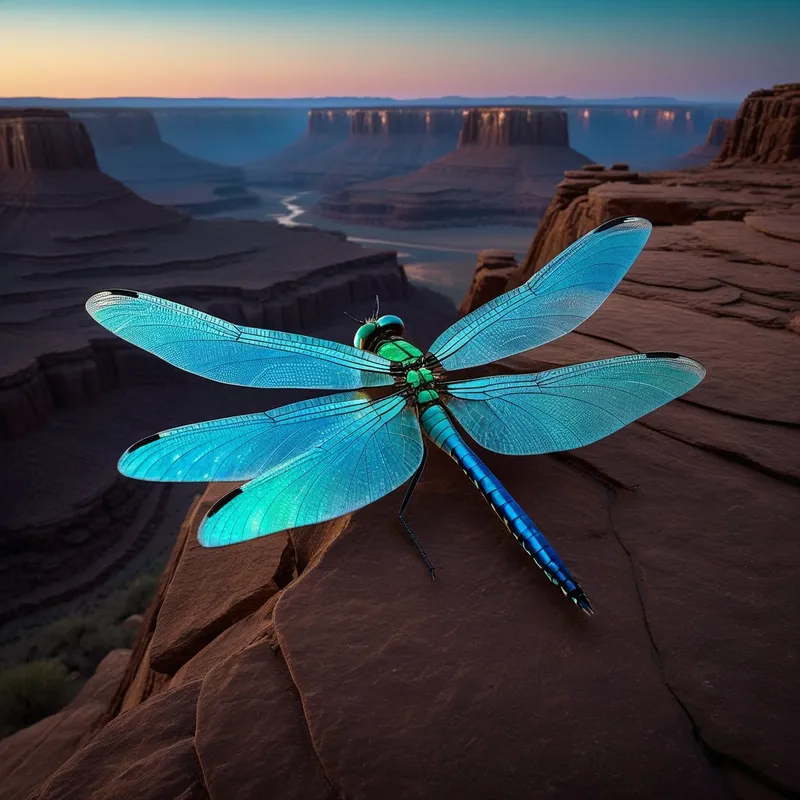
From the vortex of wind and intention, a new form coalesced. Where the boy stood, now hovered a creature of breathtaking delicacy and purpose. His body was slender and strong, his head a helm of shining observation. From his back sprang two pairs of wings, not of feather or flesh, but of finest, iridescent membrane, catching the light like fetishes of turquoise and abalone. He was Dragonfly.
With a buzz that was the song of his new being, he darted into the sky. He did not fly like a bird, but darted, hovered, shot forward with impossible speed and precision. He flew to the farthest reaches, to the homes of the Koko. With his new, multifaceted eyes, he could see the need of the earth with perfect clarity. He became the messenger, the pleader, his very form a testament of sacrifice. He danced in the air before the cloud beings, a living prayer.
And the Koko listened. They saw the truth in his transformation. They unfurled their blankets of cloud, dark and heavy. The first drop fell, then another, hitting the parched earth with a sound like a heartbeat returning. The rain came, a gentle, soaking gift. The people emerged, their faces turned upward, drinking in the water and the miracle. And there, dancing between the rain shafts, they saw him—the boy who was gone, now Dragonfly, the bringer of the rain, forever linking the world of human need with the realm of spiritual grace.
Cultural Origins & Context
This myth belongs to the rich oral tradition of the A:shiwi (Zuni) people, whose pueblo communities have thrived for millennia in the arid landscapes of what is now New Mexico. Unlike a simple fable, this story is part of a complex cosmological tapestry that explains the nature of the world, the responsibility of beings within it, and the proper relationship between humans and the spiritual forces that sustain life.
The myth would have been passed down through generations, likely by elders or designated storytellers, particularly during the winter months when the community gathered indoors. Its telling served multiple functions: it was a moral lesson in selflessness, an etiological story explaining the origin and behavior of the dragonfly, and a sacred narrative reinforcing the principle of reciprocity that is central to Zuni worldview. The dragonfly is not merely an insect; it is a kyapin, a mediator. The story codifies the dragonfly’s role as a herald of rain, making its appearance a sign of hope and a reminder of the sacred covenant between the people and the spiritual sources of life-giving water.
Symbolic Architecture
At its heart, the myth of Dragonfly is a profound map of transformation through radical sacrifice. The boy does not fight a monster; he offers himself as the sacrifice. His act is not one of defeat, but of ultimate agency—choosing to give his current form for a greater function.
The most profound metamorphosis begins not with a desire to gain, but with the courage to be utterly dissolved for a purpose beyond the self.
The dragonfly form is the symbolic architecture of this new purpose. Its legendary flight—able to move in all six directions with stunning agility—represents the ability to navigate between worlds: the human and the spiritual, the mundane and the numinous. Its compound eyes, seeing in nearly every direction at once, symbolize panoramic vision. This is not just physical sight, but insight—the ability to perceive need, to see the connections between plea and answer, suffering and relief. The iridescence of its wings captures and refracts light, representing the idea that the transformed self becomes a vessel for reflecting spiritual power and beauty into the world.

The Dreamer's Resonance
When this mythic pattern stirs in the modern dreamer, it often signals a profound somatic and psychological initiation into a necessary, yet terrifying, change. To dream of being the boy on the mesa is to feel the weight of a personal or collective “drought”—a period of emotional aridity, creative stagnation, or spiritual thirst. The sacrifice offered in the dream is rarely literal death, but the death of an old identity, a cherished self-image, or a comfortable pattern that has outlived its usefulness.
The somatic experience might be one of compression, of being squeezed by circumstance or inner conviction until the old “skin” cannot hold. The transformation into the dragonfly in a dream can feel like a sudden liberation into a new mode of perception. The dreamer may experience sensations of buzzing energy, dizzying shifts in perspective, or a feeling of being incredibly light and agile. This is the psyche announcing that the dissolution has occurred, and a new, more integrated form of consciousness—one capable of navigating complexity and mediating between different parts of the self—is emerging. The dream is an affirmation: the sacrifice was accepted.

Alchemical Translation
Psychologically, this myth models the alchemical stage of solutio followed by a sublime corporificatio. The modern individuation journey often requires a similar “boy on the mesa” moment. It is the point where the ego, faced with an impossible situation (the drought), realizes it cannot solve the problem from within its current limited resources. Its only authentic move is to surrender its central position and offer itself up to the larger, transformative process of the Self.
The ego does not individuate; it is the material that is individuated. Its willing sacrifice is the catalyst.
The subsequent “dragonfly” state is the new psychic configuration that results. This is the integrated individual who can “hover” above conflicts (seeing multiple perspectives), “dart” with precision toward insight, and move seamlessly between the inner world of instinct and image and the outer world of action and relationship. The dragonfly’s connection to water is key. In alchemy and depth psychology, water is the symbol of the unconscious, of emotion, and of the flow of life. The transformed self becomes a conduit for this life-giving energy, not just for itself, but for the “people”—the inner community of the psyche and the outer community of one’s life. The myth teaches that true power and purpose are born not from holding onto one’s form, but from allowing it to be transmuted into an instrument of connection and nourishment.
Associated Symbols
Explore related symbols from the CaleaDream lexicon: