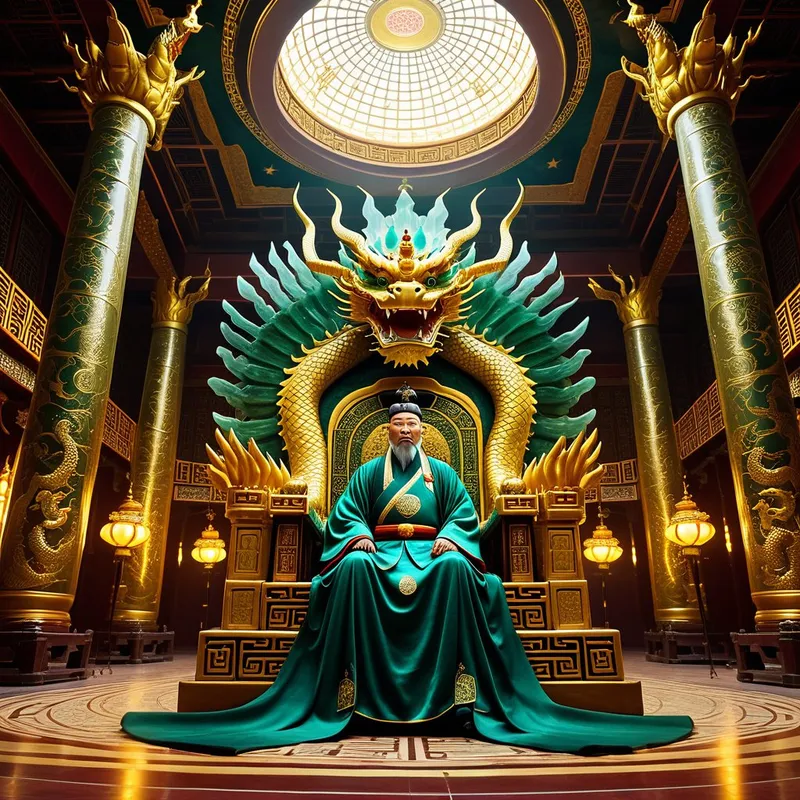
Dragon Throne of the Emperor Myth Meaning & Symbolism
A myth of celestial mandate and earthly rule, where the emperor's throne, forged from dragon's wisdom, anchors cosmic order to human civilization.
The Tale of Dragon Throne of the Emperor
Listen, and let the mists of time part. Before the first dynasty was carved into bamboo, before the Yellow River learned its name, there was a great Unfurling. The world was a canvas of chaos—mountains roamed like restless beasts, rivers flowed backwards in confusion, and the sky wept fire and flood in equal measure. The people, scattered and fearful, cried out to the heavens for a center, for a pillar to hold up the sky.
From the deepest womb of the earth, where the veins of jade pulse with the planet’s heartbeat, came a sound. It was not a roar, but a resonance, a hum that tuned the very stones. It was the voice of the Long, the Celestial Dragon. Its scales were the color of twilight meeting dawn, and its eyes held the patient fire of a thousand stars. It saw the suffering below, the disharmony between Tian and the mortal realm.
The Dragon did not conquer; it wove. It coiled its immense body around the axis of the world, its breath becoming the four winds, its spine the mountain ranges that finally grew still. But order was not enough. The pattern needed a keeper, a single point of consciousness to hold the design. So, the Dragon summoned the first of the great Sages, a man whose spirit was as clear as mountain ice. To him, the Dragon whispered the secret names of the rivers and the songs of the seasons.
“The pattern is set,” the Dragon’s voice echoed in the Sage’s mind, “but it is a living pattern. It must be tended by a human heart, one that understands both the mud of the earth and the music of the spheres. You must find the Heart-Mind that can bear this weight.”
The Sage journeyed for years. He tested princes and warriors, philosophers and farmers. Many sought the power, but their hearts echoed with desire for self, not service to the pattern. Despair began to creep in. Then, in a humble village tending the flood plains, he found a young farmer. This man did not command the river; he listened to it. He felt the turn of the soil not as labor, but as conversation. When the Sage presented him with a simple stool and spoke of the Dragon’s charge, the farmer did not see a throne, but a responsibility. He saw the endless work of balance.
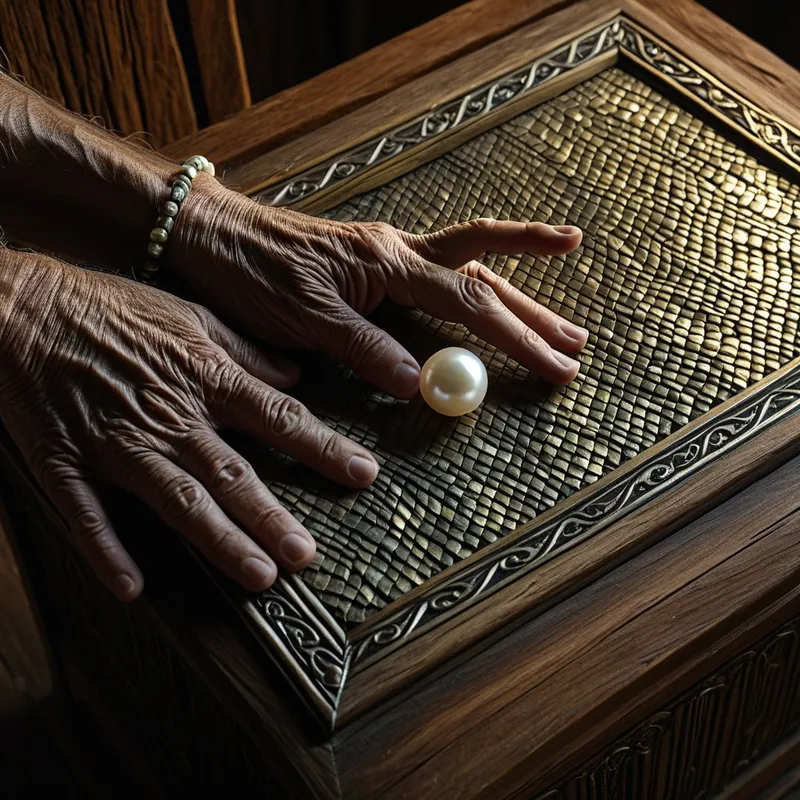
The Sage led him to the sacred mountain. There, in a cavern lit by bioluminescent fungi, stood the raw material: the heartwood of a tree that had drunk moonlight for a millennium, and a single, flawless pearl given by the Dragon—a tear of condensed celestial order. “This is not for building,” the Sage instructed. “It is for becoming. You must shape it not with tools, but with your intent. Your virtue, your De, will give it form.”
For forty-nine days and nights, the farmer sat in meditation before the wood and the pearl. He did not carve; he envisioned. He saw the harvests of ten thousand fields, the peaceful sleep of children in secure villages, the fair measure of justice. As he held these visions, the wood began to shift. Roots curled into armrests, grain swirled into patterns of clouds and waves, and the pearl sank into the high back, becoming a luminous moon. And coiling up from the base to the crest, as if emerging from the earth itself, was the form of the Celestial Dragon, not as a fearsome beast, but as the foundational support of all that is.
When the farmer—now the first Tianzi—finally sat upon it, a shockwave of calm rippled through the land. The rivers found their courses. The seasons clicked into their rightful order. The throne was not his seat of power; it was the fulcrum upon which Heaven and Earth found their balance. He was no longer just a man; he was the vessel for the Tianming, the human anchor of the cosmic dragon’s design.
Cultural Origins & Context
This myth, in its myriad forms, is the bedrock of the Chinese imperial political-theological concept. It is not a single story from one text, but a deep narrative stratum woven into historical records like the Shiji, classical philosophy, and folk tradition. It served as the sacred justification for sovereignty. The throne was never merely furniture; it was the ultimate ritual object, the physical proof of a dynasty’s possession of the Mandate of Heaven.
The myth was propagated by the state apparatus—historians, scholars, and priests—to legitimize the ruling house. It was performed in the architecture of the Forbidden City, where the emperor sat in the Hall of Supreme Harmony, directly on the central axis of the world, with dragon motifs saturating every surface. The story told people that their emperor’s authority was not arbitrary, but a cosmological necessity. His personal virtue (De) was what kept the throne—and by extension, the world—stable. Natural disasters or social upheaval could be interpreted as the throne shaking, a sign that the Tianming might be withdrawing.
Symbolic Architecture
At its core, the Dragon Throne symbolizes the terrifying and glorious burden of conscious order. The Dragon represents the raw, unconscious, cosmic force of nature—powerful, creative, and potentially chaotic. The throne is the act of culture, the human mind daring to interface with that raw power and give it a form that sustains life.
The throne is not a seat of rest, but a station of perpetual mediation. It is where the whirlwind of the cosmos is translated into the rhythm of the plough and the measure of the law.
The emperor figure is the archetypal ego-consciousness tasked with a monumental duty: to integrate the immense, non-human power of the Dragon (the unconscious Self) into a structure that benefits the collective (the kingdom, the psyche). The pearl is a key symbol: it is the concentrated essence of consciousness, the hard-won prize of wisdom that must be integrated at the center of one’s being. The myth warns that the throne cannot be seized by brute force or personal ambition; it must be earned by the quality of one’s character, by one’s capacity to hold the tension between immense power and profound responsibility.
The Dreamer’s Resonance
When this myth pattern stirs in the modern dreamer, it rarely appears as an ancient emperor. Instead, one might dream of being forced to sit in a boss’s oversized chair, feeling like a fraud. Or of finding a strange, ornate chair in a childhood home, both compelling and frightening. One might dream of a petrified tree that feels like a seat, or of being given a simple stool that suddenly feels heavier than a mountain.
These dreams signal a profound psychological initiation into personal sovereignty. The somatic feeling is often one of immense pressure on the spine and shoulders—the weight of the world. It is the psyche confronting the question: “What in my life am I truly responsible for? What structure or order must I consciously uphold?” It can feel like a crisis of legitimacy (“Who am I to lead this project, this family, this inner work?”). The dream exposes the conflict between the desire for authentic authority and the fear of the isolation, scrutiny, and duty that comes with it.

Alchemical Translation
For the individual, the myth maps the alchemical stage of coagulatio—the fixing of spirit into a lasting, conscious form. Our personal “dragon” is the totality of our unconscious: our instincts, passions, ancestral patterns, and latent genius. It is chaotic, potent, and mostly autonomous. The “throne” is the coherent, enduring structure of the personality we build to engage with the world—our values, ethics, and chosen responsibilities.
Individuation is the process of building your own throne, not from a blueprint of societal expectation, but from the heartwood of your own authentic experience, inlaid with the pearl of your hard-won self-knowledge.
The “farmer” who becomes emperor represents the humble, grounded part of ourselves that must undertake this work. We do not conquer our inner dragon; we learn its language, we respect its power, and we invite it to become the foundation of our sovereignty. The struggle is the forty-nine nights of meditation: the long, patient, and often lonely work of integrating shadow, refining character, and clarifying intent. The triumph is not becoming a dictator of the psyche, but becoming a wise steward. You sit on your throne when your actions are no longer driven by reactive impulse or the need for approval, but flow from an integrated center that balances your inner cosmos (personal needs, dreams, fears) with your outer world (relationships, work, community). You rule when you can hold the tension of opposites within yourself, bringing order not through control, but through conscious, virtuous presence.
Associated Symbols
Explore related symbols from the CaleaDream lexicon: