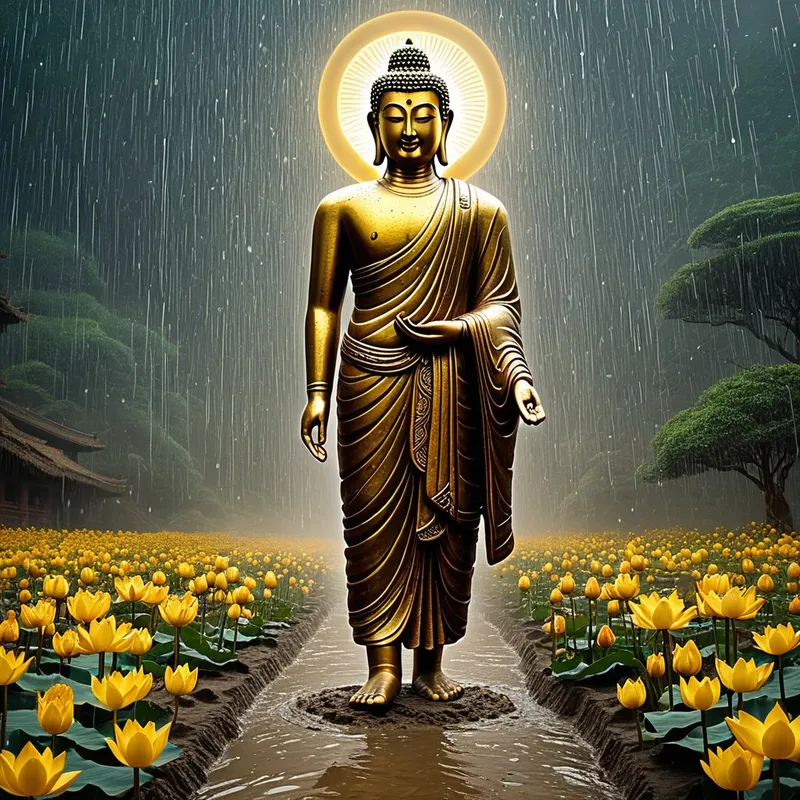
Dīpaṃkara Buddha Myth Meaning & Symbolism
The story of a young ascetic's vow to become a Buddha, sealed by the prophecy of a past Buddha, illuminating the long path of spiritual resolve.
The Tale of Dīpaṃkara Buddha
In the deep, unfathomable past of this world-cycle, when the lifespan of beings was measureless, there walked a being of perfect wisdom. His name was Dīpaṃkara, the Illuminator, the Kindler of Lamps. Wherever his feet touched the earth, the very ground softened and bloomed with lotuses. His presence was not a shout, but a dawn—a light so profound it did not cast shadows, but revealed the luminous nature of all things.
Word spread across the land of a great teacher coming to the city of Rammavatī. The air itself grew thick with anticipation, perfumed by flowers raining from the heavens. The citizens, from the king to the humblest farmer, swept the roads and strewed them with sandalwood powder and blossoms, preparing a pure path for the Blessed One.
But in the mountains, a young brahmin ascetic named Sumedha heard this news. He was a scholar of the Vedas, a practitioner of fierce austerities, yet a profound dissatisfaction gnawed at his heart. The peace he sought remained elusive, a fish slipping through the nets of his mind. Driven by a yearning he could not name, he descended to the city.
He arrived to find the royal road pristine, a golden ribbon through the city. Yet, as Dīpaṃkara approached, a problem appeared. A small, muddy stretch of the path, churned by cart wheels and recent rain, threatened to soil the Buddha’s feet. The people fretted, scrambling for clean cloths and planks, but there was not enough.
In that moment, Sumedha did not think. His body moved by an instinct deeper than reverence, a resolve older than his bones. Seeing the mud, seeing the radiant figure approaching, he knew his purpose. He loosened his long, matted ascetic’s hair—uncut for years—and spread it upon the mire. Then, he lay his entire body down upon that damp, dark hair, prostrating himself across the puddle, making of his own form a living bridge.
The crowd gasped. But Dīpaṃkara, the Illuminator, walked forward with his great retinue of monks. His gaze, containing the patience of aeons, fell upon the young man in the mud. Without hesitation, and with infinite grace, he stepped onto the bridge of Sumedha’s back. As his foot pressed down, a vision blossomed in Sumedha’s mind: not of servitude, but of ultimate possibility.
Standing upon him, Dīpaṃkara paused. He turned to his disciples and spoke, his voice like a deep bell tolling across time. “Behold this ardent one. Do not think he makes this offering in vain. In ages to come, after incalculable lifetimes of perfecting virtue and wisdom, this being will himself become a Buddha in the world. His name will be Gautama.”
As the prophecy echoed, Sumedha, his face in the mud, made his own fierce, silent vow. He saw the long, lonely path of a Bodhisattva—aeons of striving, giving, and awakening. And he chose it. He vowed to walk that path until he, too, could light a lamp in the world’s darkness. The rain of flowers fell upon them both, and the mud, for a moment, smelled of lotus.

Cultural Origins & Context
The myth of Dīpaṃkara is one of the oldest and most foundational narratives in the Buddhist literary tradition, primarily preserved in the Jātaka tales and the Buddhavaṃsa. It functions as the primordial origin story for the entire Bodhisattva path. This was not a tale told merely for inspiration; it was a cosmological anchor. It answered a critical question for early Buddhist communities: How did our Buddha, Siddhartha Gautama, begin his journey? The answer stretched back into almost unimaginable time, establishing that his enlightenment was not a sudden accident, but the fruition of a resolve made in the presence of a previous Buddha.
The story was recited by monastics and traveled with Buddhism along the Silk Road, from India to Gandhara, Tibet, China, and Southeast Asia. Its societal function was multifaceted. For monks and nuns, it modeled the ultimate commitment—the bodhicitta vow taken across lifetimes. For laypeople, it illustrated that the potential for awakening is universal, seeded by a single act of selfless devotion. It transformed the historical Buddha from a singular sage into the current protagonist of an epic narrative spanning cosmic time, making the path to Buddhahood feel both achingly long and intimately accessible through the act of vow.
Symbolic Architecture
At its heart, the myth is a profound map of psychic causality. Dīpaṃkara represents the Buddha principle itself—the fully actualized consciousness that is both a historical event and an eternal archetype existing within the psyche. He is the “first light” one encounters, the initial, overwhelming vision of wholeness that reorients an entire life.
The prophecy is not a prediction of fate, but a recognition of potential. It is the moment the unconscious confirms to the ego: the path you glimpse is real, and it has your name on it.
Sumedha is the nascent, seeking self—the ego that has exhausted worldly and ascetic knowledge but yearns for something transcendent. The mud is the unresolved, chaotic, and “impure” material of ordinary life, of samsaric existence. Sumedha’s act of using his own hair—a symbol of ascetic ego and personal identity—as a bridge through that mud is the ultimate act of psychic alchemy. He does not reject the mud; he uses the very substance of his current identity to transform it into a path for the transcendent. His prostration is the death of the seeking ego and the birth of the vowed self.
The hair in the mud becomes a powerful symbol of the connection between the transcendent (the Buddha) and the immanent (the suffering world). It is the individuating ego’s first and most crucial sacrifice: not its annihilation, but its dedication as a conduit.

The Dreamer’s Resonance
When this myth stirs in the modern unconscious, it often manifests in dreams of profound recognition and weighty commitment. One might dream of finding an ancient, dusty book with one’s own name inscribed in it as the author of a future, monumental work. Or of meeting a serene, authoritative figure in a crowd who places a hand on one’s shoulder, conferring a silent, undeniable sense of destiny.
Somatically, this can feel like a pressure on the back—not a burden, but a grounding, initiating weight. Psychologically, the dreamer is at a threshold. They have likely achieved a degree of competence or self-knowledge (Sumedha the scholar-ascetic) but feel its ultimate insufficiency. The dream introduces the “Dīpaṃkara moment”: an encounter with an inner authority (a sage archetype, a inner mentor) that reveals the staggering scale of the journey ahead. The conflict is between the comfort of the known path and the terrifying, exhilarating call to a lifetime’s—or many lifetimes’—work. The dream may evoke both deep peace (the prophecy) and profound anxiety (the vow), marking the psyche’s registration of a point of no return in its own development.

Alchemical Translation
The alchemy of the Dīpaṃkara myth models the process of psychic seeding. It is the myth of the beginning of individuation, not its end. For the modern individual, the “muddy stretch of road” is the complex, messy, and often painful nexus of one’s personal history, neuroses, and unresolved shadows—the very material we often wish to avoid or have cleansed before we proceed.
The act of laying one’s hair upon the mud is the critical operation: it is the conscious decision to use one’s present identity, with all its flaws and history, as the sole and necessary vehicle for transformation. One does not wait to become pure; one offers one’s impurity as the foundation.
Dīpaṃkara’s step is the infusion of meaning. It is the moment when the personal struggle is suddenly framed within a transpersonal narrative. The “prophecy” is the ego’s shocking, humbling, and empowering realization: “My suffering has a direction. My longing has a destination. This difficult path is my path.” This recognition transmutes despair into resolve, and random suffering into purposeful austerity.
The long aeons between the prophecy and its fulfillment represent the internal work of the Bodhisattva—the lifelong cultivation of patience, generosity, morality, and wisdom. For us, these are not literal lifetimes, but the iterative, daily commitments to growth, the small acts of courage, the enduring of difficulties with the newfound knowledge that they are part of a meaningful structure. The lamp of Dīpaṃkara, lit in the distant past, is the inner light of that initial, irrevocable “yes” to one’s deepest potential. It continues to glow, however faintly, guiding the way through all subsequent darkness, a reminder that the journey, however long, was inaugurated by a single, decisive act of self-offering.
Associated Symbols
Explore related symbols from the CaleaDream lexicon: