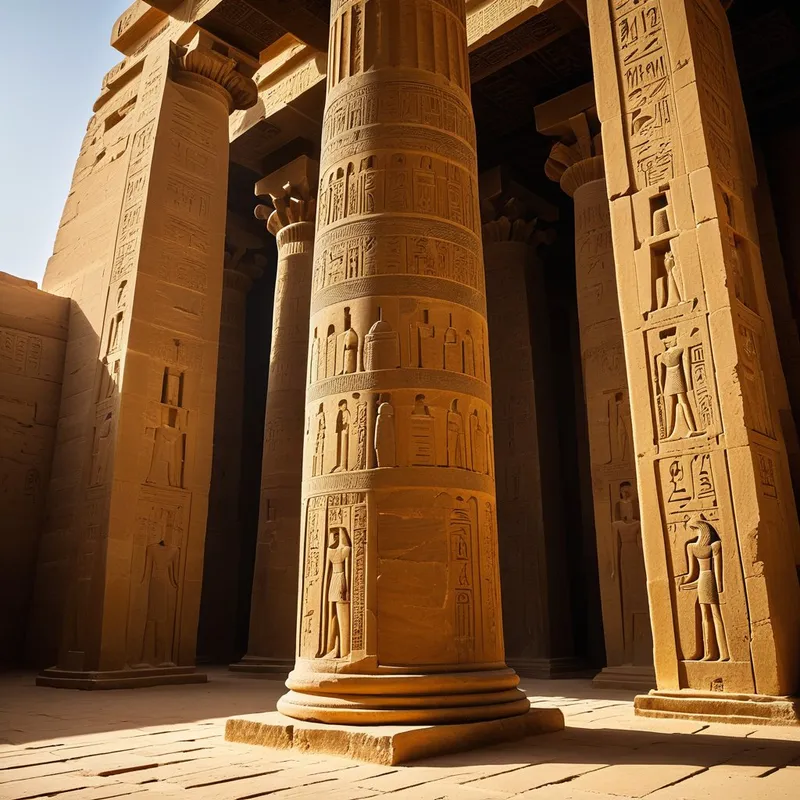
Djed Pillar Myth Meaning & Symbolism
The story of Osiris's spine, cast down and raised again, becoming the eternal symbol of stability and resurrection at the heart of Egyptian cosmology.
The Tale of the Djed Pillar
Listen, and hear the tale not of stone, but of bone. Not of a thing built, but of a thing become.
In the green, sighing time when the world was young and the gods walked with their shadows long upon the black earth of Kemet, there was a king who was the world’s green heart. His name was Osiris, and his flesh was the rich silt of the Nile, his breath the north wind that filled the sails. He taught the people the arts of civilization—the rhythm of the seed, the law of the plumb line, the song of the harvest. His rule was the rule of the growing stalk, steady and sure.
But in the red, dry places, where the sun beats without mercy, a shadow grew. Set</ab title>, whose voice was the crack of thunder in a barren wadi, whose heart was a flint sparking with envy, watched the ordered green world and found it a prison. He coveted the throne that was life itself. With a trick woven from malice and a feast of false fellowship, he trapped the green king. In a chest of exquisite tamarisk wood, he sealed Osiris and cast it into the Nile’s hungry, brown current.
The chest sailed to the far reaches, to the marshy fens of Byblos, where it was encased within the trunk of a mighty tamarisk tree, becoming a living tomb. There, the world’s heart stopped beating. The Nile shrank in its bed. The grain withered on its stalk. A great stillness, a cosmic paralysis, fell upon the Two Lands.
The wail of Isis, the devoted queen, cut the silence. With wings of a kite, she searched the length of the world-river, her grief a sandstorm scouring the dunes. She found the tree-pillar housing her lord, and with words of power that made the reeds tremble, she freed his body. But Set, the ever-wakeful serpent of chaos, was not done. He found the sacred body and in a rage that split the sky, he tore it into fourteen pieces, scattering them to the farthest nomes of Egypt.
Again, Isis searched, with her sister Nephthys as her shadow. From swamp to desert edge they journeyed, gathering the divine fragments. They found all but one. The spine, the central column of the god, the axis of his being, had been cast into the deep, fertile mud of the Nile itself, lost to the abyssal dark.
Yet, where the material form failed, magic and love wove a new reality. With Anubis presiding, the first mummy was made. But the spine was gone. So, from the memory of its strength, from the necessity of its support, Isis and the gods fashioned a new spine—not of bone, but of potent symbolism. They conjured a pillar of four stacked capitals, bound together with the cords of magic. They set it upright in the sacred city of Busiris. And as they raised this pillar, this Djed, a shudder went through the earth. The Nile stirred in its banks. The paralyzed world drew a breath. Osiris was made whole, not to rule the green land again, but to become king of the beautiful West, the land of the eternal. His spine remained in the world of the living—the Djed—the unshakable backbone of creation itself.
Cultural Origins & Context
This was not merely a story told for wonder, but a ritual enacted for survival. The myth of the Djed is embedded in the very agricultural and political psyche of ancient Egypt. It is the narrative heart of the Heb-Sed and other key rituals performed by the Pharaoh, the living Horus on earth. The most dramatic enactment was the "Raising of the Djed Pillar" ceremony, a central act of the royal jubilee and likely connected to harvest and renewal cycles.
In this public, state-sponsored ritual, the Pharaoh, with priests assisting, would physically raise a massive Djed pillar using ropes, mimicking the gods’ act of resurrecting Osiris. This was not theater; it was cosmic maintenance. By performing this act, the Pharaoh channeled the stability of Osiris, ensuring the continuity of the state, the fertility of the land, and the triumph of Maat (order) over Isfet. The myth was thus a divine blueprint for kingship and a communal anchor. It was passed down in temple liturgies, carved on tomb walls to grant the deceased a "stable spine" for the afterlife, and understood by every farmer who saw the Djed amulet as a guarantee that the dormant seed would, like Osiris, rise again.
Symbolic Architecture
The Djed is a masterpiece of symbolic condensation. At its most literal, it is the spine of Osiris, the physical support without which the body—and by extension, the kingdom and cosmos—collapses. But its architecture reveals deeper strata.
The four stacked segments may represent the four pillars that hold up the sky, the four directions, or the sequential stability of the cosmos. It is the Axis Mundi, the world-tree or world-pillar connecting the underworld (its base), the earth, and the heavens (its summit). As the backbone of Osiris, it directly symbolizes resurrection—the ultimate re-establishment of order after dissolution. To "raise the Djed" is to perform the act of integration, of making the fragmented whole, of causing life to stand upright once more after the paralysis of death or despair.
Stability is not the absence of collapse, but the eternal moment of rising after the fall. The Djed does not deny the scattering; it is the artifact created from its memory.
Psychologically, it represents the core Self, the central, integrating principle of the psyche (what Jung might call the Self archetype). It is the internal structure that allows consciousness to "stand upright," to maintain integrity amidst the fragmenting pressures of trauma, chaos, or complex inner conflict.
The Dreamer's Resonance
When the Djed pillar appears in the modern dreamscape, it rarely comes as a literal Egyptian artifact. It manifests as the experience of the spinal column. One may dream of their own spine as a column of light, stone, or crystal; of a central pillar in a crumbling house being repaired; or of the urgent, somatic need to straighten up, to stand tall against a crushing weight.
Such dreams often surface during periods of profound psychological or physical crisis—after a loss, during recovery from illness, or when one’s foundational beliefs or life structure have been "shattered" by betrayal or failure. The dream is a somatic message from the deep unconscious: the core architecture of the Self has been compromised. The feeling is one of existential instability, of being psychologically "unable to stand up for oneself," or of a deep, central fragility.
The dream of raising the Djed—of the dreamer themselves lifting a heavy, sacred pillar—signals the psyche’s initiation of the reintegration process. It is the body-mind’s way of rehearsing resilience, of asserting, on the most primal archetypal level, that the central axis can and must be re-established. The energy is not of frantic repair, but of slow, deliberate, and sacred realignment.
Alchemical Translation
The myth of the Djed models the alchemical process of individuation—the journey toward psychic wholeness—with stark clarity. The journey begins with the scattering. In our lives, this is the experience of trauma, crisis, or deep disillusionment that shatters our naive wholeness (Osiris’s initial rule). Our identity, our sense of purpose, is dismembered and lost in the murky depths of the unconscious (the Nile).
The Isis-function—the devoted, searching consciousness guided by love and intuition—must undertake the long, painful work of collectio (gathering). We must retrieve the lost parts of ourselves: the talents abandoned, the wounds ignored, the passions buried. Yet, some central piece, often the very core of our conviction or will (the spine), seems irrevocably lost to the mud of despair or habit.
The alchemical gold is not found in the original, naive state, but forged in the new structure built from the memory of its collapse.
Here, the myth offers its supreme insight: wholeness is not a return to the original, naive state. It is a transmutation. The new spine, the Djed, is not the old bone. It is a symbolic creation, a psychic structure consciously built from the meaning derived from the experience of fragmentation. The "raising of the Djed" is the active, willed integration of these gathered parts around a new, more conscious central principle. It is the moment we choose to stand upon the foundation of our scars, not in spite of them but because of their testament to survival. We become, like Osiris, ruler of a different realm—no longer the innocent king of the surface world, but the integrated sovereign of our entire inner landscape, capable of bearing the weight of both life and death, stability and transformation, within a single, upright being. The Djed, once raised, is eternal.
Associated Symbols
Explore related symbols from the CaleaDream lexicon: