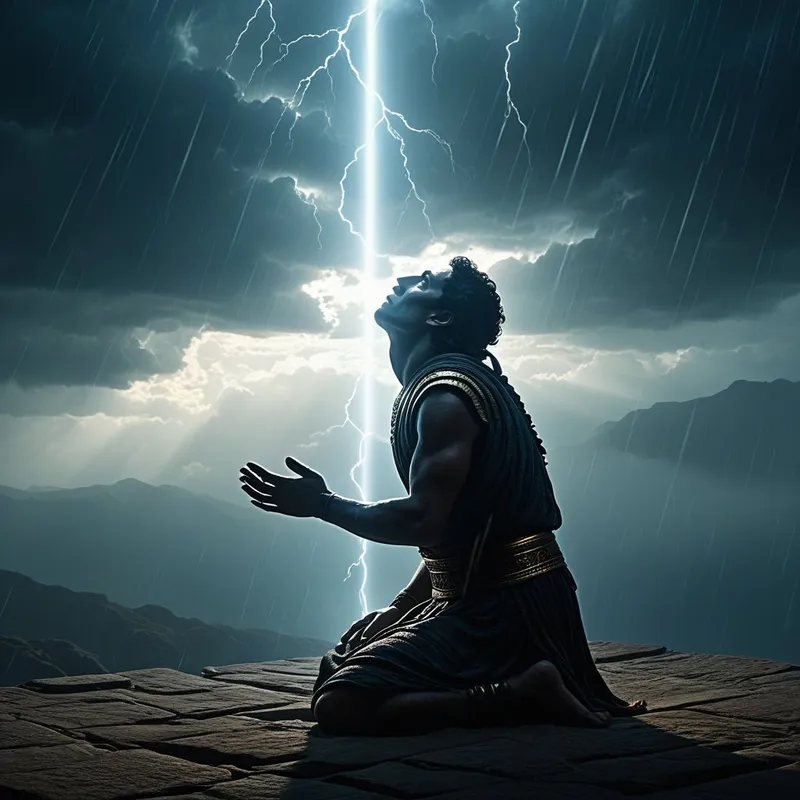
Divine Light Epiphanies Myth Meaning & Symbolism
A universal mythic pattern where a profound, world-altering truth is revealed in a sudden, blinding flash of celestial light.
The Tale of Divine Light Epiphanies
Listen, and let the veil thin. In the time before memory, when the world was a whisper and humanity walked in a twilight of half-knowing, there existed a profound silence in the soul. People tended their fires, charted their stars, and told stories of gods who were distant, carved in stone or painted in the far vault of heaven.
Then, it would happen. Not to kings in their halls, nor always to priests in their temples, but often to the solitary ones—the shepherd on the barren hill, the fisherman gazing at the moon-touched sea, the artisan lost in the rhythm of their craft. The world would grow still. The chatter of the mind would cease as if commanded. The air would thicken, charged with a presence both immense and intimate.
And then—the Light.
It did not come as the gentle dawn, but as a sudden, silent cataclysm. A searing, white-gold radiance would fracture the sky, or bloom from within a humble object—a burning bush that was not consumed, a humble loaf of bread, the surface of a still pool. This was no ordinary light. It was intelligent. It saw into the marrow of the witness, stripping away all pretense, all story, all fear. In its glare, the individual was both annihilated and utterly confirmed.
Figures often stood within this luminous rupture: a being with a face like the sun and feet like burnished bronze; a goddess whose form was woven from lightning; a simple man, transfigured, his garments shining whiter than any fuller on earth could bleach them. Sometimes, there was only the Voice, a sound that was not a sound, speaking a name, issuing a call, delivering a truth so fundamental it rewrote the witness’s reality.
The experience was never gentle. The shepherd would fall to the ground as if dead. The prophet would cry, “Woe is me! I am undone!” The seeker would shield their eyes, blinded for three days. This was the death of the old self, slain by sheer truth. But in the heart of that annihilation was a seed of impossible grace. When the light faded, leaving the world strangely dim, the witness was remade. They rose, not with a new philosophy, but with a knowing etched into their bones. They had been touched, and they must now carry that impossible fire back into the world of shadow, often to a destiny they never sought.

Cultural Origins & Context
The pattern of the Divine Light Epiphany is a human universal, a mythic shard found in the bedrock of countless traditions. It is the core of the prophetic call, from the Moses narrative in the Hebrew Bible to the Damascus Road experience in the Christian New Testament. It appears in the Buddha’s awakening, where he perceived the morning star and the entire chain of causation in a flash of understanding. It is present in the Apollonian oracle, where light was synonymous with truth (phōs and alētheia), and in the Amesha Spentas of Zoroastrianism, emanations of the uncreated light of Ahura Mazda.
These stories were not mere entertainment. They served a crucial societal function as maps of the ultimate human experience. They were told by mystics, preserved by scribes, and contemplated by initiates to validate and contextualize the most radical shifts in consciousness. The myth provided a container for the ineffable, assuring the community that such shattering encounters were not madness, but a recognized, albeit rare, mode of contact with the foundational layer of reality. It established a lineage of illumination, connecting the present to a primordial moment of revelation.
Symbolic Architecture
Psychologically, the myth maps the eruption of the Self into the realm of the conscious ego. The ego, identified with its personal history and societal role (the shepherd, the persecutor, the seeker), is the figure in the ordinary world. The Divine Light represents a quantum of psychic energy so potent, so total, that it cannot be integrated gradually. It must arrive as a catastrophe to the status quo.
The Light does not inform; it transforms. It does not argue with the old identity; it incinerates it, leaving only the essential signature of the soul.
The accompanying blindness is profoundly symbolic. It represents the necessary obliteration of the ego’s former way of “seeing” the world—its prejudices, assumptions, and self-narratives. One must be rendered blind to the old world to gain vision of the new. The luminous figure or voice is the archetypal image of the Self, presenting itself in a form the individual psyche can barely comprehend. The call or command that follows is the birth of a new, non-negotiable imperative from the core of one’s being—the beginning of individuation.
The Dreamer's Resonance
When this mythic pattern stirs in the modern dreamscape, it signals a profound psychic pressure. The dreamer may not see a classical deity, but the symbols are isomorphic: a lightbulb shattering with impossible brightness in a dark room; a computer screen flooding with pure white light, erasing all data; a nuclear explosion in the distance that illuminates everything with a silent, beautiful, terrifying glow.
Somatically, the dream often carries a feeling of awe bordering on terror, a sense of being “struck.” This is the psyche’s enactment of a revelation that the conscious mind is resisting. The process underway is the forced confrontation with a truth too large for the current personality structure. It may relate to a repressed talent, a denied calling, or the shocking recognition of one’s own authentic nature beneath layers of adaptation. The dream is the initial fracture, the first warning that a foundational reordering is not only possible but imminent. The psychological process is one of defragmentation—the old, inefficient mental structures are being overloaded by a surge of integrative energy from the unconscious.

Alchemical Translation
The alchemical journey mirrored in this myth is the solutio followed by the coagulatio—dissolution and recombination. The ordinary “lead” of the egoic personality is dissolved not in a gentle bath, but in the aqua permanens of the Divine Light, the fiery water of spirit. This is the terrifying stage of the nigredo, where all is reduced to a uniform, blackened chaos. The ego’s certainty is annihilated.
The epiphany is not the gift of an answer, but the violent bestowal of a new question that becomes the axis of one’s life.
The triumph is not in the moment of blinding light, but in the subsequent, painful journey of coagulatio. The individual must stumble forward, psychologically “blind,” and slowly, painstakingly, rebuild a world and an identity that can house the memory of that light. The carried mandate—to preach, to create, to heal, to lead—is the new “gold,” the philosopher’s stone. It is the conscious embodiment of the unconscious revelation. For the modern individual, this translates to the moment a buried truth becomes undeniable: the artist who can no longer not create, the caregiver who discovers their vocation in a moment of crisis, the leader who finds their authentic voice not through strategy, but through surrender. The light epiphany marks the death of the life lived by default and the violent, glorious birth of the life lived by destiny. The struggle is to have the courage to walk in the dim world with the unextinguishable memory of the sun.
Associated Symbols
Explore related symbols from the CaleaDream lexicon: