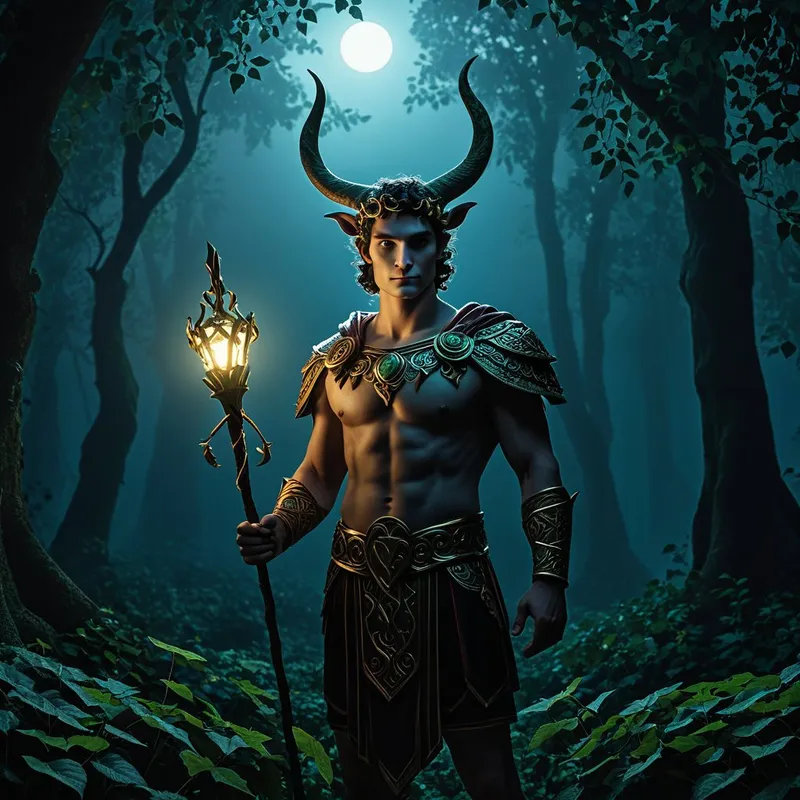
Dionysus Zagreus Myth Meaning & Symbolism
The story of the divine child, torn apart by Titans and reborn, embodying the soul's fragmentation and sacred return through ecstatic surrender.
The Tale of Dionysus Zagreus
Listen, and hear the story not of one god, but of a god twice-made. Before the wine, before the revel, there was the child. In the hidden, echoing halls of Zeus, a secret was born. His name was Zagreus, the "Great Hunter," and he was destined. His father, in a moment of both love and terrible foresight, placed the boy upon the high throne of heaven and gave him the thunderbolt and the eagle, declaring this radiant child his heir.
But the air on Olympus is thin, and whispers travel far. The jealousy of Hera was a cold wind that found its way to earth. She looked upon the divine child, this proof of her husband’s infidelity, and her wrath took a cunning shape. She sought out the ancient Titans, beings of raw, elemental force, and offered them a prize beyond measure. She gave them a toy—a polished mirror, a disc of captivating illusion—and a command wrapped in a promise.
They found the child at play. Zagreus, curious and mighty even in his youth, saw his own reflection shimmering in the strange disc. He leaned in, captivated by the image of himself. It was in that moment of divine distraction, of self-regard, that the Titans struck. They were painted with white gypsum, like ghosts, their true forms hidden. With hands of soot and primal hunger, they seized him.
What followed was not a battle, but a terrible, methodical unmaking. The child-god transformed, trying to escape: a lion, a horse, a serpent. But the Titans held fast. Finally, they tore him apart, limb from sacred limb. They dismembered the heir of heaven on a lonely mountainside. His heart, still beating with a stubborn, divine fire, was the last piece. One of the Titans seized it. In a final, blasphemous act, they roasted his flesh in a cauldron and consumed it, devouring the god whole.
But the heart would not be consumed. Athena, ever watchful, snatched the pulsating core from the ashes and carried it, still alive, to her father. Zeus’s thunder was a roar of grief and fury. He unleashed his lightning, reducing the Titans to blackened dust. And from that ash, mixed with the divine substance they had ingested, humanity was said to have arisen—part mortal clay, part stolen god-spark.
Then came the second making. Zeus took the heart of his son. He gave it to Semele, or in another telling, consumed it himself to bear the child again. From the heart, through fire and mortal womb, the god was born a second time. He was given a new name: Dionysus. The Hunter was now the Liberator, the Torn-Apart One became the Gatherer. He who had been utterly dissolved returned, bearing the memory of fragmentation within his wholeness, and the ecstatic knowledge that what is scattered can be made one again.
Cultural Origins & Context
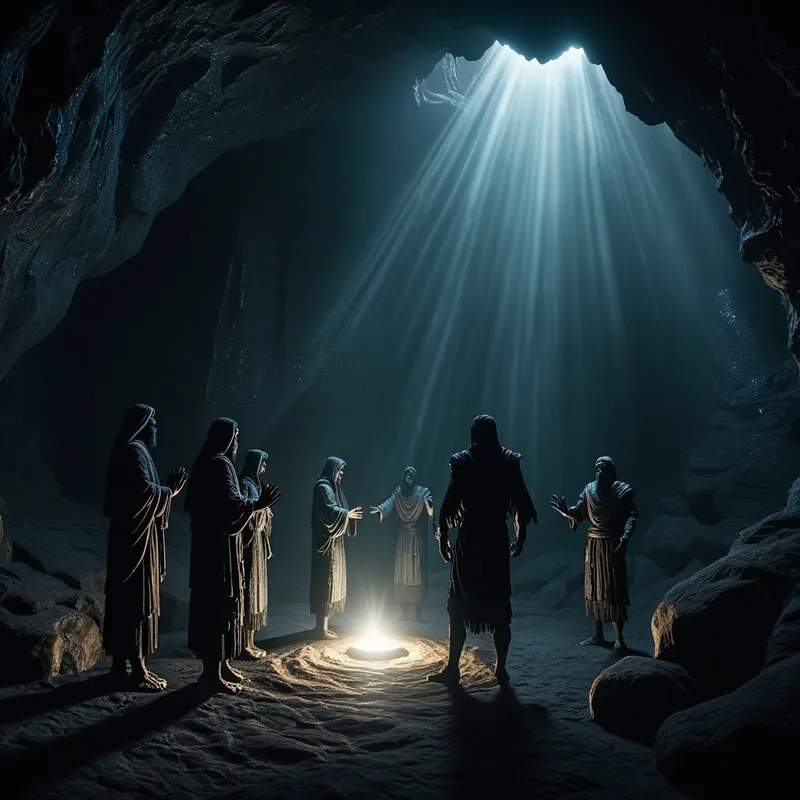
The myth of Dionysus Zagreus is a deep, esoteric river flowing beneath the more popular tales of the wine god. Its primary sources are late and poetic—chiefly from the Homeric Hymns and fragments from later poets like Nonnus. It was not a story for the public festival but for the inner circle of mystery cults, particularly the Orphic tradition.
Orphism was a reformist, mystical movement within Greek religion that placed this myth at its cosmological and psychological center. For Orphic initiates, the tale was a sacred narrative explaining the origin and condition of the human soul. We were not merely clay animated by the gods; we were the ash of Titans who had consumed divinity. Thus, human nature was fundamentally dual: a Titanic, earthly, fragmenting body housing a Dionysian, divine, and unifying spark. The function of the myth was to provide a map for the soul's journey—from its primordial unity (Zagreus), through its fall into fragmentation and materiality (the Titans' crime), to its potential for reintegration and liberation (Dionysus reborn). It was told in hushed tones during initiations, a story that didn't just explain the world but aimed to transform the listener.
Symbolic Architecture
The myth is a perfect symbolic engine for the psyche's most profound struggles. Dionysus Zagreus represents the original, pristine state of the Self—the total, undifferentiated psychic wholeness of the infant or the unmanifest potential of the soul. This wholeness is inherently threatening to the established order (Hera, representing the defensive, status-quo ego complex).
The mirror the Titans hold is the archetype of identification. To see oneself reflected is to enter duality, to become fascinated by the persona over the essence.
The Titans symbolize the fragmenting power of the material world, of literal thinking, of instinctual urges divorced from spirit—the forces that pull the coherent Self apart into disparate complexes, drives, and social masks. Their dismemberment of the child-god is not mere violence; it is the inevitable process of incarnation, of a unitary consciousness entering a world of time, space, and separation.
The heart, remaining undigested, is the indestructible core of the Self, the divine spark or the Self-archetype that survives all trauma, fragmentation, and life's "devouring" experiences. Its rescue is the promise that essence cannot be destroyed. The rebirth as Dionysus is the ultimate symbol: the fragmented Self does not simply revert to its original state. It is reconstituted at a higher level, now carrying the memory and experience of its own dissolution. This Dionysus is the god of ecstasy—ekstasis, meaning "to stand outside oneself." He embodies the paradoxical state of being whole precisely by having transcended the illusion of a simple, bounded wholeness.
The Dreamer's Resonance
When this myth stirs in the modern unconscious, it rarely appears as a literal narrative. Instead, it manifests as the somatic and emotional landscape of dismemberment and nascent reintegration. One might dream of their body coming apart—limbs detaching cleanly, teeth falling out, the skin peeling away—but without horror, instead with a strange, observational calm. Or dreams of being pulled in multiple directions by shadowy figures, of feeling one's identity scattered across different rooms, cities, or versions of oneself.
These are not nightmares of attack, but dreams of deconstruction. The psyche is performing a necessary, if terrifying, operation: dismantling an outdated, rigid, or false structure of identity (the old, brittle "I"). The emotional tone is key. If there is panic, the ego is resisting the process. If there is a numb or curious awe, the deeper Self is at work. One may also dream of finding a small, glowing object in ashes (a gem, a seed, a still-beating clock), symbolizing the discovery of that indestructible heart-core amidst a life crisis or period of breakdown. The dreamer undergoing this pattern is in the liminal space between a death and a rebirth, where the old self must be taken apart so the new, more authentic one can be assembled from the salvaged essence.
Alchemical Translation
The alchemical process mirrored in this myth is the Nigredo, the blackening, the descent into the primal murk. In psychological terms, this is the stage of shadow-work, depression, or profound life crisis where the conscious personality feels dissolved, its certainties stripped away. The ego, like the child Zagreus, is lured by its own reflection (its achievements, its self-image) and is subsequently torn apart by unconscious contents (the Titans).
The goal is not to avoid being torn apart, but to learn the sacred art of being put back together differently. The rebirth is not a return, but an arrival somewhere new.
The alchemical fire that reduces the Titans to ash is the searing heat of conscious awareness and suffering applied to these fragmenting forces. From this ash—the acknowledged and accepted rubble of our failures, complexes, and traumas—a new base material is created: the humble, mixed substance of the human being who knows their own darkness.
The final stage is the Albedo and Rubedo, the whitening and reddening. This is the retrieval of the heart (the core value, the unwavering sense of "I am" beneath the "I do" or "I have") and its transmutation into a new, resilient consciousness. The reborn Dionysus is the individuated Self. He holds the thyrsus (the spine of identity, now flexible and alive) and the cup (the container that can hold both joy and suffering). He has integrated his fragmentation, and thus his ecstasy is not an escape from self, but a profound gathering of all its parts. For the modern individual, the myth maps the journey from naive unity, through necessary disintegration, to a hard-won, ecstatic coherence—a self made whole not in spite of its breaks, but because of the gold that seals them.
Associated Symbols
Explore related symbols from the CaleaDream lexicon: