Dionysus & the Vine Myth Meaning & Symbolism
The god of ecstasy discovers the vine, transforming his suffering into the sacred wine that dissolves boundaries and births a new consciousness.
The Tale of Dionysus & the Vine
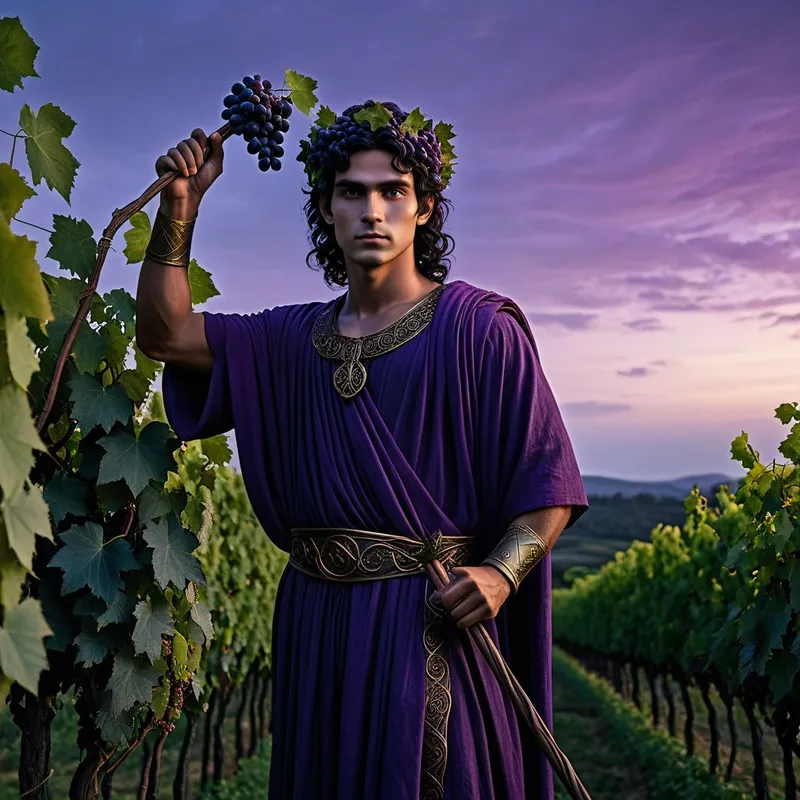
Hear now the tale of the god who was born twice, the stranger who arrives, the one who unravels the neat tapestry of the world. His name is Dionysus. Before the vine, he was a god in exile, a divine child torn from the womb of his dying mother, Semele, and sewn into the thigh of his father, Zeus. He carried within him a double nature: the blazing fire of heaven and the mortal dust of the earth. This was his first suffering.
He wandered the world, a beautiful, long-haired youth, driven by a restlessness that was both a wound and a calling. One scorching afternoon, in the rocky hills of Phrygia, the weight of his duality became unbearable. The sun was a bronze hammer on the stones. Thirst, a deep, cracking thirst that was more than physical, clawed at his throat. It was the thirst of a spirit not yet at home in flesh, of a god not yet manifest in the world.
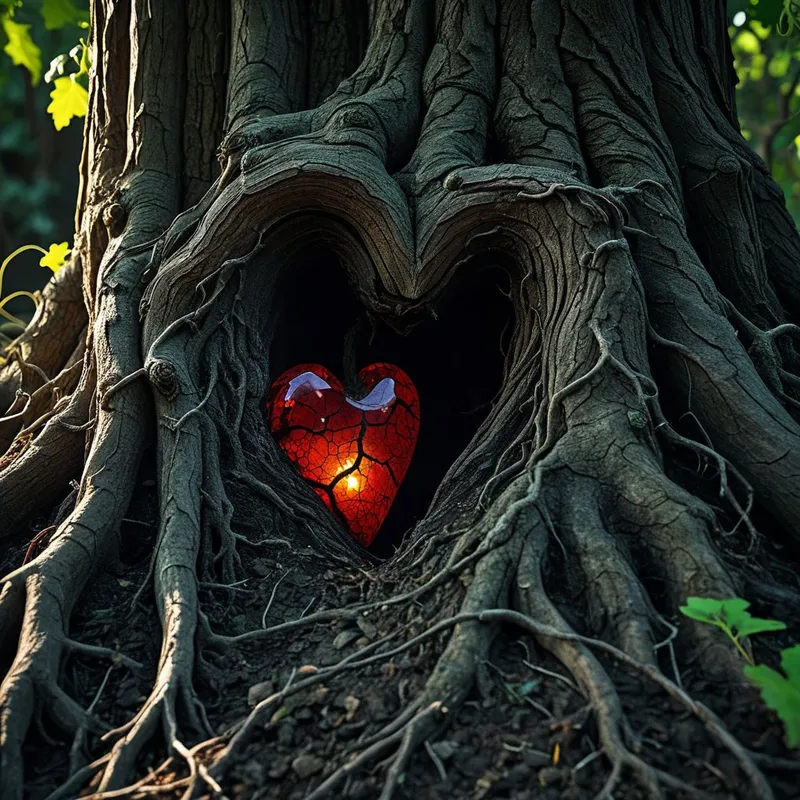
He sank to his knees on the hard ground, a prince of Olympus brought low by mortal need. In his despair, he plunged his fingers into the dry earth, not to plant, but to claw, to find some hidden moisture. His divine blood, the ichor of the heavens, mingled with his mortal sweat and fell upon the parched soil where he knelt. It was a sacrifice unbidden, an offering of his own fractured being to the dust.
From that spot, where his essence soaked into the earth, something stirred. Not a gentle sprout, but a sudden, violent eruption of life. A dark, gnarled shoot thrust upward, coiling like a serpent, grasping at the sun. Leaves, broad and deep green, unfurled with a sound like whispered secrets. Then came the fruit: clusters of tight, green beads that swelled under his gaze, turning to deep, dusky purple, dusted with the bloom of creation itself.
Drawn by a force he did not understand, Dionysus plucked a cluster. The skin burst against his teeth, and the world dissolved. The sweet, sharp juice was not just a drink; it was a revelation. The burning thirst vanished, replaced by a spreading warmth that began in his belly and flowed out to his very fingertips. The hard lines of the world—stone from sky, self from other, joy from sorrow—began to soften, to melt, to dance. The suffering that had driven him to the earth was not erased; it was transformed. It had become the very source of this ecstatic, boundary-dissolving nectar.
He laughed, a sound that echoed through the hills, and in that laugh was the birth of his power. He had not found a plant; he had midwifed his own sacrament from the marriage of his divine agony and the receptive earth. The vine was his body made manifest in the world, his suffering made communal, his ecstasy made drinkable. He rose, no longer a wandering exile, but a god in possession of his holy mystery. He would now carry this gift—this terrifying, beautiful gift of the vine—to all of humanity, a cup of liberation offered to a world asleep in its own order.
Cultural Origins & Context
This myth is not a singular story from one text, but a core narrative woven through the fabric of Dionysian cult and later recorded by poets and playwrights. It finds its most profound expressions in the Homeric Hymns and the frenzied choruses of Athenian tragedy. The myth was not merely entertainment; it was the foundational liturgy for the god’s worship. It was told and retold in the context of the City Dionysia, where the community gathered for theater, and in the secretive, nocturnal rites of the Maenads on the mountainsides.
Its societal function was profoundly ambivalent, reflecting the god’s own nature. For the polis, the myth and its associated festivals served as a controlled, seasonal release valve. It allowed for the sanctioned expression of chaos, emotion, and irrationality within a structured, civic framework—the birth of theater itself from dithyrambic song. Yet, for the individual initiate, the story was a map of personal transformation. It modeled a sacred rupture: the deliberate dissolution of the everyday self (the thirst) through ritual intoxication (the wine) to achieve a state of divine unity and liberation (the ecstasy). The myth justified and sanctified the experience that lay at the heart of his mysteries.
Symbolic Architecture
The myth of Dionysus and the vine is a perfect symbolic equation for the alchemy of the soul. Every element is a psychic component.
The Thirst: This is not simple dehydration. It is the soul’s anguish, the feeling of alienation, the existential longing for something that ordinary life cannot quench. It is the suffering of a consciousness trapped between realms—the spiritual fire yearning for embodiment, and the mortal clay yearning for transcendence.
The Earth & the Blood: The act of kneeling and mingling his essence with the soil represents the necessary descent. Transformation cannot happen in the abstract realm of ideas alone. It requires a full, embodied engagement with the "ground" of one’s being—the unconscious, the shadow, the raw material of pain and instinct.
The vine does not grow in the air; it must root in the dark, fertile soil of what has been broken.
The Vine: It is the archetypal symbol of connective, transformative life. It is not a mighty oak (stable, singular identity) but a creeping, embracing, prolific network. It represents the psychic system that emerges from the marriage of spirit and matter, conscious and unconscious. Its fruit holds the potent, paradoxical secret: the poison and the medicine are the same substance.
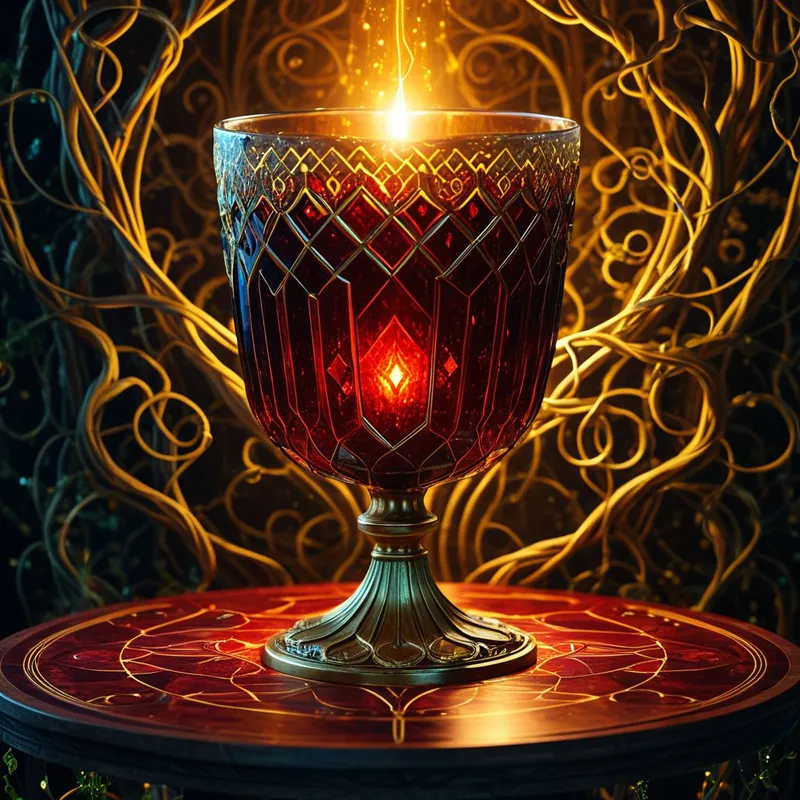
The Wine: This is the distilled spirit of the process—the transformed suffering made communicable. Wine symbolizes the ecstatic state where duality collapses. It is the medium of enthousiasmos ("the god within"), breaking down the ego’s walls to allow a flood of non-ordinary consciousness, creative frenzy, and communal bonding.
The Dreamer's Resonance
When this myth stirs in the modern dreamer, it signals a profound somatic and psychological process of fermentation. To dream of wild, overgrown vines invading a structured garden or home is to feel the insistent pressure of repressed vitality, instinct, or emotion threatening the orderly ego-complex. A dream of crushing grapes with bare hands, staining them purple, speaks to a raw, perhaps painful, engagement with one’s own creative or emotional "juice"—the messy, vital process of bringing something inner into manifestation.
Dreams of drinking a strange, potent wine and experiencing both terror and elation mirror the initiation into a new state of being. The dream ego is being invited, or forced, to ingest its own transformed essence. This is often accompanied by somatic sensations in the dream—a spreading warmth, a loss of bodily boundaries, a dizzying shift in perspective. Such dreams occur at life thresholds: before a creative breakthrough, during a psychological crisis that demands a new way of being, or when the soul thirsts for a meaning that rational life cannot provide. The dream is the psyche’s own Dionysian rite, administering the sacred intoxicant of transformation from within.

Alchemical Translation
For the modern individual navigating the path of individuation, the myth of Dionysus and the Vine is a master blueprint for psychic transmutation. It models the move from nigredo to rubedo.
The process begins with the Acknowledgement of the Thirst—the conscious suffering, the depression, the alienation that signals the old, adapted personality has become a prison. This is the nigredo, the blackening. One must, like Dionysus, "kneel" into this state, not flee from it. The next stage is the Descent and Sacrifice: plunging the hands into the "earth" of the unconscious through active imagination, dream work, or engaging with one’s shadow. This is where the "blood" of one’s current conscious attitude is willingly offered up. It feels like a loss, a dissolution.
From this fertile decay emerges the Vine of the New Attitude—a nascent, living connection to a deeper, more instinctual and creative layer of the Self. It grows unpredictably, entangling old structures. Finally, the Vintage of Integration is the moment of tasting the "wine." This is the rubedo, the reddening. It is the conscious integration of the transformative experience, where the once-painful material is now felt as a source of enlivening energy, connection, and creative spirit.
The goal is not to become perpetually intoxicated, but to learn the sacrament: how to consciously partake of the vintage born from your own depths, thereby transforming the leaden weight of suffering into the golden spirit of meaning.
The individual who undergoes this alchemy does not become a chaotic maenad lost in frenzy, but achieves what the Greeks called sophrosyne—a tempered, wise balance—but a balance that now includes the ecstatic, irrational depths, rather than defending against them. They become whole, carrying within them both the order of Apollo and the ecstasy of Dionysus, able to offer the cup of deep, transformative life to others and to the world.
Associated Symbols
Explore related symbols from the CaleaDream lexicon: