Dionysus & Ariadne Myth Meaning & Symbolism
The god of ecstasy finds the abandoned princess on a desolate shore, transforming her mortal despair into an immortal constellation of love.
The Tale of Dionysus & Ariadne
Hear now a tale not of a hero’s conquest, but of a heart’s redemption, sung where the wine-dark sea meets the lonely shore.
The story begins in ashes and thread. Ariadne, whose name means “most holy,” had dared everything for love. She gave the hero [Theseus](/myths/theseus “Myth from Greek culture.”/) a ball of thread, a clew of hope to guide him through the monstrous [Labyrinth](/myths/labyrinth “Myth from Various culture.”/). With her help, he slew the beast and emerged victorious. In the frantic escape from her father’s wrath, she fled with him across [the sea](/myths/the-sea “Myth from Greek culture.”/), her old life unraveling behind her like the thread she had spent.
They made landfall on the island of Naxos, a place of wild [thyme](/myths/thyme “Myth from Greek culture.”/) and whispering pines. Exhaustion claimed her. As she slept on the sun-warmed stones of the beach, a deeper sleep, a sleep of betrayal, was being woven. Theseus looked upon the princess who had saved him, who had betrayed her kingdom for him, and saw only complication, a reminder of a bloody deed. As the first stars pricked the violet sky, he gave the order. His men boarded their ship in silence. The sails caught [the wind](/myths/the-wind “Myth from Various culture.”/), and they slipped away, leaving her alone with the sound of the waves and the crushing weight of the infinite sky.
Her awakening was a second [death](/myths/death “Myth from Tarot culture.”/). The sea was empty. [The world](/myths/the-world “Myth from Tarot culture.”/) was empty. She was a thread cut loose, a story without an ending, weeping on a foreign shore where the only witness was the cold moon.
But the gods witness all.
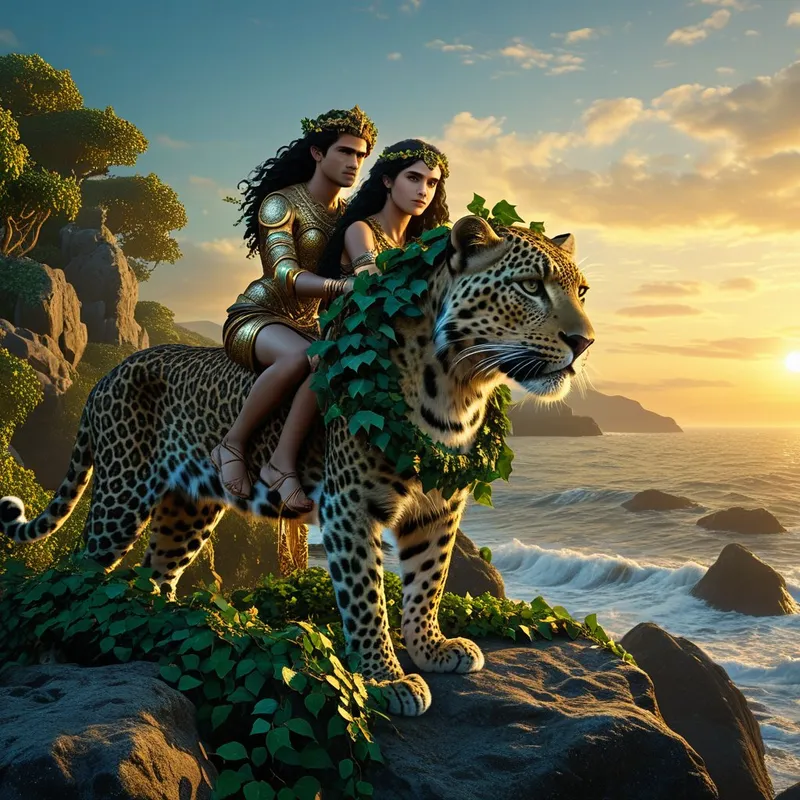
From the deep green heart of the island, from the vine-tangled groves, a presence approached. It was not the measured step of a mortal man, but the untamed rhythm of [the earth](/myths/the-earth “Myth from Hindu culture.”/) itself. It was [Dionysus](/myths/dionysus “Myth from Global/Universal culture.”/). His eyes held the storm and the vintage, his hair was wreathed in ivy and grape leaves, and the scent of wine and damp soil moved with him. He did not find a forsaken princess; he saw a soul at the precise point of dissolution, ripe for a different kind of creation.
He knelt beside her. He did not offer platitudes or pity from a hero’s height. He met her in the raw truth of her abandonment. In his gaze, her despair was not erased; it was seen, absorbed, and transformed. He spoke not of rescue, but of recognition. He saw the holy one within the broken one. He lifted her, not as a prize, but as a partner. His chariot, drawn by panthers with eyes like amber, awaited. He placed in her hands not a sword or a distaff, but a cup, and from it, he offered the wine of forgetting and remembering—forgetting the mortal betrayal, remembering her own divine worth.
And as [the chariot](/myths/the-chariot “Myth from Tarot culture.”/) rose, not to Olympus, but into the very fabric of the night, a miracle was wrought. From Dionysus’s own hand, a circlet of gold and gems was lifted. He cast it into the heavens, where it caught fire with eternal light. There it remains, the [Corona](/myths/corona “Myth from Roman culture.”/) Borealis, a crown for a queen, a wedding gift written in stars. Ariadne the abandoned was now Ariadne [the immortal](/myths/the-immortal “Myth from Taoist culture.”/), her story not ended on a lonely beach, but forever woven into the cosmic dance of life, death, and ecstatic rebirth.
Cultural Origins & Context
This myth echoes from the Bronze Age, a strand woven into the epic cycles of heroes like Theseus and the cultural memory of Minoan Crete. Its primary tellers were the poets: Hesiod mentions it briefly, while the fuller, most resonant version comes from the Nonnus in his epic Dionysiaca. It was a favorite subject for vase painters and playwrights, a narrative that existed in the liminal space between heroic epic and divine hymn.
Societally, it served multiple functions. On one level, it was an aetiological myth, explaining the origin of the Corona Borealis. On a deeper level, it acted as a sacred narrative for the Mysteries, particularly those of Dionysus. It modeled the god’s central promise: he is the god who arrives in the moment of greatest personal dissolution—of madness, grief, or abandonment—not to punish, but to transform. The myth reassured initiates that behind the terrifying chaos of the god’s rites lay the potential for a [sacred marriage](/myths/sacred-marriage “Myth from Alchemy culture.”/) (hieros gamos) and a profound re-ordering of the soul.
Symbolic Architecture
At its core, this is a myth of alchemical transformation through the meeting of profound opposites. Ariadne represents the abandoned, betrayed, and loyal feminine principle. She is the [human](/symbols/human “Symbol: The symbol of a human represents individuality, complexity of emotions, and social relationships.”/) [soul](/symbols/soul “Symbol: The soul represents the essence of a person, encompassing their spirit, identity, and connection to the universe.”/) that has given its all to a temporal, heroic ideal (Theseus, [the ego](/myths/the-ego “Myth from Jungian culture.”/)’s [quest](/symbols/quest “Symbol: A quest symbolizes a journey or search for purpose, fulfillment, or knowledge, often representing life’s challenges and adventures.”/) for glory) only to be discarded by it. Her [abandonment](/symbols/abandonment “Symbol: A dream symbol representing feelings of being left behind, isolated, or emotionally deserted, often tied to primal fears of separation and loss of support.”/) on Naxos is the ultimate dark [night](/symbols/night “Symbol: Night often symbolizes the unconscious, mystery, and the unknown, representing the realm of dreams and intuition.”/) of the [soul](/symbols/soul “Symbol: The soul represents the essence of a person, encompassing their spirit, identity, and connection to the universe.”/), where all previous identities and contracts are nullified.
Dionysus is the [spirit](/symbols/spirit “Symbol: Spirit symbolizes the essence of life, vitality, and the spiritual journey of the individual.”/) of undifferentiated, amoral [life](/symbols/life “Symbol: The symbol of ‘Life’ represents a journey of growth, interconnectedness, and existential meaning, encompassing both the joys and challenges that define human experience.”/) force—the zoe that persists beyond the bios of individual life. He is not a “[savior](/symbols/savior “Symbol: A figure representing rescue, redemption, or deliverance from crisis, often embodying hope and external intervention in times of need.”/)” in the classical sense, but a [transformer](/symbols/transformer “Symbol: A symbol of profound change, adaptability, and the ability to shift between different states, forms, or functions.”/). He does not fight her battle; he changes the very ground of her being.
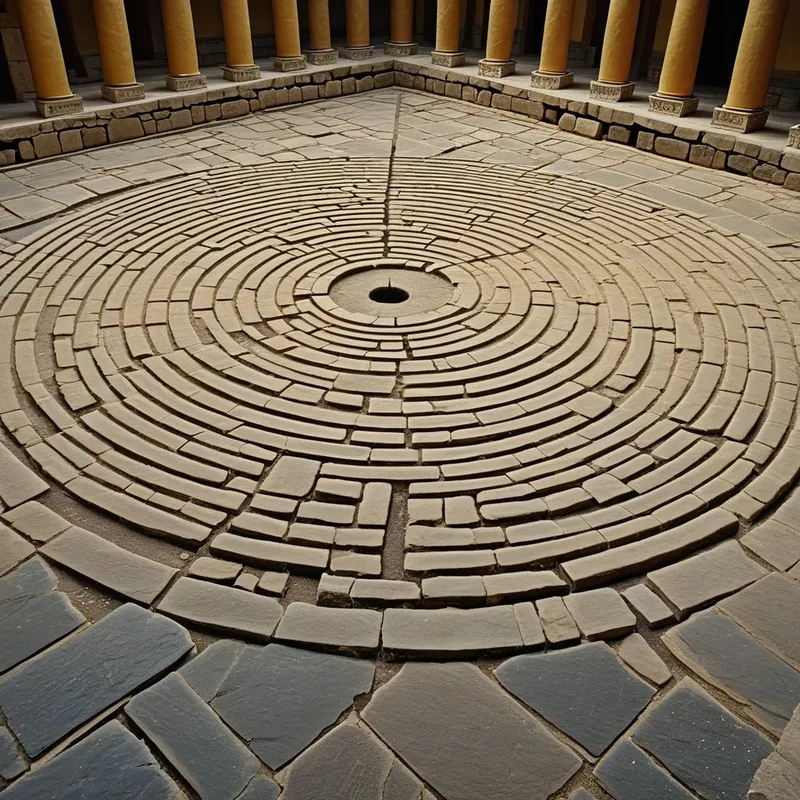
The labyrinth is not a puzzle to be solved, but a spiral of the soul to be fully traversed until one reaches the center of one’s own abandonment. Only there can the god be met.
Their union symbolizes the [integration](/symbols/integration “Symbol: The process of unifying disparate parts of the self or experience into a cohesive whole, often representing psychological wholeness or resolution of internal conflict.”/) of the ego (Ariadne) with the dynamic, overwhelming power of the unconscious (Dionysus). The [crown](/symbols/crown “Symbol: A crown symbolizes authority, power, and achievement, often representing an individual’s aspirations, leadership, or societal role.”/) cast into the stars signifies the eternal, symbolic value that emerges when a personal tragedy is fully metabolized by the [psyche](/myths/psyche “Myth from Greek culture.”/)—it becomes a fixed point of meaning, a [constellation](/symbols/constellation “Symbol: Represents guidance, destiny, and the navigation through life, symbolizing the connections between experiences and paths.”/) that guides others.
The Dreamer’s Resonance
When this myth stirs in modern dreams, it often signals a profound process of psychic re-orientation following a betrayal or abandonment. The dreamer may not see Dionysus or Ariadne directly, but will feel the pattern.
Somatically, one might dream of being left on a shoreline, a train platform, or a empty house—places of transition now frozen. There is a visceral feeling of exposure and crushing silence. This is the body remembering Ariadne’s awakening. Alternatively, one might dream of chaotic, fertile growth—vines breaking through walls, wild animals appearing calmly in domestic spaces. This is the approach of the Dionysian force.
Psychologically, the dreamer is in the gap between stories. The old narrative (the heroic quest with Theseus) has ended in betrayal. The new narrative (the divine marriage) has not yet begun. The dream psyche is working to dismantle the ego’s attachment to the old savior and make it receptive to a different, more terrifying and fulfilling kind of wholeness. The dream asks: Can you stay in the emptiness long enough for it to become a vessel?

Alchemical Translation
The alchemy here is the transmutation of abandonment into sovereignty. In the individuation process, we all have our “Theseus”—a goal, a person, a ideology we believe will complete us. We give it our thread, our cleverness, our loyalty. And often, it fails us. It leaves us on the shore. The modern temptation is to immediately find a new “Theseus,” a new project to fill [the void](/myths/the-void “Myth from Buddhist culture.”/).
The myth insists the transformative work happens in the stay. The [nigredo](/myths/nigredo “Myth from Alchemical culture.”/), the blackening, is the despair of Naxos. The crucial, alchemical agent is not effort, but a paradoxical receptive surrender to a non-heroic force. One must stop trying to re-board the ship and instead let the island—the unconscious—come alive.
The god of ecstasy finds you only when you have ceased all attempts to flee your own devastation.
Dionysus represents the acceptance of the full, chaotic spectrum of life—the pain, the madness, the irrational joy—as sacred. To “marry” this principle is to internalize a partnership with one’s own depths. [The crown](/myths/the-crown “Myth from Various culture.”/) that results is not a trophy for achievement, but a symbol of self-containment and eternal value forged in [the crucible](/myths/the-crucible “Myth from Alchemical culture.”/) of heartbreak. The individual no longer seeks their worth from a departing hero, but discovers it as a constant, inner luminosity—a personal constellation by which to navigate the dark.
Associated Symbols
Explore related symbols from the CaleaDream lexicon: