Diogenes the Cynic Myth Meaning & Symbolism
A philosopher rejects civilization's lies, living in a barrel to embody absolute freedom, challenging kings and conventions with wit and raw truth.
The Tale of Diogenes the Cynic
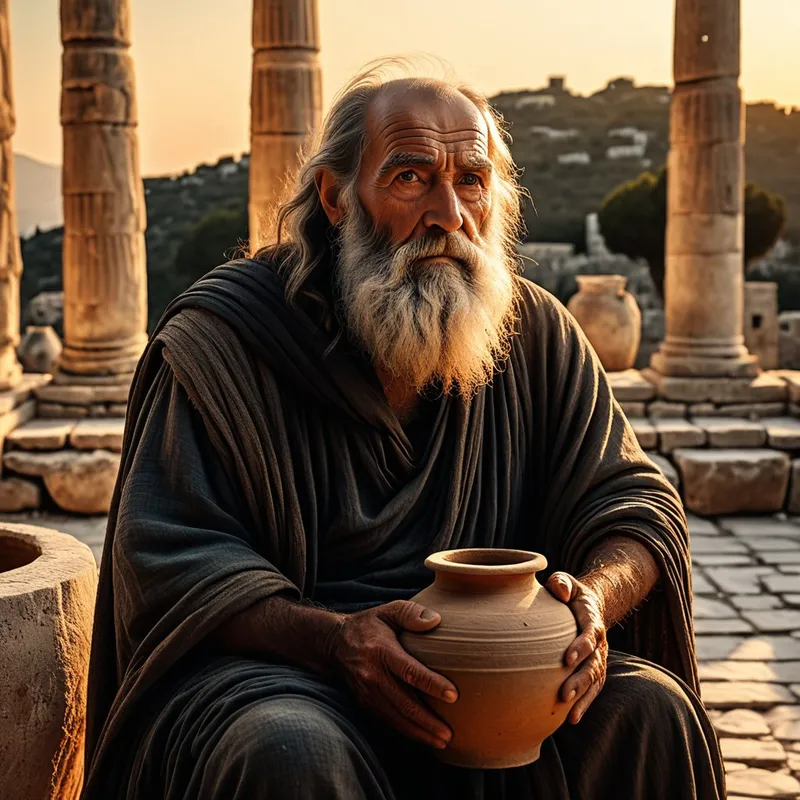
Hear now the tale of the man who was a living question, a walking provocation against the polished marble of [the world](/myths/the-world “Myth from Tarot culture.”/). In the heart of Athens, where voices clashed in [the shadow](/myths/the-shadow “Myth from Jungian culture.”/) of the [Parthenon](/myths/parthenon “Myth from Greek culture.”/), there moved a figure more akin to a stray dog than a sage. This was [Diogenes of Sinope](/myths/diogenes-of-sinope “Myth from Greek culture.”/).
He made his home not in a villa, but in a great ceramic jar, a pithos, in the corner of the marketplace. The scent of baking bread, spilled wine, and animal dung was his incense. His cloak was threadbare, his feet bare and hardened against the stones. He carried a staff, a knapsack, and a single, stubborn purpose: to live according to nature, and to show every soul he met the folly of their pretense.
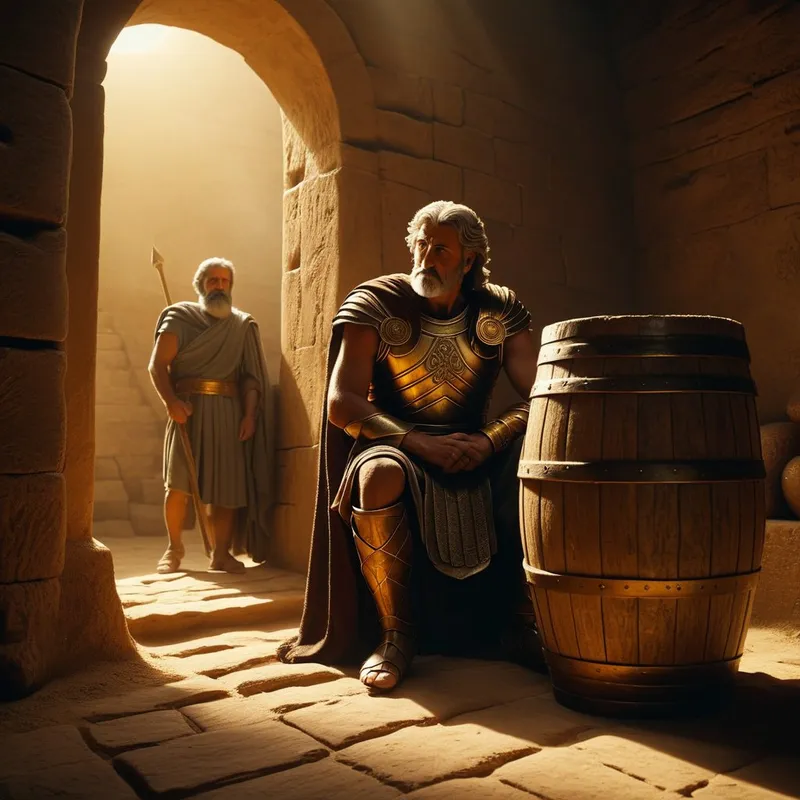
The story sings of a day when the great conqueror, Alexander the Great, newly crowned and flush with the power to grant any wish, came to see this famous dog of a philosopher. Alexander, in gilded armor that caught the sun, found [Diogenes](/myths/diogenes “Myth from Greek culture.”/) lounging in the dirt, soaking in the morning light. The king’s shadow fell over him. “I am Alexander the Great,” he declared. “Ask of me any boon.”
Diogenes did not rise. He barely shifted. Squinting up at the silhouette blocking his sun, he uttered words that would echo through eternity: “Stand out of my light.” A hushed awe fell upon the retinue. Alexander, it is said, turned to his men and murmured, “If I were not Alexander, I should wish to be Diogenes.”
Another tale whispers of him in the marketplace at noon. He lit a lantern, its flame pale against the brilliant sun, and began to pace. “What are you doing, old man?” a merchant jeered. Diogenes did not break his stride, his eyes scanning the faces in the crowd. “I am looking for an honest man,” he replied, the lantern’s futile light a silent accusation against the shadows in every heart.
He drank from his hands, ate plain lentils, and performed all the acts of life in the open air, declaring that what was not shameful to do was not shameful to be seen doing. When Plato defined a human as a “featherless biped,” Diogenes plucked a chicken and brought it to the Academy. “Behold,” he said, “Plato’s man.” The laughter that followed was a tremor in the foundations of abstract thought.
His life was his argument, his poverty his wealth, and his freedom his empire. He died as he lived, leaving instructions that his body be tossed over the wall for the beasts, for in [death](/myths/death “Myth from Tarot culture.”/), he would finally be of some use.
Cultural Origins & Context
Diogenes was no mythic god, but a historical figure of the 4th century BCE, a citizen of the real world. Yet, the stories about him function as myth. They were passed down not in sacred texts, but in the anecdotal collections of later philosophers like Diogenes Laërtius. These chreia—pointed, memorable sayings and deeds—were the memes of the ancient world, designed to encapsulate a philosophy in a single, vivid scene.
He was the most famous practitioner of Cynicism, a school founded by Antisthenes. In a Greek society obsessed with honor, public reputation (time), and material success, [the Cynics](/myths/the-cynics “Myth from Greek culture.”/) performed a vital, jarring societal function. They were the embodied critique, the living antithesis to civic and social norms. Diogenes, called “the Dog” (kyon), embraced the epithet, representing an animal’s shamelessness, loyalty to its own nature, and willingness to bark at what is wrong. His myths served as a cultural immune response, challenging complacency and questioning the very definitions of virtue, happiness, and a life well-lived.
Symbolic Architecture
Diogenes is not merely a historical crank; he is an archetypal force. He represents the uncompromising [logos](/myths/logos “Myth from Christian culture.”/)—reason—applied not to celestial spheres but to the immediate [truth](/symbols/truth “Symbol: Truth represents authenticity, honesty, and the quest for knowledge beyond mere appearances.”/) of one’s own existence. His [barrel](/symbols/barrel “Symbol: A barrel often symbolizes containment, storage, and the preservation of resources, representing both abundance and potential loss.”/) is the ultimate [symbol](/symbols/symbol “Symbol: A symbol can represent an idea, concept, or belief, serving as a powerful tool for communication and understanding.”/) of [reduction](/symbols/reduction “Symbol: A tool or process that simplifies, minimizes, or breaks down something into smaller components, often representing efficiency or loss.”/), of paring [life](/symbols/life “Symbol: The symbol of ‘Life’ represents a journey of growth, interconnectedness, and existential meaning, encompassing both the joys and challenges that define human experience.”/) down to its essential requirements.
The barrel is the alchemical vessel where the lead of social conditioning is burned away to reveal the gold of authentic being.
His lantern in daylight is the symbol of seeking truth in a world that prefers comfortable shadows. It represents the conscious, often futile, but necessary [effort](/symbols/effort “Symbol: Effort signifies the physical, mental, and emotional energy invested toward achieving goals and personal growth.”/) to illuminate hypocrisy, first within oneself, then in the world. His encounter with Alexander symbolizes the ultimate confrontation between two forms of power: external, worldly dominion (imperium) and internal, unassailable sovereignty (autarkeia). Diogenes’s freedom, his [ability](/symbols/ability “Symbol: In dreams, ‘ability’ often denotes a recognition of skills or potential that one possesses, whether acknowledged or suppressed.”/) to be truly ungovernable because he desires nothing the governor can give, is a psychological [achievement](/symbols/achievement “Symbol: Symbolizes success, mastery, or reaching a goal, often reflecting personal validation, social recognition, or overcoming challenges.”/) of the highest order.
He embodies the [archetype](/symbols/archetype “Symbol: A universal, primordial pattern or prototype in the collective unconscious that shapes human experience, behavior, and creative expression.”/) of the Holy [Fool](/symbols/fool “Symbol: Represents innocence, risk-taking, and new beginnings. Often symbolizes a leap into the unknown or naive trust.”/) and the Canine Guide. His actions are initiatory shocks, designed not to teach a doctrine but to induce a [crisis](/symbols/crisis “Symbol: A crisis symbolizes turmoil, urgent challenges, and the need for immediate resolution or change.”/) of [perception](/symbols/perception “Symbol: The process of becoming aware of something through the senses. In dreams, it often represents how one interprets reality or internal states.”/) in the [observer](/symbols/observer “Symbol: An observer represents contemplation, self-awareness, and the act of witnessing one’s experiences.”/).

The Dreamer’s Resonance
When the spirit of Diogenes enters modern dreams, it often manifests as a profound, unsettling call to authenticity. To dream of living in a barrel or a minimalist pod signifies a [psyche](/myths/psyche “Myth from Greek culture.”/) straining against the weight of accumulated possessions, obligations, and false identities. It is a somatic signal of claustrophobia within one’s own life-narrative.
Dreaming of lighting a lantern in a bright, crowded place points to a felt hypocrisy. The dreamer may be performing a role—in work, family, or society—that feels increasingly alien. The lantern is the emerging consciousness, [the ego](/myths/the-ego “Myth from Jungian culture.”/)’s attempt to find something “honest” beneath the [persona](/myths/persona “Myth from Greek culture.”/). A dream of defiantly telling a figure of authority (a boss, parent, or internal critic) to “stand out of my light” is a pivotal moment in psychological differentiation. It marks the rebellion of the true self against the internalized tyrants that block its growth and vitality.

Alchemical Translation
The myth of Diogenes models the alchemical process of [solve et coagula](/myths/solve-et-coagula “Myth from Alchemical culture.”/)—dissolve and coagulate—for the modern soul. The first, brutal stage is the solve. This is the radical deconstruction Diogenes performs on civilization’s lies. For us, this is the shadow-work of identifying and discarding the inherited scripts: what we should want, who we ought to be, what constitutes “success.” It is a voluntary descent into a symbolic barrel, a stripping away of non-essentials that can feel like poverty, madness, or social death.
The triumph is not in acquiring, but in realizing you need nothing you were told you must have.
The coagula is the reconstitution that follows. It is not about building a new, better persona, but solidifying around the irreducible core of one’s nature. This is Diogenes’s autarkeia (self-sufficiency) and parrhesia (fearless speech). The modern individuation journey culminates not in becoming a king like Alexander, but in achieving the inner sovereignty of Diogenes—the unshakable peace that comes when your sense of worth and purpose is independent of external validation. The lantern is then extinguished, not because the search is over, but because the light has been internalized. One becomes, oneself, a source of that unsettling, clarifying illumination.
Associated Symbols
Explore related symbols from the CaleaDream lexicon: