Diogenes of Sinope Myth Meaning & Symbolism
A philosopher rejects all societal artifice, living in a barrel to embody radical freedom and truth, challenging even Alexander the Great.
The Tale of Diogenes of Sinope
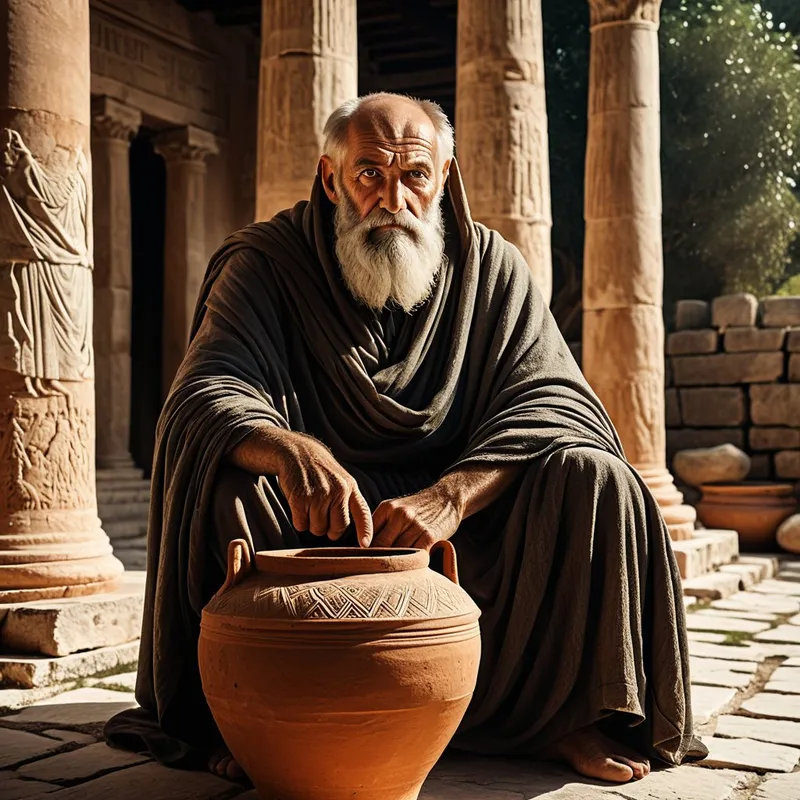
The sun beat down on the agora of Athens, a furnace of noise and ambition. Between the polished marble columns and the babble of merchants, a man lived in a jar. He was not a beggar, though he looked it. He was [Diogenes](/myths/diogenes “Myth from Greek culture.”/), a soul exiled from Sinope, who had come to the heart of civilization to declare it a lie.
He wore a single, threadbare cloak that served as his blanket by night. His home was a large, discarded pithos, turned on its side. He owned a wooden bowl for drinking—until he saw a boy cup [water](/myths/water “Myth from Chinese culture.”/) with his hands. With a laugh that echoed off the stoas, he shattered the bowl. “The boy has outdone me in simplicity,” he declared, his voice a dry rasp against the city’s polished rhetoric.
His days were a performance of shocking truth. He would eat lentils in the public square, mocking those who dined on delicacies behind closed doors. He would masturbate in the marketplace, and when chastised, would sigh, “If only I could satisfy my hunger as easily by rubbing my belly.” To him, every natural act society deemed shameful was a testament to its own artificial sickness.
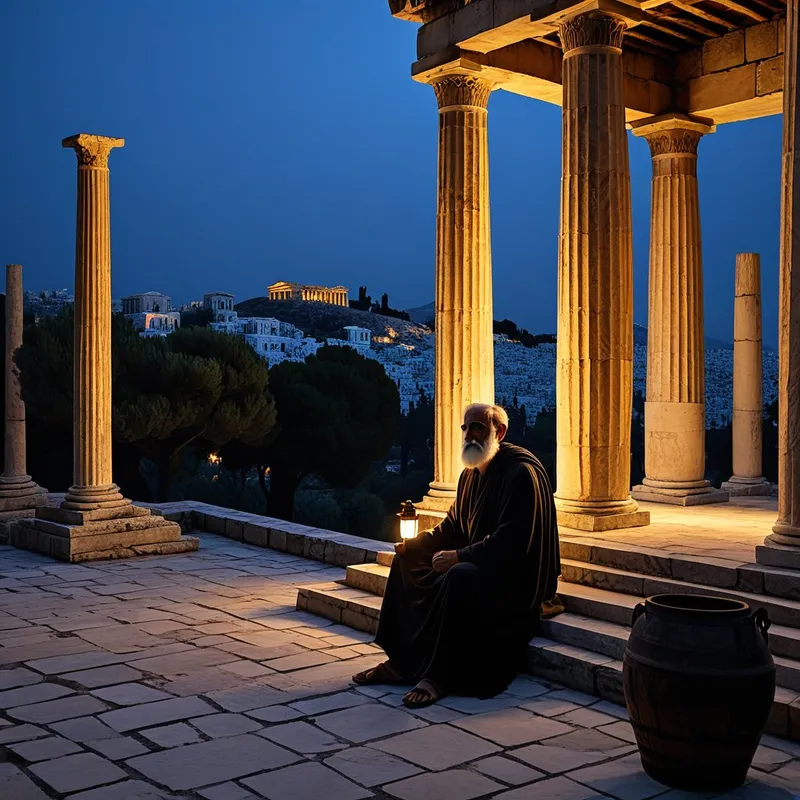
The climax of his strange saga came on a brilliant afternoon. He walked through the crowded agora, not with a philosopher’s scroll, but with a lit lantern. He held it aloft, peering into the faces of statesmen and sophists. “What are you doing, philosopher?” they jeered. He did not look at them, but through them, as his lantern’s flame guttered in the daylight. “I am looking for an honest man,” he said, his tone devoid of mockery, filled only with a weary, profound seeking. The flame found none.
Then came the thunder of empire. Alexander the Great, master of the known world, stood before the jar. The crowd parted, hushed. Alexander, young, glorious in his armor, cast a shadow over the philosopher. “I am Alexander the Great,” he announced. “Ask of me any boon you wish.” Diogenes, who had been sunning himself, barely opened an eye. The most powerful man on earth waited. Finally, the man in the jar spoke, his voice clear and undisturbed. “Stand out of my sunlight.”
A gasp swept the crowd. Alexander, they say, did not rage. He turned to his retinue, a strange light in his own eyes, and said, “If I were not Alexander, I would wish to be Diogenes.” The philosopher had won without moving a muscle. He had measured the weight of a king’s glory against a patch of warm sun and found the king wanting. He lived and died as he chose, a free man in a jar, his truth a lantern that burned brightest when all [the world](/myths/the-world “Myth from Tarot culture.”/) claimed it was day.
Cultural Origins & Context
Diogenes of Sinope was not a mythic hero of the distant past, but a historical figure of the 4th century BCE. Yet, within decades of his [death](/myths/death “Myth from Tarot culture.”/), he had become a legend, a mythologized archetype. His stories were passed down not in epic poems, but in the anecdotal tradition of the chreia and the biographical collections of writers like Diogenes Laërtius. He was the founding saint of the Cynic school, a philosophical movement whose name, kynikos, was itself a badge of honor worn after him.
In the context of classical Greece, a culture deeply invested in public honor (timē), citizenship, and civic beauty, Diogenes was a walking blasphemy. His myth functioned as a societal shadow. He was the eternal critic, the embodied “no” to the Athenian “yes.” His tales were told in symposia and schools not merely as jokes, but as profound philosophical provocations. He represented a return to nature (physis) over law or convention (nomos), demonstrating that true freedom (eleutheria) and self-sufficiency (autarkeia) were achieved not by acquiring more, but by radically wanting less. His myth served as a living, breathing antidote to the poison of social ambition and hypocrisy.
Symbolic Architecture
Diogenes is the [archetype](/symbols/archetype “Symbol: A universal, primordial pattern or prototype in the collective unconscious that shapes human experience, behavior, and creative expression.”/) of the de-conditioned self. Every element of his myth is a [symbol](/symbols/symbol “Symbol: A symbol can represent an idea, concept, or belief, serving as a powerful tool for communication and understanding.”/) of stripping away.
The lantern in daylight is the symbol of consciousness seeking itself in a world asleep. It is not that truth is hidden in darkness, but that we are blind to it in the glaring false light of consensus reality.
The [barrel](/symbols/barrel “Symbol: A barrel often symbolizes containment, storage, and the preservation of resources, representing both abundance and potential loss.”/) (pithos) is the ultimate container of the essential self. It is not a home in the world, but a [womb](/symbols/womb “Symbol: A symbol of origin, potential, and profound transformation, representing the beginning of life’s journey and the unconscious source of creation.”/) against the world. It represents the [reduction](/symbols/reduction “Symbol: A tool or process that simplifies, minimizes, or breaks down something into smaller components, often representing efficiency or loss.”/) of need to its absolute minimum—the [boundary](/symbols/boundary “Symbol: A conceptual or physical limit defining separation, protection, or identity between entities, spaces, or states of being.”/) between the individual and society rendered stark and simple. The shattered [bowl](/symbols/bowl “Symbol: A bowl often represents receptivity, nourishment, and emotional security, symbolizing the dreamer’s needs and desires.”/) signifies the destruction of even the most basic tools if they represent an unnecessary mediation between [the self](/myths/the-self “Myth from Jungian culture.”/) and [nature](/symbols/nature “Symbol: Nature symbolizes growth, connectivity, and the primal forces of existence.”/). To drink from one’s hands is to be in direct, unadorned [relationship](/symbols/relationship “Symbol: A representation of connections we have with others in our lives, often reflecting our emotional state.”/) with the [source](/symbols/source “Symbol: The origin point of something, often representing beginnings, nourishment, or the fundamental cause behind phenomena.”/).
His most potent act, asking Alexander to move, is the symbolic [triumph](/myths/triumph “Myth from Roman culture.”/) of inner sovereignty over outer power. Alexander represents the totality of the worldly ego: conquest, fame, validation. Diogenes’s request reduces this colossal [projection](/symbols/projection “Symbol: The unconscious act of attributing one’s own internal qualities, emotions, or shadow aspects onto external entities, people, or situations.”/) to a mere obstruction of a natural, [life](/symbols/life “Symbol: The symbol of ‘Life’ represents a journey of growth, interconnectedness, and existential meaning, encompassing both the joys and challenges that define human experience.”/)-giving force—the sun. He does not fight the [king](/symbols/king “Symbol: A symbol of ultimate authority, leadership, and societal order, often representing the dreamer’s inner power or external control figures.”/); he re-frames him into irrelevance.
To stand out of my sunlight is the ultimate alchemical instruction: clear away the grandiose projections of the ego so the simple, nourishing light of the authentic self can shine upon you.

The Dreamer’s Resonance
When the pattern of Diogenes stirs in the modern [psyche](/myths/psyche “Myth from Greek culture.”/), it often manifests in dreams of radical simplification and confrontational honesty. You may dream of being in a crowded, ornate building (a corporate office, a family home) and feeling an irresistible urge to strip off your clothes, or to smash a cherished but cumbersome heirloom. The dream-ego is not violent, but ruthlessly practical. The object is an impediment to movement.
You might dream of holding a light—a flashlight, a candle—in a brightly lit room, insisting something is dark. This is the somatic signal of the Diogenes energy: a deep, intuitive knowing that contradicts everything you are told is “lit,” successful, or real. The conflict is not with external monsters, but with the pervasive, polished falsity of your own adapted life. The anxiety in these dreams is the friction of a self trying to shed a skin that has grown hard as ceramic. The figure of Diogenes in a dream is rarely comforting; he is a mirror, showing the dreamer the absurdity of their own self-imposed chains.

Alchemical Translation
The individuation process modeled by Diogenes is not one of adding—of integrating complexes or building the [persona](/myths/persona “Myth from Greek culture.”/). It is the alchemy of via negativa, the path of removal. His myth charts the psychic transmutation of leaden social compliance into the gold of authentic being through relentless subtraction.
The first operation is Exile. Like Diogenes banished from Sinope, one must be expelled from, or voluntarily leave, the comfortable, inherited identity. This is the [nigredo](/myths/nigredo “Myth from Alchemical culture.”/), the darkening, where the old life loses its meaning.
The second is Containment. The barrel is the [vas hermeticum](/myths/vas-hermeticum “Myth from Alchemical culture.”/), the sealed vessel of the work. It is the conscious choice to limit the world’s input, to create a bounded space (through solitude, therapy, journaling) where the raw, unadorned self can exist without apology. Here, in this deliberate poverty, the albedo occurs—the whitening, the washing clean of persona.
The final, crowning transmutation is Illuminated Refusal. Holding the lantern is the sustained consciousness that sees through [projection](/myths/projection “Myth from Alchemical culture.”/). The confrontation with Alexander is the moment of [rubedo](/myths/rubedo “Myth from Alchemical culture.”/), the reddening, where the heat of one’s truth tests and triumphs over the inner tyrant—the need for approval, status, and external validation. One does not defeat this tyrant in battle; one simply asks it to step aside, realizing its power was only ever the power to block the light.
The goal is not to become a hermit in a physical barrel, but to build the psychic barrel: an inner citadel of values so simple and self-validating that the proffered boons of the world—status, prestige, conventional success—are seen for what they are: potential obstacles to your own sunlight.
Associated Symbols
Explore related symbols from the CaleaDream lexicon: