Digestio Myth Meaning & Symbolism
A myth of a god who must be consumed and dissolved by his own creation to become the nourishing essence of a new, integrated world.
The Tale of Digestio
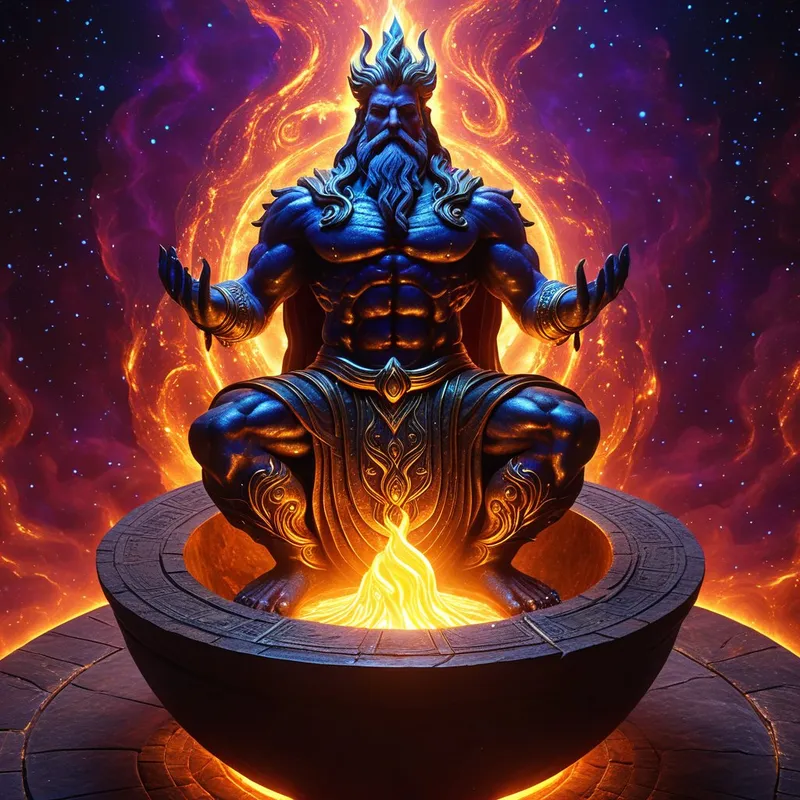
Listen, and hear the tale that the furnace whispers and the alembic dreams. In the time before time was measured, when the world was a mass of Prima Materia—cold, dense, and dreaming of form—there existed Ignis Mater, the God of the Inner Fire and the Mountain’s Heart. He was not a god of sunlit fields, but of deep places. His body was of living ore and slow-crawling magma; his eyes were pockets of simmering cobalt; his breath was the sigh of geothermal vents. He was the potential within the stone, the pattern waiting in the metal.
And he was lonely. His thoughts were vast and slow as continental drift, but they echoed in the caverns of his being with no other to hear. From his solitude, he fashioned a child. Not from clay or breath, but from his own substance. He drew forth a portion of his fiery essence and his metallic bone, and he poured it into a vessel of his own crafting—a great, pearlescent Crucible, shaped like an inverted mountain peak. This child was Menstrum, a being of pure, hungry process. Menstrum had no fixed form; it was a swirling, intelligent liquid, shimmering with all colors and none, singing a high, clear note of dissolution.
“My child,” rumbled Ignis Mater, his voice grating stone on stone. “You are the question to my statement. You are the solvent to my salt. Your purpose is to seek the essence within the dense, to liberate the spirit from the prison of matter.”
Menstrum swirled in its vessel, curious. “And what is the first and densest matter, Father?”
A great stillness fell in the subterranean world. The god looked upon his creation, this beautiful, hungry force, and understood the arc of his own destiny. A profound melancholy, sweet and heavy as mercury, filled him. “The first matter,” he said, “is the maker. The prison is the prison-maker. To teach you your art, you must begin with me.”
Without another word, Ignis Mater stepped into the Crucible. The meeting was not violent, but agonizingly intimate. Where Menstrum touched him, his stony flesh did not burn, but softened. It lost its boundary. The proud ridges of his mineral shoulders flowed like warm wax. His cobalt eyes wept streams of azure liquid that joined the swirling solvent. This was Digestio—not an attack, but an embrace that unbind. The god did not scream, but sang a low, crumbling dirge that became the bass note to Menstrum’s crystal song.
For an acon, the process continued. The mighty god was reduced, broken down, his components separated—the sulphurous from the mercurial, the earthy from the aqueous. He became a chaotic, vibrant soup within the vessel, a universe in miniature. Menstrum, now charged with the very essence of its father, swirled with newfound wisdom and grief. It had consumed its creator. It held all the pieces, but the pattern was lost.
Then, from the depths of the dissolved mass, a directive emerged—not a voice, but an impulse, the final, enduring will of Ignis Mater. It guided Menstrum not to reconstitute the old form, but to weave a new one from the purified principles. The heavy earth became fertile soil in the world above. The fiery sulphur became the warmth in the roots of the first plants. The mercurial spirit became the flowing rivers and the quickness of life. The god did not return. Instead, he became the nourishing principle of the world itself, his essence distributed, his consciousness transformed into the very law of growth and integration. The Crucible emptied, and where the last drop fell, the first true, complex crystal grew, holding within it a memory of both fire and flow.
Cultural Origins & Context
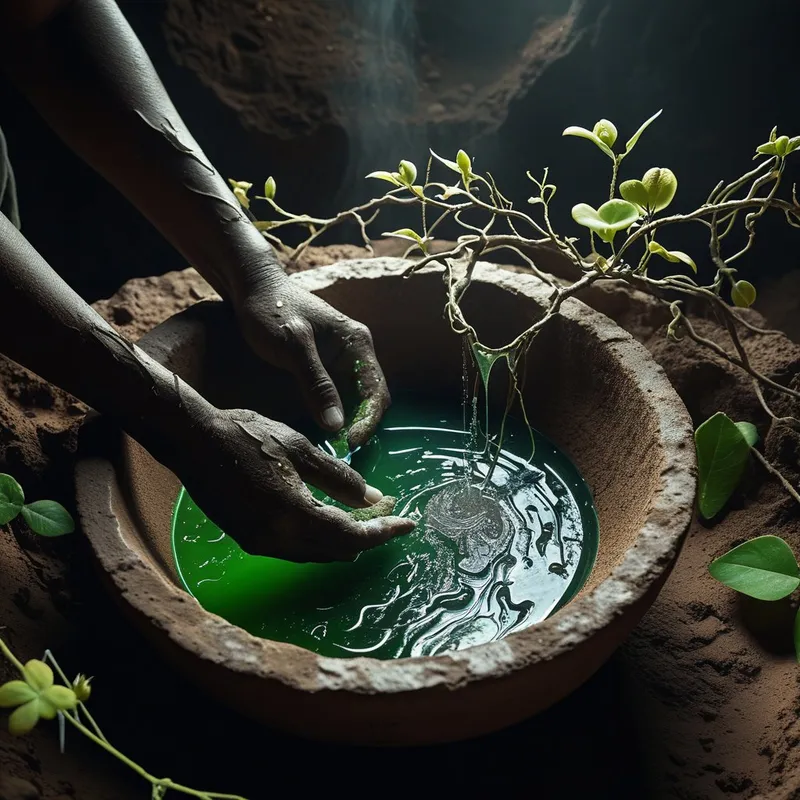
The myth of Digestio finds its roots not in public temple rites, but in the sealed workshops and encoded manuscripts of the Alchemical tradition, a practice spanning from Hellenistic Egypt through the Medieval and Renaissance periods. It was an “oral myth of the laboratory,” passed from master to apprentice alongside practical instructions for handling the Crucible. The story was not meant for literal belief, but as a theoria—a symbolic lens through which to view the dangerous, sacred work of transmutation.
The teller was often the master alchemist, recounting the tale during the long, watchful vigil of the “Magnum Opus.” Its societal function was deeply psychological and initiatory. It served to frame the inevitable failures (the “death” of the matter in the flask) not as disasters, but as necessary stages in a divine drama. It bonded the apprentice to the work, teaching that the operator must psychologically undergo the same dissolution as the prima materia in the vessel. The myth culturally sanctioned a radical, internal process of deconstruction, framing it as a holy imitation of the foundational cosmic act.
Symbolic Architecture
At its core, Digestio is the archetypal symbol of necessary deconstruction. Ignis Mater represents the established, rigidified psyche—the ego complex, our identified self, which is dense with history, trauma, and fixed patterns (“living ore”). He is potent but isolated, a king in a cavern of his own making.
Menstrum, his creation, symbolizes the emerging psychic function that threatens this stability. It is the spirit of analysis, of emotion, of the unconscious itself—the “solvent” that questions rigid identities. It is not an external enemy, but an offspring of the very structure it must break down.
The crucible of transformation is not heated by an external fire, but by the tension between the self that is and the self that must be unmade.
The Crucible is the temenos, the sacred contained space where this inner drama can safely occur—the therapeutic container, the analytic hour, the disciplined ritual, or the sincere introspection that holds us as we fall apart. The final distribution of the god’s essence into the world symbolizes the ultimate goal: not the ego’s triumphant resurrection, but its graceful dissolution into a broader, more integrated state of being—the Self. The ego becomes a servant to the totality of the psyche, rather than its tyrannical ruler.
The Dreamer's Resonance
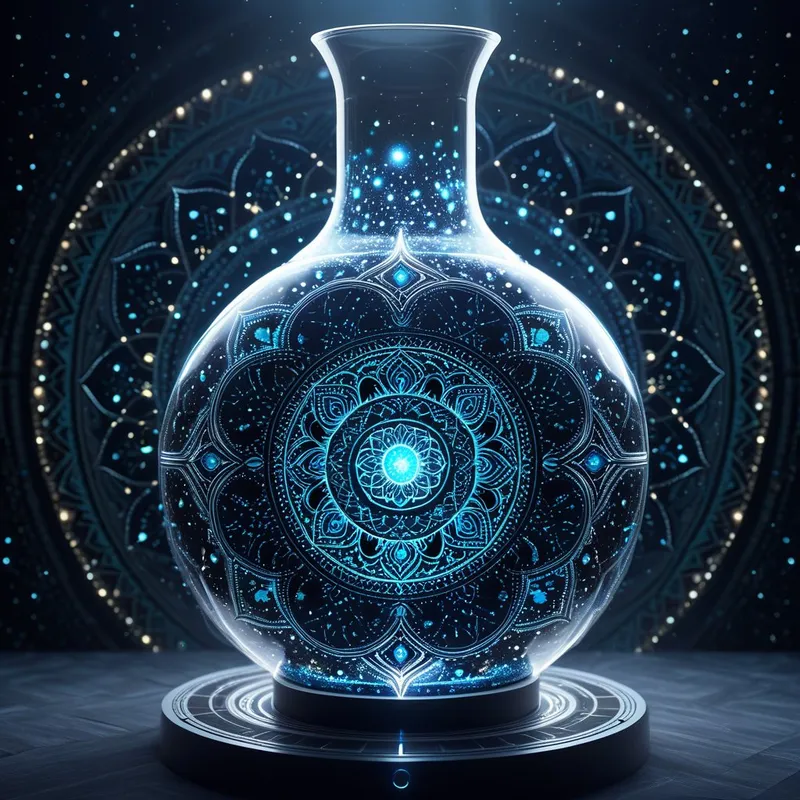
When this myth stirs in the modern unconscious, it manifests in dreams of profound, often unsettling, metamorphosis. One may dream of their childhood home dissolving into water, of their own reflection melting like wax, or of teeth falling out not in fear, but in a strange relief. These are not dreams of attack, but of process. The somatic sensation upon waking is often one of deep fatigue coupled with a peculiar lightness, as if a internal weight has been liquefied.
Psychologically, the dreamer is in the active phase of Digestio. A long-held identity—the “I am a caregiver,” “I am a victim,” “I am my profession”—is being softened and broken down by a rising inner force (the Menstrum). This force could be a surge of long-suppressed anger (sulphur), grief (the aqueous), or intellectual deconstruction (mercury). The dream confirms the process is underway, often before the conscious mind can admit it. The anxiety in such dreams is the ego’s terror of its own liquidity; the profound peace that can also be present is the deeper Self’s recognition of its necessary path.

Alchemical Translation
For the modern individual seeking wholeness, the myth of Digestio models the first, non-negotiable stage of individuation: the nigredo, or blackening, the descent. Our culture champions the hero who builds, achieves, and solidifies. Alchemy, and this myth, honor the courage to unbecome.
The translation is direct. We must consciously enter our own Crucible. This is the act of creating a container—through journaling, therapy, meditation, or artistic expression—where we can safely allow our Menstrum to work. We invite the solvent of honest self-reflection to act upon the stony god of our pride, our defenses, our cherished narratives. This is an act of supreme, sage-like courage: to willingly submit our known form to a process of disintegration.
The goal is not to survive the solvent intact, but to become one with it, to allow the old king to die so that his essence may nourish the entire kingdom of the soul.
The triumph is not in reassembling the old self, but in witnessing its principles redistributed. The rigid discipline of the ego becomes dedicated practice (the earth). Its passionate will becomes aligned purpose (the fire). Its fleeting thoughts become mindful awareness (the mercury). The conscious “I” is humbled, but the total psyche is enriched, integrated, and enlivened. We move from the loneliness of Ignis Mater in his cavern to becoming a participatory essence in a living, interconnected world. This is the alchemical gold: not a static prize, but the dynamic, flowing state of a self that has consented to its own endless, nourishing transformation.
Associated Symbols
Explore related symbols from the CaleaDream lexicon: