Diana's Tear Myth Meaning & Symbolism
A hunter's forbidden love for the goddess Diana leads to tragedy, her grief crystallizing into a sacred, eternal spring in the forest.
The Tale of Diana's Tear
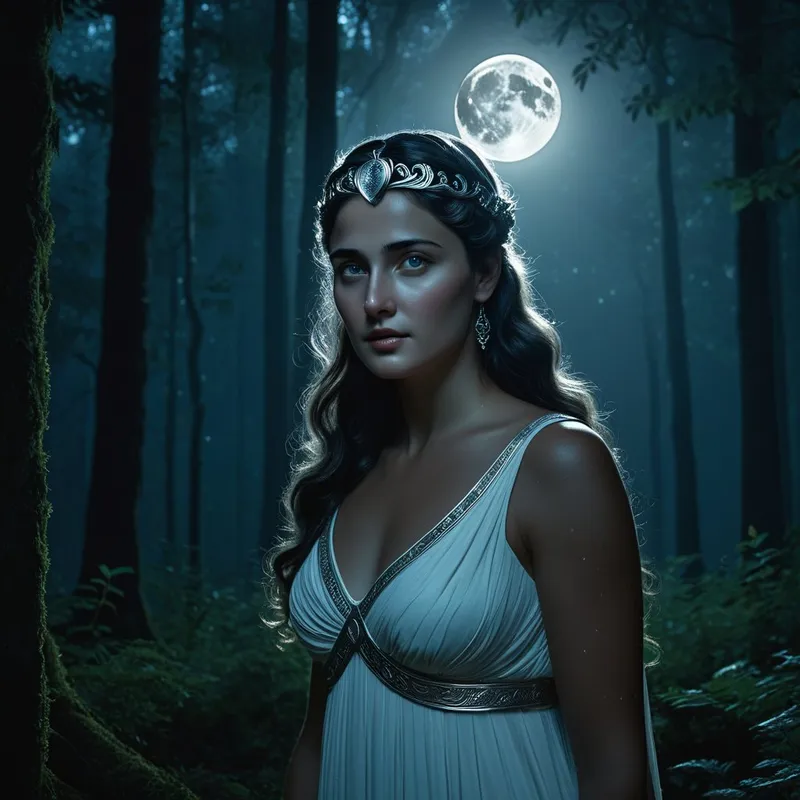
Hear now a tale not of Rome’s marble forums, but of her wild, beating heart. In the deep, untamed forests of Latium, where moonlight filters through oak leaves like silver dust, the goddess Diana walked. She was a creature of shadow and swiftness, her footsteps silent on the fern-carpeted earth, her only companions the stag, the wolf, and the cold, constant stars. She had sworn an oath to Jupiter: to remain forever chaste, forever free, her heart as untouched as the virgin snow on the mountain peaks.
But the heart, even a divine one, is a wild thing that does not heed oaths.
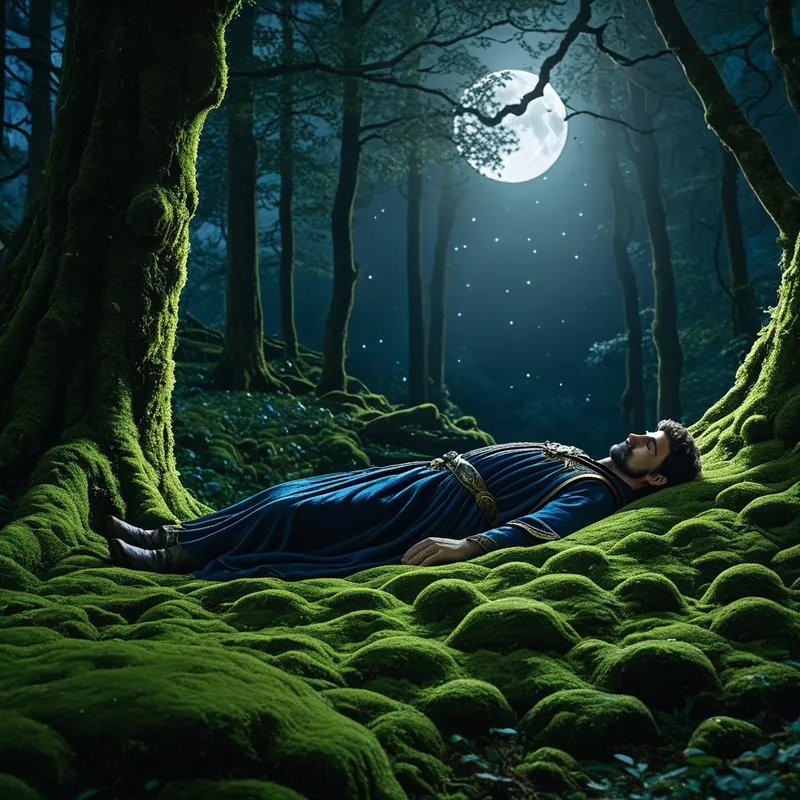
It began with a sound—not the snap of a twig from a fleeing deer, but the soft, steady rhythm of a mortal’s breath in sleep. In a hidden grove, bathed in her own celestial light, she found him: Endymion, a hunter. He was not like the boisterous heroes who sought glory; he was stillness incarnate. Curled on a bed of moss, his face was peaceful, unguarded, beautiful in a way that struck the goddess with a force sharper than any arrow.
Night after night, drawn by a pull she could not name, Diana returned. She would sit beside him, her luminous form the only light in the clearing, and watch the dreams play beneath his eyelids. In his sleeping presence, her eternal vigilance softened. Here was a beauty that asked for nothing, that existed without demand, and in its silent offering, it disarmed her. A forbidden warmth, tender and terrifying, began to thaw the perpetual frost around her heart.
This secret vigil could not last. The all-seeing eyes of the gods are jealous. Venus, who delights in unraveling the resolve of the chaste, saw the longing in Diana’s moonlit gaze. With a whisper to Jupiter, the idyll was shattered. The king of gods decreed that no mortal could look upon a goddess with impunity, and no goddess could break her sacred vow. The punishment was swift and cruel: Endymion would sleep forever. Not death, but an eternal, unchanging slumber, forever beautiful, forever just out of reach.
Diana stood over her sleeping love, the forest holding its breath. The goddess who never wept felt a pressure behind her eyes, a cracking in the ice of her being. A single tear, molten silver and heavier than any mortal sorrow, welled and fell. It did not splash upon the moss. It struck the earth with a sound like a tiny bell, and where it landed, the ground drank it deeply, then gave it back. A spring bubbled forth, its waters clear, cold, and luminous, mirroring the moon. The sacred grove now held two eternal things: a man locked in a perfect dream, and a pool born from a single, divine moment of broken grace. Diana turned away, her face once more a mask of serene power, but the forest now whispered of a place where a goddess’s heart once broke, and where her tear still flows.
Cultural Origins & Context
The tale of Diana’s Tear is a fascinating example of interpretatio Romana, where the Romans seamlessly wove Greek narratives into their own religious tapestry. The core story of Diana (Greek Artemis) and Endymion is fundamentally Greek in origin, likely from Asia Minor. However, its adoption into Roman lore speaks to a specific cultural need. While Roman state religion was highly formal and public, focused on the pax deorum (the peace of the gods), there existed a parallel, deeply personal strand of devotion to natural spirits and localized numinous sites.
This myth would have been told not in the grand forum, but in the countryside, by hearths and in sacred groves. It served to explain and sanctify a specific, real-world location—a spring with peculiarly clear, cold, or perhaps luminescent waters. Such a place would be designated a lucus, a sacred grove, and become a site for private devotion, particularly for women, who saw in Diana a protector of women and childbirth. The story gave the spring a divine biography, transforming it from a natural feature into a monument to sacred emotion. It functioned as a bridge between the untouchable, austere goddess of the state cult and a more accessible, emotionally complex figure who understood loss and longing.
Symbolic Architecture
At its core, this myth is an alchemical vessel containing the volatile elements of contradiction. Diana represents the perfected, self-contained psyche: autonomous, powerful, and bound by conscious oaths (the persona). Endymion symbolizes the unconscious, latent beauty—the soul-image or anima—that exists in a state of potential, outside of time and the ego’s control.
The eternal sleep is not a punishment, but the inevitable fate of the unconscious content when grasped by the conscious mind’s desire to possess it. To ‘awaken’ it would be to destroy its essential nature.
The forbidden love is the psyche’s inevitable, often painful, attraction to its own missing wholeness. The oath to Jupiter represents the super-egoic structures and societal contracts that forbid this inward turn, demanding allegiance to outer roles (the chaste huntress, the independent ruler). The tear is the critical symbol. It is the prima materia of transformation—the first, involuntary admission of feeling that cracks the armor of perfection. It is not a full surrender, but a sacred leakage of the soul.
The tear is the solvent that dissolves the boundary between the divine and the earthly, the conscious and the unconscious, giving tangible, lasting form to a fleeting, forbidden emotion.
The resulting spring is the symbol made manifest, the psychic energy now available as a resource. It is a place of reflection (literally, mirroring the moon), healing, and remembrance, born not from union, but from the acceptance of eternal, poignant separation.

The Dreamer's Resonance
When this myth stirs in the modern dreamer, it often manifests as dreams of profound, melancholic beauty just out of reach. You may dream of a radiant, unapproachable figure in a wilderness; of finding a perfectly still, sleeping person in a strange, peaceful place; or most poignantly, of a body of water—a well, a pool, a fountain—that glows with an inner light. The somatic experience is one of aching longing mixed with a strange peace, a tightening in the chest accompanied by a sense of awe.
Psychologically, this indicates a process of encountering a deeply valued part of the self that feels forbidden. This could be creative potential, vulnerable emotion, or a sense of spiritual connection that feels at odds with one’s chosen identity or life’s duties (the “oath”). The dreamer is in the moment of the “tear”—the involuntary recognition of this inner value and the grief that it cannot be fully integrated into waking life without disrupting the established order. The psyche is creating its own sacred spring, a inner reservoir for this forbidden love, acknowledging its beauty and importance while accepting that it may forever remain in a separate, numinous space within the soul’s landscape.

Alchemical Translation
The individuation process modeled here is not one of heroic conquest and integration, but of sacred acknowledgment and creative sublimation. The myth guides us through the mortificatio—the death of the possibility of conventional possession or union. Diana does not wake Endymion; she does not abandon her nature. Instead, she allows the conscious ego (Diana) to be genuinely affected by the soul (Endymion). The tear is the coniunctio occurring not as a marriage, but as a poignant, generative touch.
For the modern individual, the alchemy lies in translating inner conflict into sacred art. The struggle is between the part of us that is sworn to duty, autonomy, or a certain self-image (the Hunter) and the part that is vulnerable, receptive, and beautiful in its passivity (the Sleeper). The triumph is not in choosing one over the other, but in allowing the tension between them to produce something new—the Tear become Spring.
Individuation is not always the waking of the sleeper; sometimes it is the watering of the entire inner world with the grief of that eternal sleep.
This means giving form to the longing. Write the poem you fear is too sentimental. Create the art that honors the fragile beauty you feel you must protect. Designate a personal ritual or a place (literal or metaphorical) that holds the meaning of that which cannot be fully possessed. In doing so, you perform Diana’s act. You acknowledge the eternal separation of certain inner opposites, and from that conscious, felt grief, you allow a permanent, nourishing source to emerge in your psyche. The spring is the symbol that now feeds your life, a testament that the most profound transformations are often born not from fulfillment, but from the sacred, creative acceptance of an unbridgeable gap.
Associated Symbols
Explore related symbols from the CaleaDream lexicon: