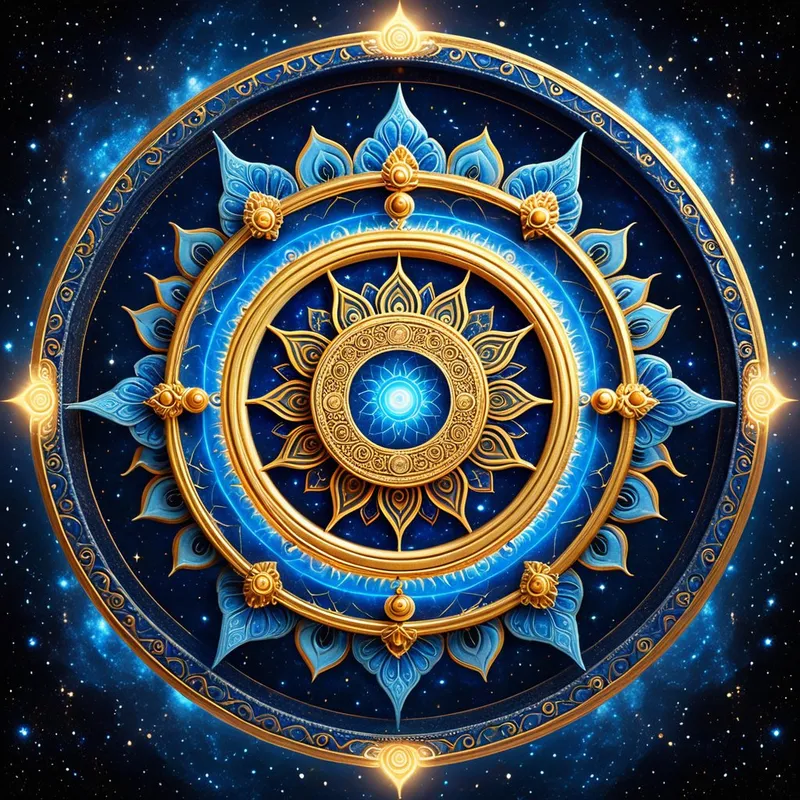
Dharmachakra / Sudarshana Chakra Myth Meaning & Symbolism
The tale of the sacred wheel, a cosmic weapon and teaching, representing the eternal cycle of law, order, and the cutting of ignorance.
The Tale of Dharmachakra / Sudarshana Chakra
Listen. In the silence before the first word, there was a turning. Not of gears, but of law. Not of stone, but of spirit.
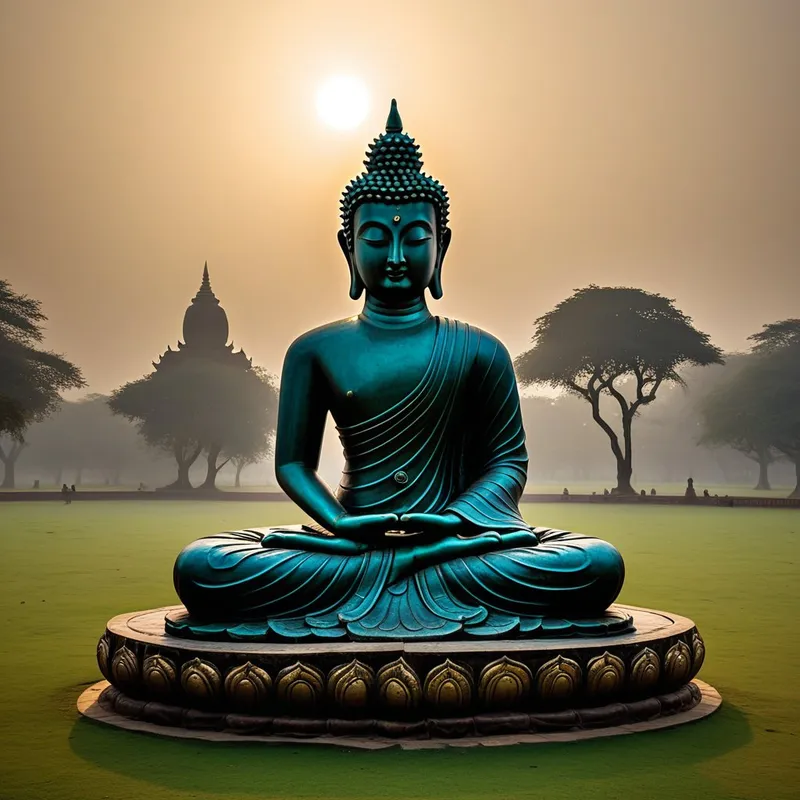
Beneath the ancient Bodhi tree, the air thick with the perfume of resolve, a prince sat with bones of light. For six years, the specters of desire and fear had clawed at him—Mara, the tempter, had marshaled his legions of doubt. “By what authority do you sit?” Mara thundered, his army a nightmare of clinging forms. The prince did not speak. He merely reached down and touched the earth. The ground itself roared witness, and Mara’s illusions shattered like glass. In that victory, in that profound, wordless understanding, the first movement was conceived. Not a weapon, but a wheel. The Dharmachakra began to turn in the heart of reality, a silent, cosmic axle settling into place.
Seven weeks later, in the gentle grove of Isipatana, he spoke. To five ascetics who had shared his earlier struggles, he set in motion what was glimpsed in silence. “There is a middle way,” his voice, calm as a deep river, set the wheel rolling upon the earth. He spoke of suffering, its origin, its cessation, and the path. With each truth, a spoke of the wheel was forged in the minds of the listeners. The First Turning had begun. The Dharma was no longer a solitary realization but a path for the world, a wheel that would roll across continents, its hub unwavering, its rim touching all of life.
Yet, in another realm of story, a wheel of a different fire was born. From the cosmic churn of the milky ocean, from the depths of divine necessity, it emerged—not as a teaching, but as a promise of order. Vishnu, the all-pervading, held in his hand a discus of such terrible, perfect beauty it could slice through time. This was the Sudarshana Chakra, spinning with the sound of a universe in balance. It was the fury of preservation, the sharp edge that severs the heads of demons who would tilt the world into chaos. When the demon Shishupala hurled insult after insult, his hatred a poison cloud, it was the Sudarshana that flew, humming a lethal hymn, a single, flawless arc of cosmic justice that restored the sanctity of the law. It is always returning, this wheel, to the finger of its lord, its duty done, its revolution a prayer for equilibrium.
Cultural Origins & Context
These two wheels spin from the deep cultural bedrock of ancient India, one emanating from the shramana (ascetic) traditions that gave rise to Buddhism in the 6th-5th century BCE, the other from the vast, evolving tapestry of Vedic and Puranic Hinduism. The Dharmachakra is fundamentally a doctrine made symbol. Its first historical “turning” was the sermon at Sarnath, an event that founded the Sangha. It was passed down orally by monks for centuries before being etched into stone by Emperor Ashoka, whose pillars crowned with the wheel spread the symbol across Asia. Its function was and is pedagogical and communal: it represents the Buddha’s teachings (the Dharma) as the unifying core, the spokes as the various paths within it, all leading to the still hub of Nirvana.
The Sudarshana Chakra emerges from the epic and Puranic literature, like the Ramayana and Mahabharata, texts that were performed by bards and storytellers. It is a theistic symbol of Vishnu’s active, protective power. Its societal function was to model dharma as an active, sometimes fierce, principle. The king’s duty (rajadharma) was mirrored in Vishnu’s wielding of the Sudarshana—to protect the cosmic and social order by cutting away adharma (disorder). It is a myth for rulers and devotees, illustrating that true vision (sudarshana) is not passive sight but discerning action.
Symbolic Architecture
At their core, both wheels are mandalas of order. The Dharmachakra is the architecture of enlightened mind. Its hub is the unmoving center of wisdom, the silence after Mara’s defeat. The rim is the cycle of samsara, the world of form and suffering. The spokes are the Noble Eightfold Path—right view, intention, speech, action, livelihood, effort, mindfulness, concentration—the practical means by which the rim is connected to the hub, by which the wandering mind is tethered to liberating truth.
The wheel turns not to go somewhere, but to show that the journey from the rim to the hub is a collapse of distance, a realization of inherent centrality.
The Sudarshana Chakra is the dynamism of that order in the field of conflict. Its spinning represents the cyclical nature of time (kalachakra) and the inevitability of karmic consequence. Its razor edge is discernment (viveka), the ability to sever the head of ignorance (the demon) from the body of consciousness. It is “auspicious vision” because to see truly is to see what must be cut away for wholeness to remain.
Psychologically, these wheels represent the ego’s necessary submission to a greater, organizing principle. The Dharmachakra is the archetype of the Self (in Jungian terms) imposing a coherent structure of meaning on the chaos of the psyche. The Sudarshana Chakra is the function of the Self that actively engages with and dismembers psychic complexes—those autonomous “demons” of inflation, resentment, or fear that threaten the integrity of the individual.
The Dreamer's Resonance
When the wheel appears in a modern dream, it is rarely a peaceful religious icon. It is active. It is turning. To dream of the Dharmachakra may manifest as finding oneself in a vast, institutional library where the books are rearranging themselves into a perfect, rotating pattern, implying a deep, somatic restructuring of one’s core beliefs and life philosophy. There is a sense of a “teaching” emerging from within, a new, more authentic law being revealed.
To dream of the Sudarshana Chakra is often more visceral. One might be fleeing a monstrous embodiment of a toxic habit or a suffocating relationship, only to turn and see a whirling disc of light sever the creature’s neck. There is shock, release, and a hum in the air afterwards. This dream signals an active, perhaps ruthless, psychological process of cutting away what is obsolete, deceitful, or parasitic in the dreamer’s life. The somatic feeling is often a sharp intake of breath followed by a profound lightness—the physical echo of a psychic amputation necessary for health.
Alchemical Translation
The myth models the alchemical opus of individuation—the forging of a coherent, individual self. The first stage is the “touching the earth” under the Bodhi tree: the confrontation with the shadow (Mara) and the firm establishment of one’s own reality principle. This is the creation of the immutable hub.
The alchemical wheel does not turn on the axis of wishful thinking, but on the axle of unshakable, witnessed truth.
The First Turning at Sarnath is the internalization and articulation of this truth—structuring the chaotic elements of one’s personality (the ascetic disciplines, the worldly desires) into a coherent system, the Eightfold Path of one’s own unique life. This is the spinning of the golden, teaching wheel within.
The Sudarshana’s flight represents the final, critical stage: the separatio and mortificatio. Individuation is not just about adding wisdom; it is about the necessary, often painful, subtraction of all that is not-self. This is the application of fierce discernment—cutting the cords of toxic loyalty, ending draining cycles, silencing the inner critic that masquerades as wisdom. It is the psyche’s own immune response, a divine violence wielded for the sake of wholeness.
The ultimate goal, mirrored in both wheels, is the return to the center. The Dharmachakra leads to the still hub of Nirvana. The Sudarshana Chakra returns to Vishnu’s finger. For the modern individual, this is the state where the wheel, having turned through all the conflicts and teachings, is fully integrated. The struggle for order becomes the embodiment of order. One becomes the silent hub around which the world turns, and the discerning hand that can, when necessary, wield the cutting wheel of truth. The revolution is complete.
Associated Symbols
Explore related symbols from the CaleaDream lexicon: